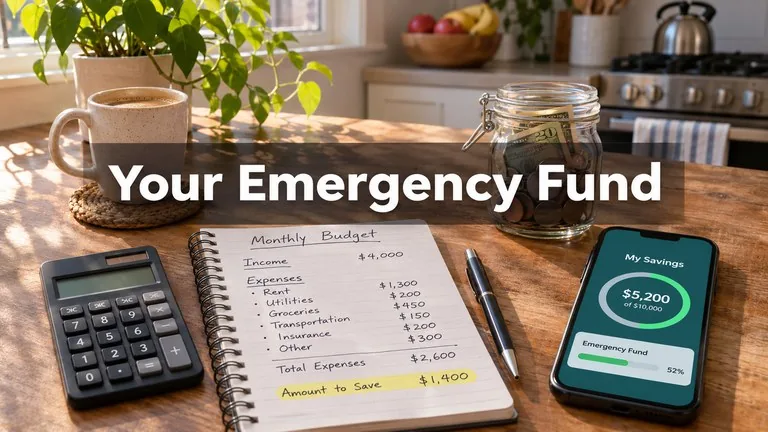
Most households should aim for an emergency fund that covers three to six months of essential expenses. Two steady incomes in secure jobs can sit near three months. A single earner, a commission-based job, or a household with kids and one paycheck should aim for six months, and self-employed people often need nine to twelve. The number is based on what you must spend each month, not on your salary.
That last point changes the math more than people expect. A family earning $7,000 a month after tax might only need $4,300 a month to cover rent, food, insurance, utilities, transportation and minimum debt payments. Six months of that is $25,800, not $42,000. The sections below show how to find your own number, how to adjust it for your job, where to keep the money so it earns something but stays reachable, and how to build it without stalling everything else.
How to calculate your emergency fund number
Start with essential monthly spending, the bills that keep coming if your income stops tomorrow. Pull the last three months of bank and card statements and add up only these categories:
- Rent or mortgage payment, including property tax and homeowners insurance if they are escrowed
- Utilities, phone and internet
- Groceries (not restaurants)
- Health, auto and life insurance premiums, plus regular prescriptions
- Car payment, gas, transit fares and basic maintenance
- Minimum payments on credit cards, student loans and other debts
- Childcare and child support, if they apply
Leave out streaming services, dining out, vacations and retirement contributions. Those are real expenses, but you would cut them in a true emergency. Average the three months, round up, and multiply by your target number of months.
One adjustment matters if you get health coverage through work. Losing your job may mean paying for COBRA or a marketplace plan, which can cost several hundred dollars a month or more for a family. Add an estimate of that premium to your monthly essentials if your job is the source of your insurance.
Three, six or twelve months: matching the size to your job
The range exists because some incomes are much more likely to stop, or to stop for longer, than others. Use this table as a starting point and move up a row if more than one risk factor applies to you.
| Your situation | Suggested target | Why |
|---|---|---|
| Two earners, both salaried in stable fields, no dependents | 3 months of essentials | One income can usually cover most bills while the other person job hunts |
| Two earners with kids, or one earner with stable government or tenured work | 4 to 6 months | More fixed costs and fewer places to cut |
| Single earner, or one income covers most bills | 6 months | No backup paycheck if that job ends |
| Commission, sales, seasonal or gig work | 6 to 9 months | Income swings even without a layoff |
| Self-employed or small business owner | 9 to 12 months, kept separate from business cash | No unemployment insurance in most cases, and slow months cluster together |
| Homeowner with an older house or car | Add $2,000 to $5,000 to any row above | Roof, water heater and transmission repairs show up without warning |
Unemployment insurance helps salaried workers, but it replaces only part of your old pay and most states cap regular benefits at 26 weeks. Some states pay for as little as 12 weeks when their unemployment rate is low. Self-employed and gig workers usually can’t claim it at all, which is why their target runs longer.
Example: Maria is a single nurse who rents. Her essentials come to $3,400 a month: $1,650 rent, $420 car payment and insurance, $450 groceries, $280 utilities and phone, $250 student loan minimum, $150 gas and $200 for other insurance and prescriptions. Hospital jobs are in demand where she lives, but she is the only income, so she targets six months: $3,400 x 6 = $20,400. Her car is nine years old, so she adds $2,000 for repairs and rounds her goal to $22,500.
Where to keep an emergency fund
Emergency money needs three traits: it must hold its value, you must be able to reach it within a few days, and it should earn something so inflation doesn’t eat it. In late 2026 the best online high-yield savings accounts paid roughly 4% APY, while the FDIC’s national average savings rate was under half a percent. On a $20,000 fund, that gap is about $700 a year.
- High-yield savings account. The default home for most of the fund. Choose one that is FDIC insured (or NCUA insured at a credit union), which covers up to $250,000 per depositor, per bank, per ownership category. Transfers to checking usually take one to three business days.
- Money market account. A bank deposit account, also FDIC insured, sometimes with check writing or a debit card. Rates are often similar to high-yield savings.
- Money market fund. Offered by brokerages. It is an investment, not a bank deposit, so it isn’t FDIC insured, but these funds hold very short-term debt and are designed to keep a stable $1 share price. Selling usually settles in one business day.
- Short-term Treasury bills or a no-penalty CD. Reasonable for the deeper layer of a large fund, such as months seven through twelve for a business owner. T-bill interest is exempt from state income tax.
Keep emergency money out of stocks and out of regular CDs with early withdrawal penalties. A stock fund can be down 20% in the same month you lose your job, since recessions tend to cause both. I bonds are also a poor fit for the first layer because you can’t cash them in during the first 12 months.
A practical setup is two tiers. Keep one month of essentials in your checking account or a linked savings account at the same bank so you can move it instantly. Keep the rest in a high-yield account at a separate bank, which makes it a little harder to dip into for things that aren’t emergencies.
How to build it step by step
Few people can set aside six months of expenses in one go. Building it in stages keeps the goal realistic and protects you sooner.
- Set a starter goal of $1,000 to $2,000. This covers the most common surprises, like a car repair, a deductible or an urgent flight home. The Federal Reserve’s survey of household finances published in May 2026 found that about 63% of adults would cover a $400 emergency expense with cash or its equivalent, which means roughly a third would borrow, sell something or be unable to pay.
- Open a separate high-yield savings account and give it a name like “Emergency only.” Money mixed into checking tends to get spent.
- Automate a transfer for the day after payday. Even $50 a week adds up to $2,600 a year before interest. If your employer allows split direct deposit, send a fixed amount straight to the savings account so it never lands in checking.
- Once the starter fund is in place, split extra cash. If you carry credit card debt at 20% or more, a common approach is to keep building the fund to one month of essentials while sending the rest toward the card, then return to the full target once the high-rate debt is gone.
- Send windfalls to the fund. Tax refunds, bonuses, cash gifts and the money from selling something you don’t use can move you ahead by months.
- Raise the transfer when a bill disappears. When you pay off a car loan, redirect that payment amount to savings. You are already used to living without it.
- Recalculate once a year or after a big change such as a new baby, a move, or a switch to self-employment.
Example: Darnell and Kim have a combined take-home pay of $8,200 a month and essentials of $5,100. With two stable jobs and one child, they target four months, or $20,400. They start with $1,500 in savings. By automating $600 per paycheck from each of their two biweekly paychecks they add about $2,600 a month, and they put their $3,200 tax refund in as well. At about 4% APY they reach the goal in roughly six months. If they could only spare $400 a month and had no refund to add, the same goal would take almost four years, which is still workable because their first $5,000 would be in place within nine months.
What counts as an emergency
A simple test is whether the expense is necessary, urgent and unexpected. Job loss, a medical bill, a car repair you need to get to work, an emergency vet visit or a broken furnace in January all pass. A sale on a TV, a vacation or holiday gifts don’t, because you can see them coming and save in a separate account.
Predictable but irregular costs cause most “emergencies” that aren’t. Car registration, annual insurance premiums, back-to-school shopping and holiday spending happen every year. Setting up small sinking funds for these, even $50 or $100 a month each, keeps your emergency fund intact for real surprises.
If you do use the fund, that’s what it is for. Pause other extra goals and refill it with the same automatic transfer until it’s back at the target.
Options when the fund isn’t big enough yet
If something hits before your fund is ready, some backup options cost far less than others. Since 2024, the SECURE 2.0 Act lets many workplace retirement plans and IRAs allow one emergency withdrawal of up to $1,000 per year without the 10% early withdrawal penalty. Income tax still applies, and you generally can’t take another one for three years unless you repay it or contribute at least that much back to the plan. Not every plan offers it, so check with your plan administrator.
Other options, roughly from cheaper to more expensive, include asking a medical provider or utility for a payment plan, a credit union payday alternative loan, a personal loan, or a 0% intro APR credit card that you can repay before the promotion ends. Payday loans and auto title loans often carry annual rates above 300% and are the costliest way to cover a gap.
Common questions
Is $10,000 enough for an emergency fund?
It depends on your monthly essentials. For someone who spends $2,500 a month on necessities, $10,000 is four months of cover, which is solid for a stable job. For a family spending $6,000 a month, it’s under two months, so it works as a strong starter fund but not a full one.
Should I save an emergency fund or pay off debt first?
Many people do both in stages. Build a starter fund of $1,000 to one month of expenses first, so a surprise doesn’t land on a credit card. Then direct most extra money to high-interest debt, and finish the full fund after that debt is gone.
Should the emergency fund be invested?
Generally no. The money needs to be there at full value when you need it, and job losses often happen during market drops. A high-yield savings account, money market account or money market fund earns a reasonable return without that risk.
Does a retiree need an emergency fund?
Retirees don’t face job loss, but they do face home repairs, medical costs and market drops. Many keep one to two years of planned withdrawals in cash or short-term Treasuries so they don’t have to sell investments after a market decline.
Can a credit card be my emergency fund?
A card can bridge a few days until a savings transfer clears, but it is a poor substitute. Average credit card interest rates were above 22% in 2026, and a lender can lower your credit limit during a downturn, right when you might need it.
Before you start saving
- Total your essential monthly expenses from the last three months of statements.
- Pick your target in months using the job-stability table, and add a repair cushion if you own an older home or car.
- Open an FDIC- or NCUA-insured high-yield account separate from checking.
- Automate a transfer for the day after payday, even if it starts small.
- Set a starter goal of $1,000 to $2,000, then a one-month goal, then the full target.
- Write down what counts as an emergency for your household so the rules are clear before you need them.
For free worksheets on tracking spending and setting savings goals, the Consumer Financial Protection Bureau’s savings tools are a good place to start. You can confirm your bank’s deposit insurance with the FDIC.
Editorial note: This article is general information, not financial advice. Rates and rules were checked as of November 2026; confirm current terms with your bank, your retirement plan administrator and the FDIC before acting.