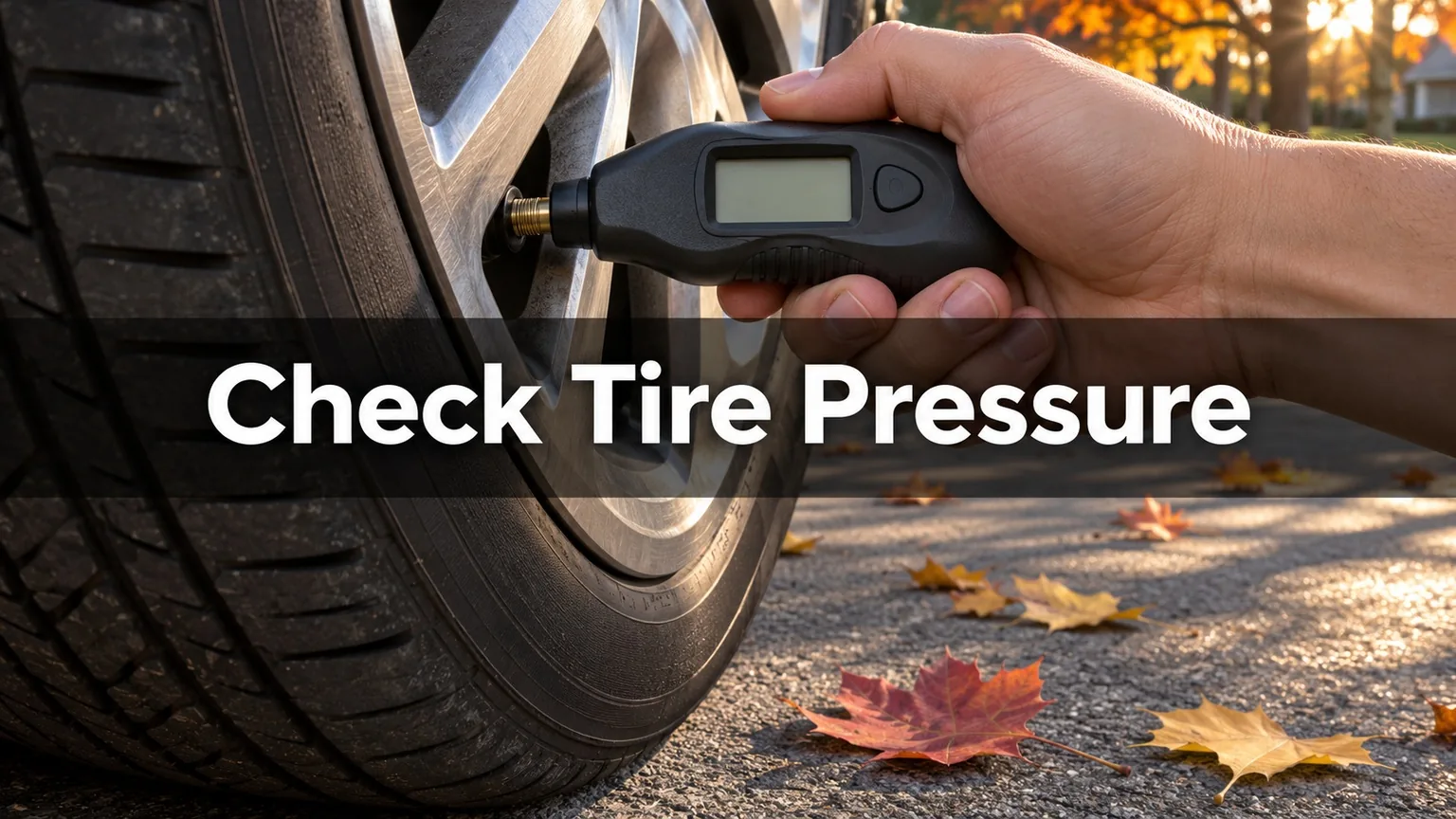
To check tire pressure, find the recommended PSI on the sticker inside the driver’s door jamb, then press a tire gauge firmly onto each valve stem while the tires are cold, meaning the car has been parked for at least three hours or driven less than a mile. Compare each reading to the sticker, add air to any tire that is low, and recheck. The whole job takes about five minutes, and a decent gauge costs $5 to $25.
Do it once a month and before long trips, and more often when the weather turns cold. Tires lose about 1 PSI for every 10°F drop in outside temperature, which is why so many dashboard tire lights come on during the first cold mornings of fall. The steps below cover reading the right number, using a gauge and an air pump, and what the tire pressure light is actually telling you.
Find the right pressure for your car
Your car’s recommended pressure is on the tire information placard, usually a sticker on the driver’s door jamb. Some vehicles put it inside the fuel door or the glove box, and it is always in the owner’s manual. It lists cold pressure for the front and rear tires, which can differ, and often for the spare.
Do not use the number molded into the tire sidewall. That is the maximum pressure the tire can safely hold, not the right pressure for your car. Filling to the sidewall number usually overinflates the tire, which reduces grip and makes the ride harsher.
Most passenger cars call for somewhere around 30 to 35 PSI, while some trucks, SUVs and vans run higher, especially on the rear. If you have replaced your tires with a different size than the original, ask the tire shop whether the recommended pressure changes.
What you need
- A tire gauge. Digital gauges are easy to read. Dial gauges are durable and accurate. Pencil-style gauges are cheap and fine for a glove box. A gauge built into a gas station air hose is often inaccurate, so use your own when you can.
- An air source. Gas station air machines often cost $1.50 to $2, though many stations offer it free, and California requires stations to provide free air to fueling customers. A portable 12-volt inflator that plugs into the car costs about $30 to $80 and is handy in winter.
- Your valve caps. Keep them in a pocket so they do not roll away.
How to check and fill your tires
- Check the tires cold, ideally first thing in the morning or after the car has been parked for three hours. Driving warms the tires and raises the reading by a few PSI.
- Look up the recommended cold pressure on the door jamb placard.
- Remove the valve cap from the first tire.
- Press the gauge straight and firmly onto the valve stem until the hissing stops, then read the number. If you hear constant hissing, reposition the gauge.
- Write down or remember the reading, then check the other three tires and the spare if it is accessible.
- If a tire is low, attach the air hose to the valve stem and add air in short bursts of a few seconds.
- Recheck with your gauge after each burst. If you overshoot, press the small pin in the center of the valve stem with the back of the gauge or a fingernail to let air out.
- Replace every valve cap. They keep dirt and moisture out of the valve.
If you must fill warm tires, for example at a gas station halfway through a drive, add about 3 to 4 PSI above the placard number and recheck once the tires have cooled.
Example: Carla’s placard calls for 35 PSI front and rear. On a 30°F November morning, her gauge reads 31, 30, 32 and 31. She had last filled the tires in September when it was around 70°F, a 40-degree drop, which accounts for the roughly 4 PSI loss. She tops each tire up to 35 at home with a $45 portable inflator. The tire light that came on during her commute goes off after a few miles of driving.
What the tire pressure light means
Every new passenger car and light truck sold in the US since the 2008 model year has a tire pressure monitoring system (TPMS). The warning light looks like a horseshoe-shaped tire cross-section with an exclamation point.
| What you see | What it usually means | What to do |
|---|---|---|
| Light stays on solid | At least one tire is about 25% or more below the recommended pressure | Check all tires with a gauge soon and fill to the placard number |
| Light comes on in cold mornings, goes off after driving | Tires are borderline low; warming raises pressure | Add air to the placard number while cold |
| Light flashes for about a minute, then stays on | A fault in the TPMS itself, such as a dead sensor battery | Check pressures manually and have the system diagnosed |
| Light on with a tire visibly flat or a thumping sound | Rapid air loss, possibly a puncture | Pull over safely; do not keep driving on a flat tire |
On a car that needs 35 PSI, the light may not come on until a tire drops to about 26 PSI. By then you are already losing fuel economy and grip and adding tire wear. A monthly gauge check catches low tires well before the light does.
Some cars use an indirect system that compares how fast each wheel spins instead of measuring pressure directly. After filling tires on those cars, you may need to reset the system with a button or a menu setting. Your owner’s manual explains how.
Why the right pressure matters
Underinflated tires flex more, which builds heat. Heat is the main cause of tire failure, and a badly underinflated tire on a hot highway is a real blowout risk. Low pressure also lengthens stopping distances on wet roads, wears the outer edges of the tread faster and lowers fuel economy.
Overinflated tires have a smaller contact patch, so they grip less, especially in rain and snow, and they wear the center of the tread faster. The ride feels stiffer and bumps hit harder.
Example: Ray drives 15,000 miles a year and never checks his tires until the light comes on. His shop notices the outer edges of his front tires are worn down while the centers still have good tread, a classic sign of running low. He replaces the pair for $380 at about 30,000 miles instead of the 50,000 miles the tread is rated for. A $10 gauge and a monthly check would likely have bought him another year or more on those tires.
Tips for winter and long trips
- Check pressure more often in fall and winter, since every cold snap lowers it.
- Do not lower pressure for snow driving. Use the placard pressure year round unless your owner’s manual says otherwise.
- Check before a road trip and again after loading the car, since some placards list a higher pressure for a full load.
- Check the spare. Compact spares often need 60 PSI, and many are found flat when they are needed most.
- If one tire keeps losing air faster than the others, have it checked for a nail, a leaking valve or a bad bead seal.
Common questions
How often should I check my tire pressure?
At least once a month and before any long drive. Check more often during big temperature swings in fall and spring.
Why does my tire pressure light come on when it is cold?
Air contracts in cold weather, so tires lose about 1 PSI for every 10°F drop. A tire that was slightly low can fall below the warning threshold overnight. Add air to the placard number while the tires are cold.
Should I fill my tires to the PSI on the tire?
No. The sidewall number is the maximum pressure. Use the recommended pressure on the door jamb placard or in your owner’s manual.
Is nitrogen better than regular air?
Nitrogen leaks out a little more slowly, but regular air is already about 78% nitrogen. For most drivers, checking pressure monthly matters far more than the type of fill.
How much does it cost to fix a TPMS sensor?
Sensor batteries usually last several years and are sealed inside the sensor, so the whole sensor is replaced. Installed prices vary by vehicle and shop, commonly somewhere around $50 to $150 per wheel at tire shops and more at some dealers. Replacing sensors when you buy new tires saves a second round of labor.
Before you drive off
- Keep a gauge in the glove box.
- Know your placard pressure for front, rear and spare.
- Check cold, monthly, and after big temperature drops.
- Replace all valve caps.
- Get a slow leak inspected instead of refilling it every week.
Editorial note: This article is general information. Recommendations were checked as of November 2026; always use the pressure listed on your vehicle’s tire placard or owner’s manual, and see NHTSA’s tire safety guidance at NHTSA.gov.