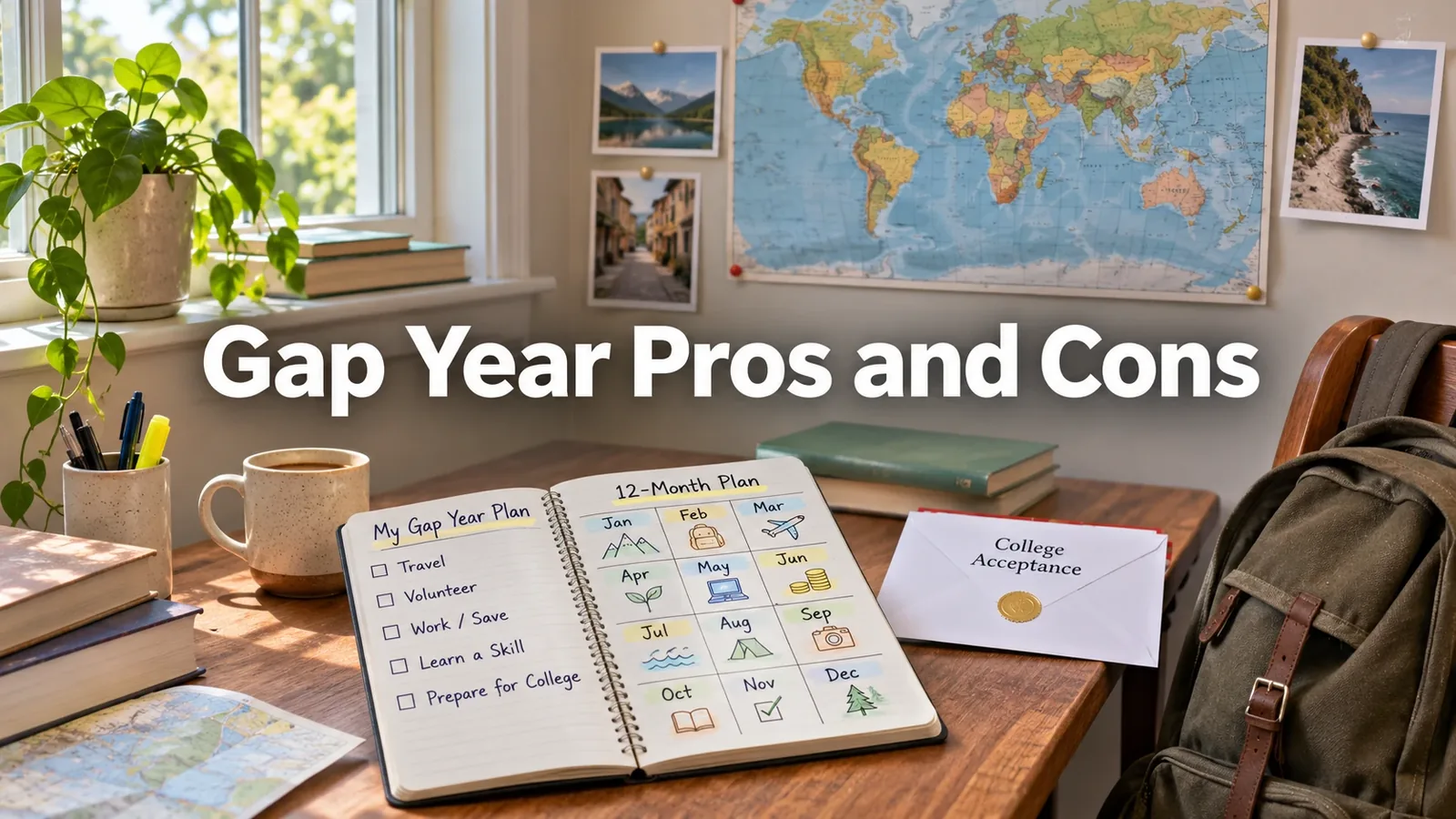
A gap year can be a smart move if it has a clear plan, such as saving money, working in a field you want to study, or serving in a program like AmeriCorps, and if you lock in your college spot with a deferral first. The main downsides are losing momentum, possibly losing a scholarship that will not carry over, and having to redo financial aid paperwork for a new year. A gap year spent with no structure tends to drift, and that is where most of the risk sits.
Most of the decision comes down to logistics that are easy to overlook in the excitement of a year off: whether your college allows deferral, what you are allowed to do during it, and how a year of work income changes your aid. Below are the real pros and cons, what different gap years cost or earn, and a step-by-step plan for deferring admission without losing your place.
The real benefits of a gap year
The strongest case for a gap year is when it fixes a specific problem or builds toward a specific goal.
- Clarity on a major or career. A year working in a hospital, a lab, a trade or an office can confirm or rule out a field before you spend tuition on it. Changing majors late often adds semesters, which costs far more than a year of planning.
- Money saved. Full-time work at $16 to $20 an hour for 10 months can bring in roughly $25,000 to $32,000 before taxes, and living at home lets much of it go to college costs.
- Recovery from burnout. Students who finish high school exhausted sometimes start college more focused after a break.
- Skills and maturity. Managing a job, a budget or living away from home teaches things that show up later in college, such as time management and asking for help.
- Service awards. A full-time AmeriCorps term earns a Segal Education Award equal to the maximum Pell Grant for the year the position was approved ($7,395 for recent terms), usable for tuition or qualifying student loans within seven years.
The downsides to weigh honestly
- Some students do not go back. Without a deferral and a plan, a year off can stretch into several. A signed deferral and a deposit make returning the default.
- Scholarships may not wait. Some merit scholarships honor a deferral, and some do not. Outside scholarships often require enrollment by a set date.
- Your friends move ahead a year. That matters more to some people than others, but it is a real social cost.
- Costs can be high. Structured international gap programs can cost as much as a year of private college.
- Aid changes. Your gap year income appears on future FAFSAs, and you have to file a new FAFSA for the year you actually enroll.
What a gap year costs or earns
The financial side varies more than anything else. Here is how common types compare for a 9 to 12 month gap year.
| Gap year type | Approximate cost | Possible income or award | Good fit for |
|---|---|---|---|
| Full-time job, living at home | Low; transportation and personal costs | About $25,000 to $32,000 before taxes at $16 to $20 an hour | Saving for college, testing a career |
| AmeriCorps full-time term | Low | Modest living allowance plus an education award equal to the max Pell Grant | Service, teaching, conservation, public health interests |
| Paid internship or apprenticeship | Low | Varies widely by field | Students with a clear career target |
| Self-designed travel with work stints | $5,000 to $20,000+, depending on destinations | Some, from seasonal or work-exchange jobs | Independent students with savings |
| Structured gap year program (domestic or abroad) | Often $10,000 to $50,000+ for a semester or year | Usually none | Families who can afford it and want supervision |
Many students mix types: for example, work from September to February, then spend two or three months on a volunteer program or travel.
Example: Jordan was admitted to a state university with a net price of about $18,000 a year. He defers, works at a hospital supply warehouse for $18.50 an hour, 38 hours a week, for 42 weeks, earning about $29,500 before taxes. After roughly $3,000 in taxes and $6,500 in car insurance, gas and personal spending, he puts about $20,000 in a high-yield savings account. That covers his first year’s net price and lets him borrow less over four years.
How to defer college admission
Deferral rules are set by each college, and some do not allow it at all, so read the policy before you commit to a year off.
- Apply to college during senior year anyway. Applying while you still have teachers and counselors close at hand is much easier than applying from a job a year later.
- Check each college’s deferral policy on the admissions website or by email. Note the request deadline, which is often May 1 or shortly after.
- Accept the offer and pay the enrollment deposit by the deadline. Most colleges require the deposit to hold your spot.
- Submit a written deferral request describing what you plan to do. Many colleges want a specific plan, not just “time off.”
- Ask about your merit scholarship in writing. Get confirmation that it will be held for the following year, or learn what you would lose.
- Follow the rules during the deferral. Many colleges forbid enrolling as a degree-seeking student, and sometimes taking any for-credit courses, at another college during the gap year. Breaking that rule can cancel your admission.
- File the FAFSA for the year you will enroll and any required CSS Profile, then confirm your intent to enroll by the college’s deadline.
If you skip deferral and apply during your gap year instead, start in late summer, ask teachers for recommendations before you graduate, and keep copies of your transcripts and test scores.
How a gap year affects financial aid
Federal aid is based on the FAFSA for the academic year you attend, and each FAFSA uses tax information from two years earlier. If you start college in fall 2028, you file the 2028-29 FAFSA, which uses 2026 tax data. That means the income you earn during a gap year that starts after high school usually shows up on the FAFSA for your second or third year of college rather than the first. See StudentAid.gov for the tax year each FAFSA uses.
A gap year does not make you an independent student. Most undergraduates remain dependent until age 24 unless they are married, a veteran, supporting a child, or meet another specific condition, so your parents’ information is still required.
Example: Maya graduates in June 2026, works full time from July 2026 to June 2027, and starts college in fall 2027. Her first-year FAFSA (2027-28) uses 2025 tax data, before she earned much. Her second-year FAFSA (2028-29) uses 2026 income, which includes about $14,000 of her gap year wages, and her aid eligibility drops slightly that year. Saving part of her earnings in her own name, then using it for her first-year costs, softens the effect.
A gap year can also affect family taxes. A child who is 19 or older at the end of the year and was not a full-time student for at least five months generally no longer counts as a qualifying child for some credits, so parents should check with a tax preparer.
How to plan a gap year that pays off
- Write a month-by-month plan with at least one concrete goal, such as a savings target, a certification or a number of service hours.
- Keep health insurance in place. Young adults can stay on a parent’s plan until 26.
- Stay in touch with the college. Read emails about housing, orientation and deposits that come during your gap year.
- Keep a simple record of what you did and learned. Colleges, scholarships and future employers ask about it.
- Set a firm return date and treat it like a deadline.
Common questions
Do colleges look down on gap years?
Generally no. Many colleges allow deferrals and some encourage them, especially when the student has a structured plan. What matters is being able to explain what you did and why.
Will I lose my scholarship if I take a gap year?
It depends on the college and the scholarship. Some institutional merit awards are held during an approved deferral, others are not, and outside scholarships have their own rules. Get the answer in writing before you commit.
Can I take community college classes during a gap year?
Many colleges prohibit taking for-credit courses elsewhere during a deferral, because it would change your status from first-year to transfer applicant. Some allow a class or two if approved. Check the deferral terms before registering.
Do I have to file the FAFSA again after a gap year?
Yes. The FAFSA is filed for each academic year you attend, so you file the one for the year you actually enroll. A FAFSA filed during senior year does not carry over to the next year.
Is a gap year a good idea if I am unsure about college?
It can be, as long as the year is structured, for example working in a field you are considering. Deferring admission while you explore keeps the option open without the pressure of reapplying.
Before you commit to a gap year
- Confirm your college allows deferral and note the request deadline.
- Pay the deposit and get the deferral and any scholarship hold in writing.
- Write a month-by-month plan with a money or skills goal.
- Check what is not allowed during the deferral, such as for-credit classes.
- Mark the FAFSA filing date for the year you will enroll.
- Set your return date and tell people about it.
Editorial note: This article is general information, not financial or tax advice, and figures were checked as of November 2026. Confirm deferral and scholarship rules with each college’s admissions and financial aid offices, and federal aid rules at StudentAid.gov.