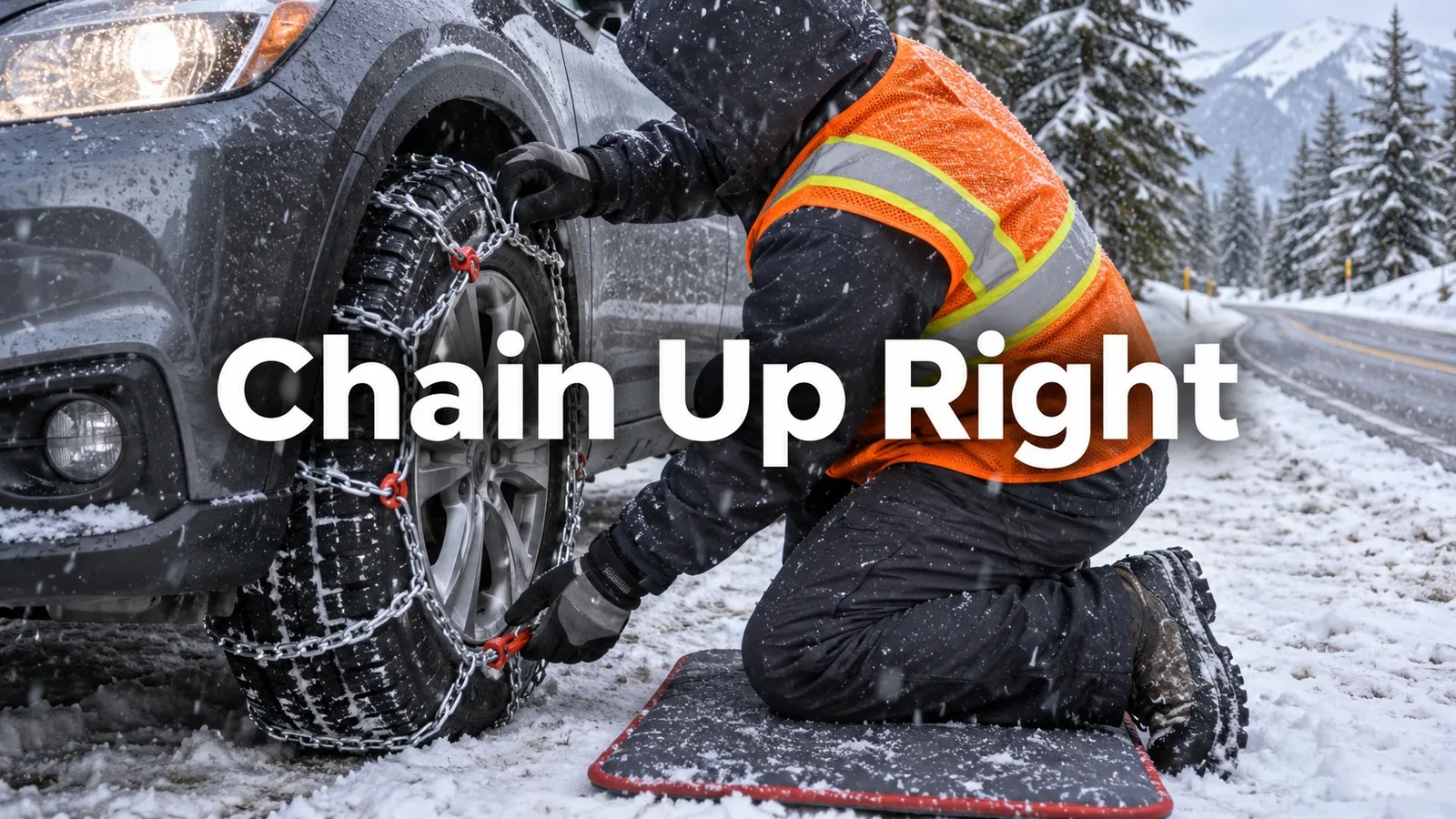
To put on tire chains, pull completely off the road, lay each chain flat behind the drive wheels, drape it over the top of the tire, connect the inside fastener behind the tire, then the outside fastener, and tighten. Drive forward 50 to 100 feet, stop and re-tighten. Chains go on the drive wheels: the front tires on front-wheel-drive cars and the rear tires on rear-wheel-drive vehicles. For all-wheel drive, follow the owner’s manual, which usually says the front.
The first time you install chains should not be on the side of a mountain pass in a blizzard. A practice run in your driveway takes about 20 minutes and makes the real thing go far faster. This guide covers sizing, which type to buy, step-by-step installation, chain control rules (California’s R1, R2 and R3 are the most common example), and how to drive and remove them without damaging your car.
Do you need tire chains?
Chains matter if you drive mountain passes, ski roads or rural areas with hills and heavy snow. In some places you must carry them during winter even if you never install them. California’s chain control rules require four-wheel and all-wheel drive vehicles to carry traction devices in chain control areas even when they’re exempt from putting them on. Colorado has a traction law and chain law that can be activated on I-70 and other mountain highways, and Washington and Oregon post chain requirements on mountain passes.
For flat suburban driving, winter tires do more good over the season than chains, which are only for short stretches of deep snow or ice. Chains are not a substitute for safe speed or decent tread.
Types of traction devices compared
| Type | Typical price per pair | Traction on ice | Ease of install | Best for |
|---|---|---|---|---|
| Steel link chains | $60 to $200 | Best | Hardest; heavy | Trucks, frequent deep snow |
| Low-profile or “Class S” chains | $70 to $180 | Very good | Moderate | Cars with tight wheel-well clearance |
| Cable chains | $40 to $100 | Good | Easier, lighter | Occasional use, small cars |
| Self-tensioning or quick-fit chains | $150 to $400+ | Very good | Easiest of the chains | People who chain up often |
| Textile snow socks | $70 to $150 | Fair on snow, weaker on ice | Easiest | Light snow, emergency use; check local legality |
Not every device meets every state’s rules. California accepts tire traction devices that are structurally sound, resist coming off, and carry a permanent maker’s mark. Some jurisdictions or chain checkpoints may not accept textile socks for all conditions, so check the state’s transportation department site before relying on them.
How to size tire chains
Chains are sold by tire size, so start with the numbers on your tire sidewall, such as 225/65R17. Match that exact size on the package. A chain that’s too big will slap the wheel well and can come off; one that’s too small won’t close.
Next, check your owner’s manual. Many cars, especially newer sedans and crossovers with large wheels, have limited clearance between the tire and suspension. The manual may say chains aren’t allowed at all, may require SAE Class S (low-profile) chains, or may limit chains to specific tire sizes. If your car’s original tires are a different size from what’s on it now, the manual’s guidance may not apply.
Example: Kevin drives an all-wheel-drive crossover on 235/55R19 tires and plans a ski trip to the Sierra Nevada. His manual says to use Class S chains on the front wheels only. He buys a pair of low-profile cable chains for his exact tire size for $85, practices once in his driveway (25 minutes the first time, 10 the second), and keeps them in the cargo area with gloves and a kneeling pad.
Step-by-step: putting chains on
Instructions vary by brand, so read the ones in your box. The general process for standard chains and cables looks like this:
- Pull completely off the road onto a flat, wide shoulder or a designated chain-up area. Never stop in a traffic lane. Turn on your hazard lights, set the parking brake and put on a reflective vest if you have one.
- Put on gloves and lay a mat or trash bag on the ground to kneel on.
- Untangle each chain and lay it flat on the ground, with the hooks or connectors facing away from the tire so they won’t rub the sidewall.
- Drape the chain over the top of the drive tire, centered, with roughly equal amounts hanging on each side. The cable or chain loop goes on the inside of the tire.
- Reach behind the tire and connect the inside fastener at the bottom. This is the hardest step; if the chain doesn’t reach, roll the car forward a foot so the unconnected section is accessible.
- Connect the outside fastener on the front face of the tire, pulling it as snug as you can.
- Attach the tensioner, rubber adjuster or cam if your set has one, and tuck loose ends so nothing flaps.
- Repeat on the other drive wheel.
- Drive slowly forward 50 to 100 feet, stop, and re-tighten. Chains settle as they seat, and a loose chain can damage the fender, brake lines or sensors.
Snow socks are simpler: pull the sock over the top of the tire as far as it goes, roll the car forward half a turn, and pull the rest of the sock over the bottom.
Chain control levels explained
California’s system is the one most drivers run into, and other western states use similar ideas. When chain control is in effect, signs appear on the highway, and CHP or Caltrans may run a checkpoint about a mile after the first “Chains Required” sign.
- R-1: Chains required on all vehicles except passenger cars and light trucks under 6,000 pounds with snow tires on at least two drive wheels. Those vehicles must still carry chains.
- R-2: Chains or traction devices required on all vehicles except four-wheel or all-wheel drive vehicles with snow-tread tires on all four wheels. Those vehicles must still carry traction devices.
- R-3: Chains or traction devices required on every vehicle, no exceptions.
Snow-tread tires are marked M+S, M/S or “Mud and Snow” on the sidewall. Under chain control, California’s speed limit drops to 25 or 30 mph. Independent chain installers often work these areas and charge a fee; they aren’t allowed to sell chains, so bring your own. Ask for a receipt with the installer’s badge number.
Example: Rosa drives a front-wheel-drive sedan with all-season M+S tires. Under R-1, she can keep going as long as she carries chains. When conditions worsen to R-2, she must chain up because her car isn’t 4WD or AWD. Under R-3, even her neighbor’s AWD SUV with snow tires has to chain up.
Driving with chains and taking them off
Chains change how a car handles. Keep it slow, with 30 mph as the usual maximum (check the chain maker’s limit, which can be lower). Accelerate and brake gently, avoid spinning the wheels, and don’t drive on dry pavement any longer than you have to, since bare roads wear chains quickly and can damage tires.
If you hear slapping or clanking, pull over right away and check the fit. A broken link or loose chain can whip around and damage brake lines, ABS sensors and bodywork in seconds.
To remove them, drive past the “End Chain Control” sign to a safe pull-off. Undo the outside fastener, then the inside one, and drive forward off the chains. At home, rinse off salt and grit, let them dry fully, and store them in their bag so they don’t rust or tangle.
Common questions
Do chains go on the front or back tires?
They go on the drive wheels: front for front-wheel drive, rear for rear-wheel drive. For AWD and 4WD vehicles, use the wheels your owner’s manual specifies, which is often the front.
How fast can you drive with tire chains?
Most chain makers and state rules set a limit of 25 to 30 mph. California’s chain control speed limit is 25 or 30 mph, as posted.
Do I need chains if I have all-wheel drive?
Often you still need to carry them. In California, AWD with snow tires is exempt from installing chains under R-1 and R-2, but not R-3, and you must have chains with you in chain control areas.
Can tire chains damage my car?
They can if they’re the wrong size, too loose, or used on a car with too little clearance. Use the size and class your manual specifies and re-tighten after the first 100 feet.
Are snow socks legal?
Many states accept textile traction devices, but rules and checkpoint practices vary. Check the state transportation department’s winter driving page before relying on socks in place of chains.
Before your winter trip
- Check your owner’s manual for chain type, clearance class and which wheels to chain.
- Buy chains for your exact tire size and do a practice install at home.
- Pack gloves, a kneeling mat, a flashlight, a reflective vest and a towel.
- Check road conditions and chain controls before leaving; in California call 800-427-7623 or use Caltrans QuickMap.
- Fill your gas tank and carry water, snacks and warm layers in case of delays.
Editorial note: This article is general information. Chain rules were checked as of November 2026 and differ by state; confirm current requirements with the state transportation department, such as Caltrans, and your vehicle’s owner’s manual.