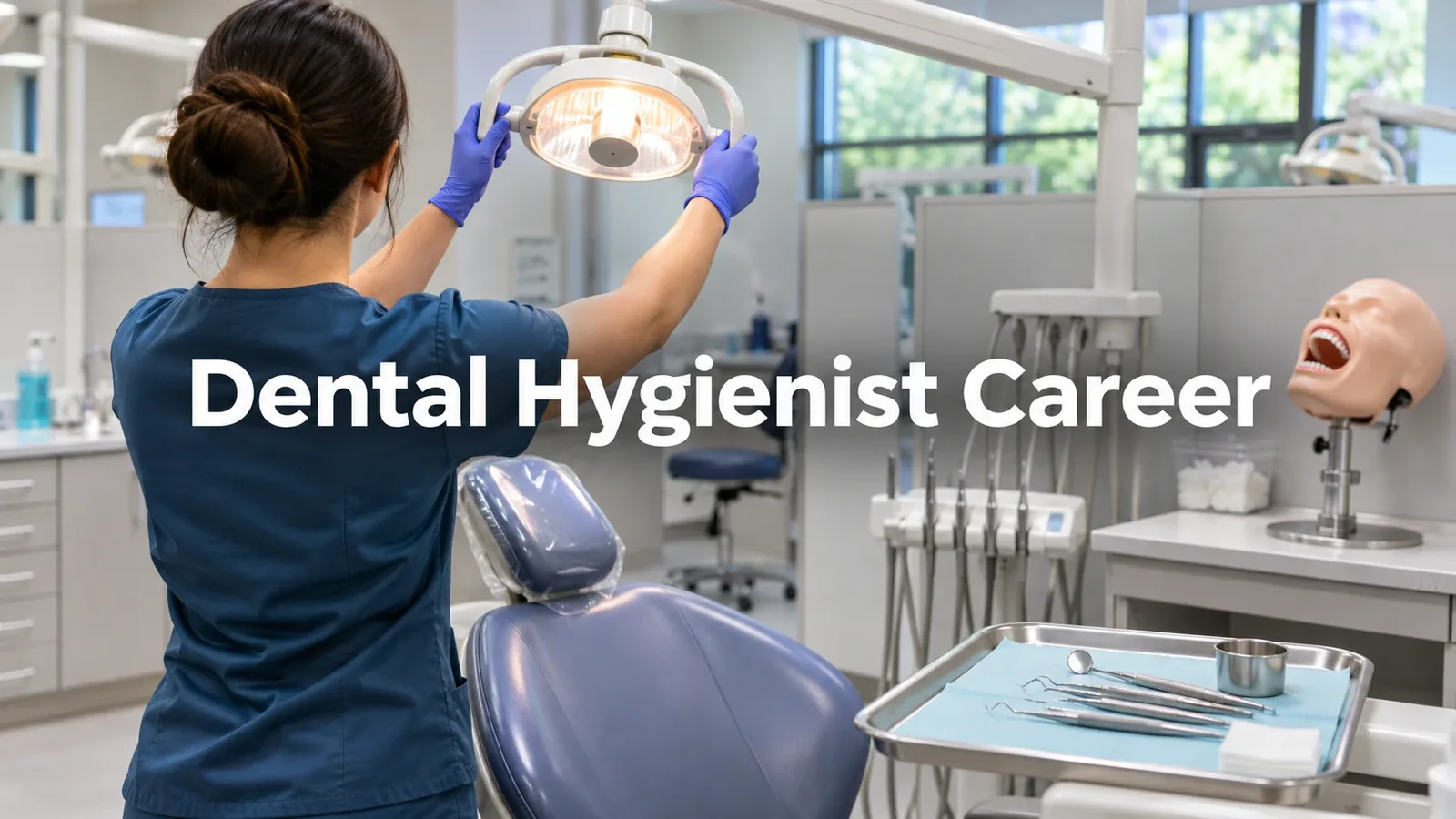
To become a dental hygienist, you complete an accredited dental hygiene program (usually an associate degree that takes about three years including prerequisites), pass the National Board Dental Hygiene Examination and a clinical exam, and get licensed in the state where you want to work. The pay is strong for a two- to three-year credential: the Bureau of Labor Statistics reports a median of $98,100 a year, or $47.16 an hour, as of May 2025.
The path is straightforward but competitive. Many programs accept a limited number of students each year, prerequisites take time, and the program itself is demanding, with clinic hours on real patients. Below is each step in order, what it costs, how the degree options compare, and what the job is like day to day.
What dental hygienists do and earn
Hygienists clean teeth, remove plaque and tartar, take X-rays, screen for gum disease and oral cancer, apply sealants and fluoride, and teach patients how to care for their teeth. In many states they can also give local anesthesia and, in some, work with limited or no dentist supervision in settings like schools and nursing homes.
According to the BLS Occupational Outlook Handbook, there were about 225,300 dental hygienist jobs in 2025, and employment is projected to grow 8% from 2025 to 2035, much faster than average, with about 15,000 openings a year. Nearly all hygienists work in dental offices, and many work part time or split the week between two practices.
Pay varies widely by region. Hygienists in high-cost metro areas often earn well above the median, while rural areas in lower-cost states pay less. Many jobs pay hourly, and benefits are less common in small offices than in large group practices.
Step-by-step path to becoming a hygienist
- Finish high school with science and math. Biology, chemistry and algebra make college prerequisites easier.
- Complete prerequisite courses. Most programs require college-level anatomy and physiology, microbiology, chemistry, English, psychology or sociology, and sometimes nutrition and statistics, often with a minimum grade of C or B. This takes one to two semesters for most students, sometimes a year or more.
- Apply to accredited programs. Choose programs accredited by the Commission on Dental Accreditation (CODA), since state licensing requires it. Many programs rank applicants on prerequisite GPA, an entrance test, and sometimes dental office observation hours.
- Complete the dental hygiene program. The professional program usually runs about two years of full-time classes, labs and supervised clinic work on patients.
- Pass the National Board Dental Hygiene Examination (NBDHE). This written computer-based exam is run by the Joint Commission on National Dental Examinations, and your program director confirms your eligibility, usually in your final semester.
- Pass a clinical exam. Most states accept a regional clinical exam, such as those given by CDCA-WREB-CITA (ADEX) or CRDTS, where you perform procedures on a patient or simulation under examiner review.
- Apply for your state license. Your state board of dental examiners usually requires a jurisprudence exam on state law, CPR certification, a background check and fees. Some states also require a separate permit for local anesthesia.
- Keep your license current. States require continuing education hours, often 12 to 25 a year or a set number per renewal period, plus current CPR.
Example: Leah, 24, works as a dental receptionist and wants to become a hygienist. She takes anatomy and physiology I and II, microbiology and chemistry at her community college over two semesters while working part time, earning A’s and B’s. She applies to two CODA-accredited programs, is waitlisted at one and admitted to the other, and starts that fall. Two years later she passes the NBDHE and a regional clinical exam, receives her state license about six weeks after applying, and is hired by the practice where she used to work, now at an hourly rate close to the area median.
Degree options compared
An associate degree is enough to get licensed and work clinically. A bachelor’s or master’s matters mostly if you want to teach, work in public health or research, or move into management.
| Path | Typical time | Rough tuition range | Best for |
|---|---|---|---|
| Associate degree (community or technical college) | About 3 years including prerequisites | Often about $10,000 to $30,000 in-state, plus instruments and fees | Most people who want clinical work |
| Associate degree (private college) | 2 to 3 years | Often $40,000 or more | Faster start where public programs have long waitlists |
| Bachelor’s degree (university) | 4 years | Varies widely by school and residency | Those aiming for public health, education or sales roles |
| Degree completion (RDH to BS), often online | 1 to 2 years | Varies | Licensed hygienists who want a bachelor’s while working |
| Master’s degree | 1 to 2 years after bachelor’s | Varies | Teaching in hygiene programs, research, administration |
Costs beyond tuition are significant. Instrument kits, loupes, scrubs, textbooks, board exam and clinical exam fees, and licensing fees can add several thousand dollars, and board and clinical exam fees alone run several hundred dollars each. Ask each program for its full cost sheet, not just tuition. Federal financial aid, including Pell Grants and student loans, is available at accredited schools.
How to get into a competitive program
Public dental hygiene programs often receive more qualified applicants than they have seats. What usually moves the needle:
- A high science prerequisite GPA. Retaking a C in anatomy can make a real difference at points-based programs.
- Strong entrance exam scores if required, such as the HESI or TEAS.
- Dental office experience or job shadowing hours, especially as a dental assistant.
- Applying to several programs, including ones within commuting distance across state lines.
- Meeting every deadline and document requirement exactly. Incomplete applications are often discarded.
Working as a dental assistant while you finish prerequisites is a common route. It shows commitment, builds familiarity with instruments and charting, and provides an income.
What the work is really like
A typical day involves seeing about 8 to 10 patients, often in one-hour appointments, with time for charting, X-rays and sterilizing between them. The work is detailed and physical: hygienists spend hours in a fixed posture using small instruments, and neck, back, shoulder and wrist strain are common complaints. Ergonomic chairs, loupes, and good stretching habits help, and many hygienists choose a four-day week to manage the physical load.
Patient communication is a big part of the job. You explain gum disease findings, coach patients on home care, and calm nervous patients. People who enjoy routine, precision and one-on-one conversations tend to do well.
Example: Tom, a licensed hygienist, works Monday through Thursday at one practice for $48 an hour and covers one Saturday a month at another. At about 32 hours a week, 48 weeks a year, his base pay is around $73,700, plus about $4,600 from the Saturday shifts. He chose the shorter week over a full-time offer with benefits because his back feels better with the extra day off, and he buys health insurance through his spouse’s plan.
Licensing across states
Hygienists are licensed by each state, so moving can mean applying for a new license. Many states offer licensure by credentials for hygienists who have practiced elsewhere for a set number of years, and a growing number of states have joined the Dental and Dental Hygienist Compact, which is designed to make practicing across member states easier once it is fully running. Scope of practice also changes from state to state, including whether you can give anesthesia, place certain fillings, or work without a dentist on site. Check with your state board of dental examiners before you choose a program if you plan to move.
Common questions
How long does it take to become a dental hygienist?
Most people take about three years: one year or so of prerequisites and two years in the dental hygiene program, followed by board exams and licensing, which can take another one to three months. Bachelor’s programs take about four years.
How much does a dental hygienist make?
The BLS reports a median salary of $98,100 a year, or $47.16 an hour, as of May 2025. Pay is higher in some metro areas and lower in many rural regions, and part-time schedules are common.
Is dental hygiene school hard?
It is demanding. Programs combine science-heavy coursework with clinic requirements on real patients, and most students cannot work many hours during the program. Students who plan finances ahead and stay on top of clinic requirements tend to manage.
Can a dental assistant become a dental hygienist?
Yes, but there is no shortcut from assisting to hygiene in most states. Assistants still need to complete an accredited hygiene program and pass the exams, though their experience helps with admission and clinical skills.
Do dental hygienists need a bachelor’s degree?
No. An associate degree from an accredited program qualifies you for licensing and clinical jobs in every state. A bachelor’s or master’s is mainly needed for teaching, research and some public health roles.
Before you apply to a program
- Shadow a hygienist for a day to see the physical and patient side of the job.
- Confirm the program is CODA accredited and check its board pass rates.
- Get each program’s prerequisite list, deadlines and full cost sheet.
- Look up your state’s licensing steps and scope of practice.
- File the FAFSA and look for dental hygiene scholarships.
- Plan your budget for two years of limited work hours.
Editorial note: This article is general information, and pay and job figures were checked as of November 2026 against the Bureau of Labor Statistics. Licensing rules vary by state, so confirm requirements with your state board of dental examiners and exam details with the Joint Commission on National Dental Examinations.