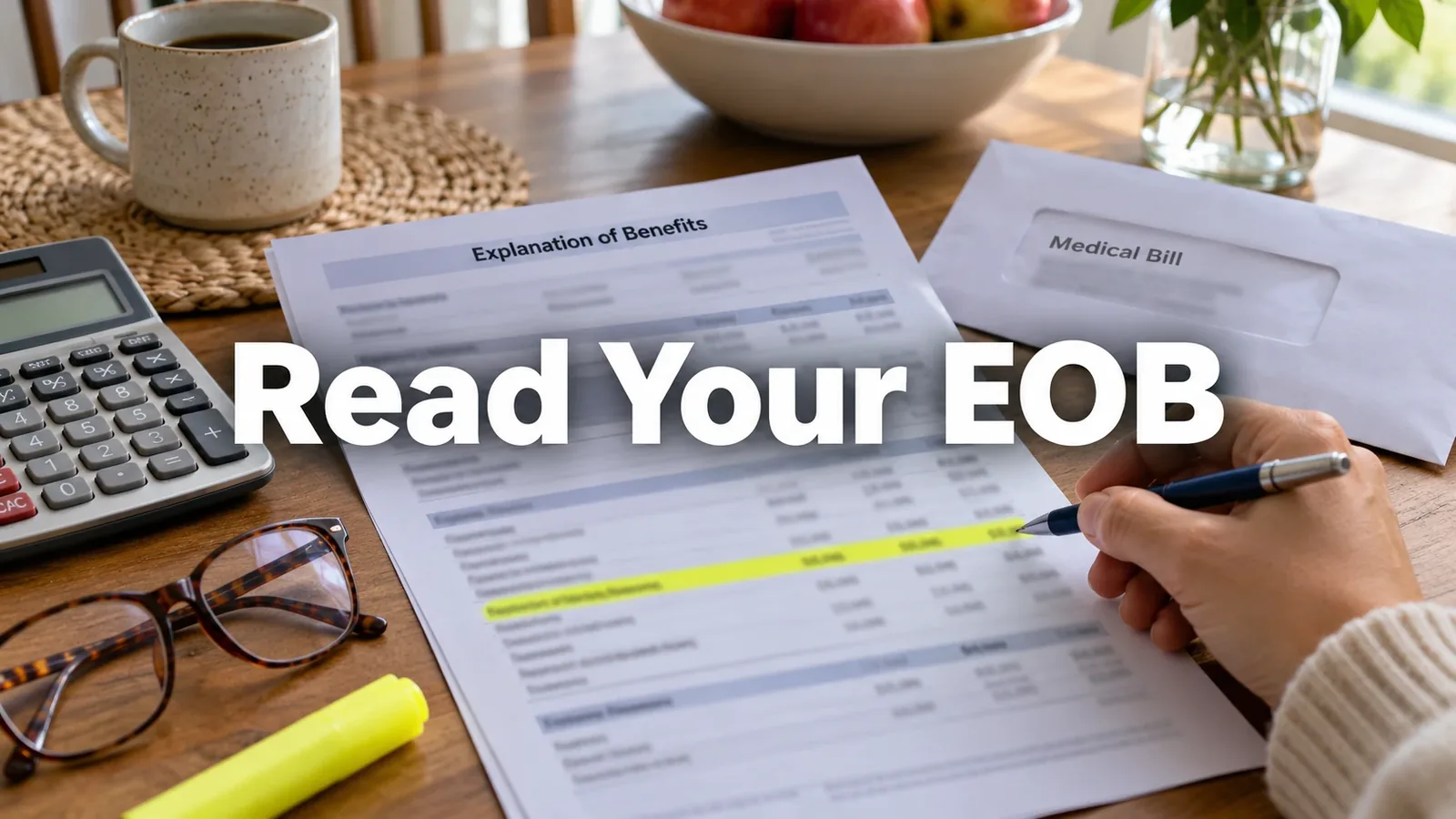
An explanation of benefits (EOB) is a statement from your health insurer showing how it processed a claim: what the provider charged, the discounted amount your plan allows, what the plan paid, and what you may owe. It is not a bill. The number to focus on is “patient responsibility” (sometimes “what you owe” or “your share”), and the bill from your doctor or hospital should match it. If the provider bills you more than that amount for an in-network service, something is off.
EOBs arrive by mail or in your insurer’s app after each claim, and they’re easy to ignore. That’s a mistake: they’re how you catch billing errors, duplicate charges, out-of-network surprises and denied claims you might be able to appeal. Here’s what each section means, how to check your bills against them, and what to do when they don’t line up.
What an EOB shows
Layouts vary by insurer, but almost every EOB has the same pieces: who got care, from whom, when, what was billed, and how the cost was split.
| EOB term | What it means | What to check |
|---|---|---|
| Patient / member | The person who received care | Right family member, correct name |
| Claim number | The insurer’s ID for this claim | Use it when calling the insurer or provider |
| Provider | Doctor, lab, hospital or facility that billed | You recognize it; in-network status |
| Date of service | When the care happened | Matches your appointment |
| Service or procedure code | Description and often a CPT code for each service | Services you really received |
| Amount billed (charges) | The provider’s full list price | Usually much higher than what anyone pays |
| Allowed amount | The rate your plan has negotiated or accepts | The basis for your cost sharing |
| Discount or plan savings | Billed amount minus allowed amount | In-network providers can’t bill you for this |
| Plan paid | What the insurer paid the provider | Zero often means it went to your deductible or was denied |
| Deductible, copay, coinsurance | How your share was calculated | Matches your plan’s terms |
| Not covered | Amounts the plan won’t pay | Look for a reason code |
| Patient responsibility | The most you should owe for this claim | Compare to the provider’s bill |
| Remark or reason codes | Short codes explaining adjustments or denials | Look up the code key on the EOB |
How the numbers fit together
The math on an EOB follows a simple order. The provider bills its full charge. The plan reduces it to the allowed amount. Then your cost sharing applies to the allowed amount: first any deductible you haven’t met, then a copay or coinsurance. The plan pays the rest.
Example: Michelle has an MRI at an in-network imaging center. Her EOB shows: amount billed $2,400, allowed amount $900, discount $1,500. She has $300 left on her deductible, then 20% coinsurance. Her share: $300 + 20% of the remaining $600 ($120) = $420. The plan paid $480. When the imaging center’s bill arrives, it should say $420. Because the provider is in network, it can’t bill her for the $1,500 discount.
On the next claim, her deductible is met, so she pays only coinsurance or copays until she reaches her out-of-pocket maximum, after which the plan pays 100% of covered in-network care for the rest of the plan year. Many EOBs show a running total of your deductible and out-of-pocket maximum, which is useful to watch late in the year.
How to check your EOB against your bill
Wait for the EOB before paying a provider’s bill for anything larger than a routine copay, unless the bill is about to go past due. Then:
- Match the bill to the EOB using the date of service, provider name and patient. Providers sometimes send separate bills for the facility, the doctor, anesthesia and lab work, each with its own EOB.
- Compare the provider’s “amount due” with the EOB’s patient responsibility. They should be the same, minus anything you already paid at the visit.
- Check every service line. Make sure you received each service, that it isn’t listed twice, and that the quantity is right.
- Look at the in-network or out-of-network label for each provider. An out-of-network label at an in-network hospital can be a sign of a surprise bill the No Surprises Act may protect you from.
- Read any reason codes for amounts not covered or denied, and note the appeal deadline printed on the EOB.
- If the bill is higher than the EOB or a line looks wrong, call the provider’s billing office first with your claim number, then the insurer if needed. Ask for an itemized bill for hospital stays.
- Keep EOBs and bills together, at least until the claim is fully paid, and longer if you use an HSA or FSA or deduct medical expenses.
Common EOB problems and what they mean
- Bill is higher than patient responsibility: The provider may have billed before the claim processed, or may be balance billing. In-network providers generally can’t charge more than your EOB share for covered services.
- Claim denied for missing information: Often a coding issue or missing referral or prior authorization. The provider can usually fix and resubmit it.
- “Not medically necessary”: The plan decided the service didn’t meet its criteria. You can appeal, often with a letter from your doctor.
- Coordination of benefits hold: The insurer needs to know whether you have other coverage. Answering its questionnaire usually releases the claim.
- Out-of-network charge for emergency care or an in-network facility: The No Surprises Act limits what you can be charged in many of these cases to in-network cost sharing.
- Care you never received: This can be a billing mistake or medical identity theft. Report it to the insurer right away.
Example: After an in-network outpatient surgery, Paul gets an EOB showing the anesthesiologist was out of network, with $1,150 “not covered.” Because the surgery happened at an in-network facility and he didn’t sign a valid consent to be treated out of network, the No Surprises Act generally limits him to in-network cost sharing for that anesthesia. He calls his insurer to have the claim reprocessed and holds off on paying the anesthesia bill until it is.
How to appeal a denied claim
If your EOB shows a denial you disagree with, you have the right to appeal. For most plans under the Affordable Care Act, you have 180 days from receiving the denial notice to file an internal appeal with the insurer. If the insurer upholds the denial, you can usually request an external review by an independent reviewer. For urgent care situations, appeals move on a faster timeline.
Start by calling the provider’s office, since many denials come from coding or paperwork errors they can correct. If that doesn’t work, file a written appeal that includes the claim number, a copy of the EOB, why you believe the service should be covered, and supporting records or a letter from your doctor.
Common questions
Is an explanation of benefits a bill?
No. It’s a summary from your insurer of how a claim was processed. Your bill comes from the provider and should match the patient responsibility on the EOB.
Why does my EOB say I owe $0?
The service may be covered in full, such as many preventive services on ACA-compliant plans, or you may have already met your out-of-pocket maximum. Some EOBs also show $0 while a claim is still pending.
Should I pay a medical bill before I get the EOB?
For larger bills, it’s usually best to wait for the EOB so you know the correct amount. If a due date is close, call the provider, explain you’re waiting on insurance and ask them to hold the account.
What’s the difference between billed and allowed amounts?
The billed amount is the provider’s full list price. The allowed amount is the lower rate your plan accepts, and your deductible, copay and coinsurance are based on it.
How long should I keep EOBs?
Keep them until each claim is fully paid and any disputes are resolved. If you reimburse yourself from an HSA or claim medical expense deductions, keep them with your tax records.
Before you pay your next medical bill
- Find the matching EOB by date, provider and patient.
- Confirm the bill equals the EOB’s patient responsibility.
- Check every service line for duplicates or care you didn’t receive.
- Note any out-of-network labels and denial reason codes.
- Call the provider, then the insurer, if anything doesn’t match, and note the appeal deadline.
Editorial note: This article is general information, not legal or insurance advice. Rules were checked as of November 2026 and plan details vary; confirm with your insurer, and see HealthCare.gov or CMS.gov/nosurprises for appeal and surprise billing rules.