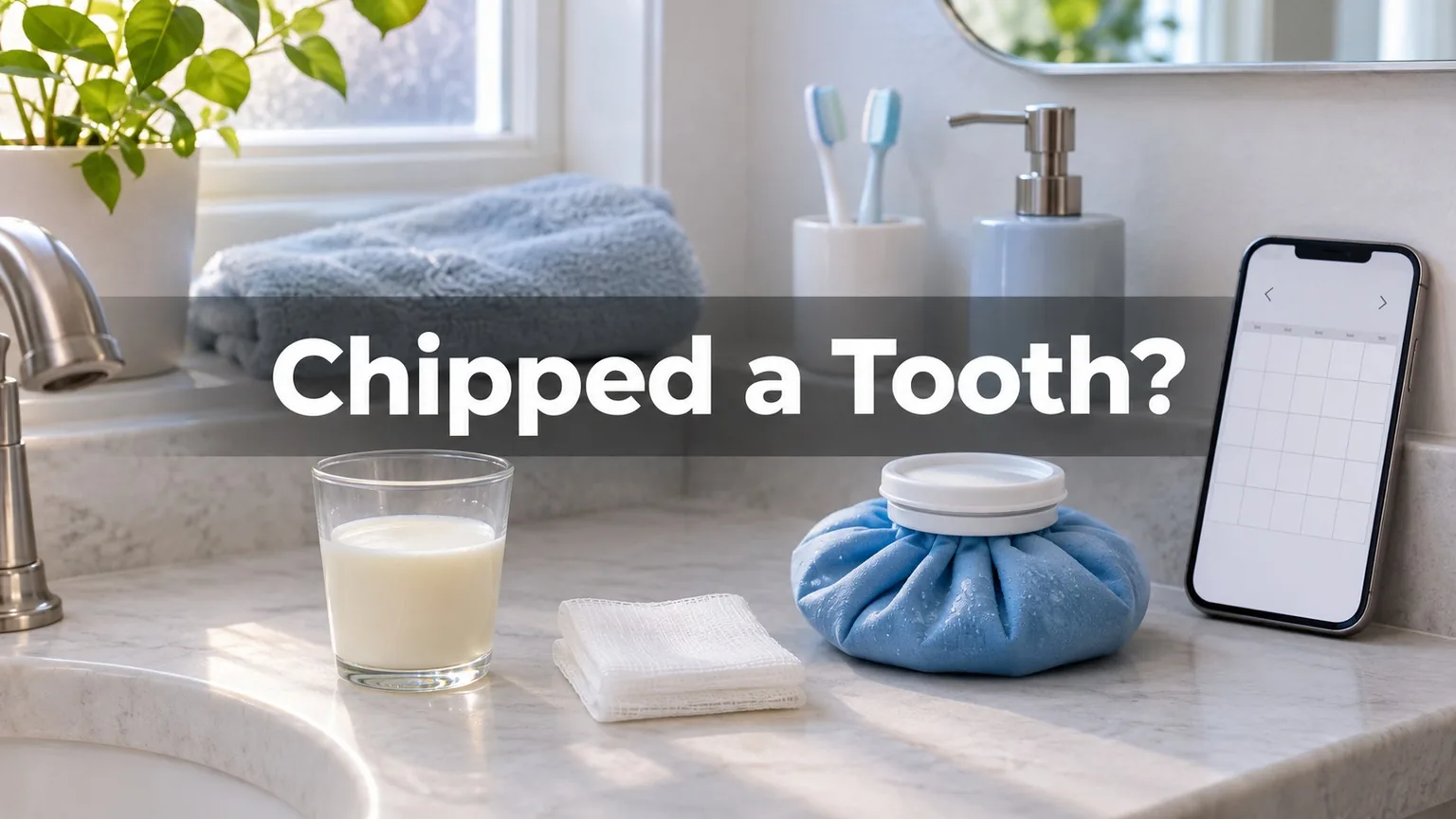
If you chip or break a tooth, rinse your mouth with warm water, save any pieces you can find, hold a cold compress against your cheek for swelling, and call a dentist the same day. A small chip with no pain can usually wait a day or two for an appointment. A break that exposes pink or red tissue, causes strong pain, or comes with a loose or knocked-out tooth needs care right away, ideally within 30 minutes for a knocked-out adult tooth.
Most chips are fixed with bonding, which typically costs $100 to $550 per tooth without insurance. Bigger breaks may need a crown ($500 to $1,500) and sometimes a root canal first. Below is how to tell which kind of break you have, what to do in the first hour, and how the repair options compare on cost and lifespan.
First steps in the first hour
These steps apply to most chipped, cracked or broken teeth in adults and older children:
- Rinse your mouth gently with warm water to clear blood and debris so you can see the damage.
- Find any tooth fragments. Put them in a small container of milk or wrap them in damp gauze. Dentists can sometimes bond a clean fragment back on.
- If there is bleeding, press a piece of clean gauze or a damp tea bag on the spot for about 10 minutes.
- Hold a cold compress or wrapped ice pack on the outside of your cheek, 15 to 20 minutes at a time, to limit swelling.
- If a sharp edge is cutting your tongue or cheek, cover it with dental wax or sugar-free gum until your appointment.
- Take an over-the-counter pain reliever if you normally can, following the label. Do not put aspirin directly on the gum, which can burn the tissue.
- Call your dentist. Many offices keep same-day slots for emergencies, and after-hours voicemail often gives an on-call number.
Chew on the other side and skip very hot, very cold and hard foods until the tooth is checked.
If a tooth is knocked out
A permanent tooth that comes out completely has the best chance of surviving if a dentist sees it within about 30 minutes, although teeth are sometimes saved after an hour or more. The American Association of Endodontists gives these steps:
- Pick the tooth up by the crown (the white chewing part). Do not touch the root.
- If it is dirty, rinse it gently with water only. Do not use soap, scrub it, dry it, or wrap it in tissue or cloth.
- If you can, push it gently back into the socket and hold it there with your fingers or by gently biting down.
- If that is not possible, keep it moist in milk, in a tooth preservation kit, or inside the cheek (for adults who will not swallow it). Tap water is fine for a quick rinse but damages the root cells if the tooth sits in it, so do not use it for storage.
- Get to a dentist or endodontist right away.
Baby teeth are different. Do not try to put a knocked-out baby tooth back in, because it can damage the adult tooth forming underneath. Call the child’s dentist for advice anyway.
Which breaks are urgent
Dentists sort tooth fractures by how deep they go. Depth decides both the urgency and the fix.
- Craze lines. Tiny surface cracks in the enamel, very common in adults. No pain and usually no treatment.
- Small chip in enamel. A rough or sharp edge with no pain. Book a regular appointment in the next few days.
- Chip into dentin. The yellowish layer under enamel shows, and the tooth may be sensitive to cold or air. See a dentist within a day or two.
- Break exposing the pulp. You may see a pink or red dot, or bleeding from inside the tooth, often with sharp pain. Same-day care is needed to limit infection.
- Cracked tooth. Pain when you bite down and release, or a sudden zing with cold, without a visible chip. Cracks can spread, so book soon.
- Split tooth or vertical root fracture. The tooth breaks into separate pieces or cracks below the gumline. Often it cannot be saved, and extraction is discussed.
Go to a hospital emergency room instead of a dental office if you have a possible broken jaw, uncontrolled bleeding, swelling that affects breathing or swallowing, or a head injury with confusion, vomiting or loss of consciousness. ER staff can stabilize you, though most cannot repair the tooth itself, so you will still need a dentist afterward.
Repair options and costs
The fix depends on how much tooth is missing and whether the nerve is involved. Prices below are typical per-tooth fees without insurance, from NewMouth’s 2026 cost data, and vary by office and region.
| Repair | Typical cost (no insurance) | Usually used for | Visits |
|---|---|---|---|
| Bonding | $100 to $550 | Small to medium chips, especially front teeth | 1 |
| Filling | $150 to $1,000 | Broken edge of a back tooth, or a break near an old filling | 1 |
| Veneer | $1,000 to $2,500 | Larger chips on front teeth where appearance matters | 2 or more |
| Onlay | $1,000 to $2,500 | A broken cusp on a molar, without needing a full crown | 1 to 2 |
| Crown | $500 to $1,500 | Large breaks, cracked teeth, or after a root canal | 1 to 2 |
| Root canal | $500 to $1,500 (plus a crown) | Breaks that expose or damage the pulp | 1 to 2 |
| Extraction and implant | $3,500 to $6,700 for the implant | Teeth split below the gumline that cannot be saved | Several over months |
An emergency or limited exam and X-ray are usually billed separately from the repair. Some offices charge a higher fee for after-hours visits.
Example: Dev catches the corner of his front tooth on a water bottle. A piece about the size of a grain of rice breaks off, with no pain. His dentist sees him two days later and repairs it with composite bonding in one 40-minute visit. Without insurance, the limited exam and X-ray come to $120 and the bonding is $310, a total of $430. With his PPO plan covering the exam at 100% and bonding as a basic service at 80% after a $50 deductible, he pays about $102.
Example: Renee bites a popcorn kernel and part of a back molar breaks off around a large old filling. The nerve is not exposed, but the remaining walls are thin. Her dentist recommends a crown instead of another filling. The quote is $1,250. Her plan pays crowns at 50%, so she owes about $625, and the crown uses $625 of her $1,500 annual maximum.
How insurance treats tooth injuries
Dental plans generally cover chip repairs that restore function or protect the tooth. Bonding and fillings usually fall under basic services, often paid at 70% to 80%. Crowns, onlays and implants fall under major services, often at 50%, and some plans have waiting periods of 6 to 12 months for major work. Veneers are often classed as cosmetic and may not be covered at all, even after an accident.
If the injury happened in a car accident, a fall on someone else’s property, or at work, other coverage may apply, such as auto medical payments coverage or workers’ compensation. Keep the dental records and receipts, and note the date and cause of the injury.
How long repairs last
Bonding is quick and affordable but is the least durable option. It can stain and chip again, and often needs touch-ups or replacement in about 3 to 10 years. Porcelain veneers and crowns commonly last 10 to 15 years or longer with good care. A tooth that has had a root canal is more brittle, which is why back teeth usually get a crown afterward.
A tooth that took a hard hit can also die slowly even if it looked fine at first. Watch for the tooth turning gray or darker over the next weeks or months, or for a pimple-like bump on the gum. Both are reasons to go back for a check.
Common questions
Can a chipped tooth heal on its own?
No. Enamel does not grow back. A tiny smooth chip may not need treatment, but anything with a sharp edge, sensitivity or exposed dentin should be checked so it does not crack further or decay.
Is a broken tooth a dental emergency?
It is urgent if there is severe pain, bleeding from inside the tooth, swelling, or a knocked-out or loose tooth. A small painless chip can usually wait for the next available regular appointment within a few days.
How much does it cost to fix a chipped front tooth?
Most small front-tooth chips are fixed with bonding at about $100 to $550 without insurance. Larger chips may need a veneer or crown, which usually cost $500 to $2,500 per tooth.
Can I glue a broken piece of tooth back myself?
No. Household glues are not safe in the mouth and can trap bacteria against the tooth. Keep the fragment moist in milk and bring it to the dentist, who may be able to bond it back with dental adhesive.
What if it happens at night or on a weekend?
Call your dentist’s main number, since many have an after-hours line. If you cannot reach anyone and have heavy bleeding, facial swelling or a possible jaw injury, go to an urgent care or the ER. Otherwise, manage pain and protect the tooth until the office opens.
Before your appointment
- Bring any tooth fragments, stored in milk.
- Note when and how the injury happened, especially if it involved a fall, sports, a car accident or work.
- Write down your symptoms: sensitivity, pain on biting, swelling, bleeding.
- Check your plan’s coverage for basic and major services and how much of your annual maximum is left.
- Ask the dentist for a written treatment plan with fees before any work beyond the emergency visit.
Editorial note: This article is general information, not medical advice. Costs were checked as of November 2026 and vary by office and region; for any tooth injury, follow your dentist’s guidance and confirm coverage with your dental insurer.