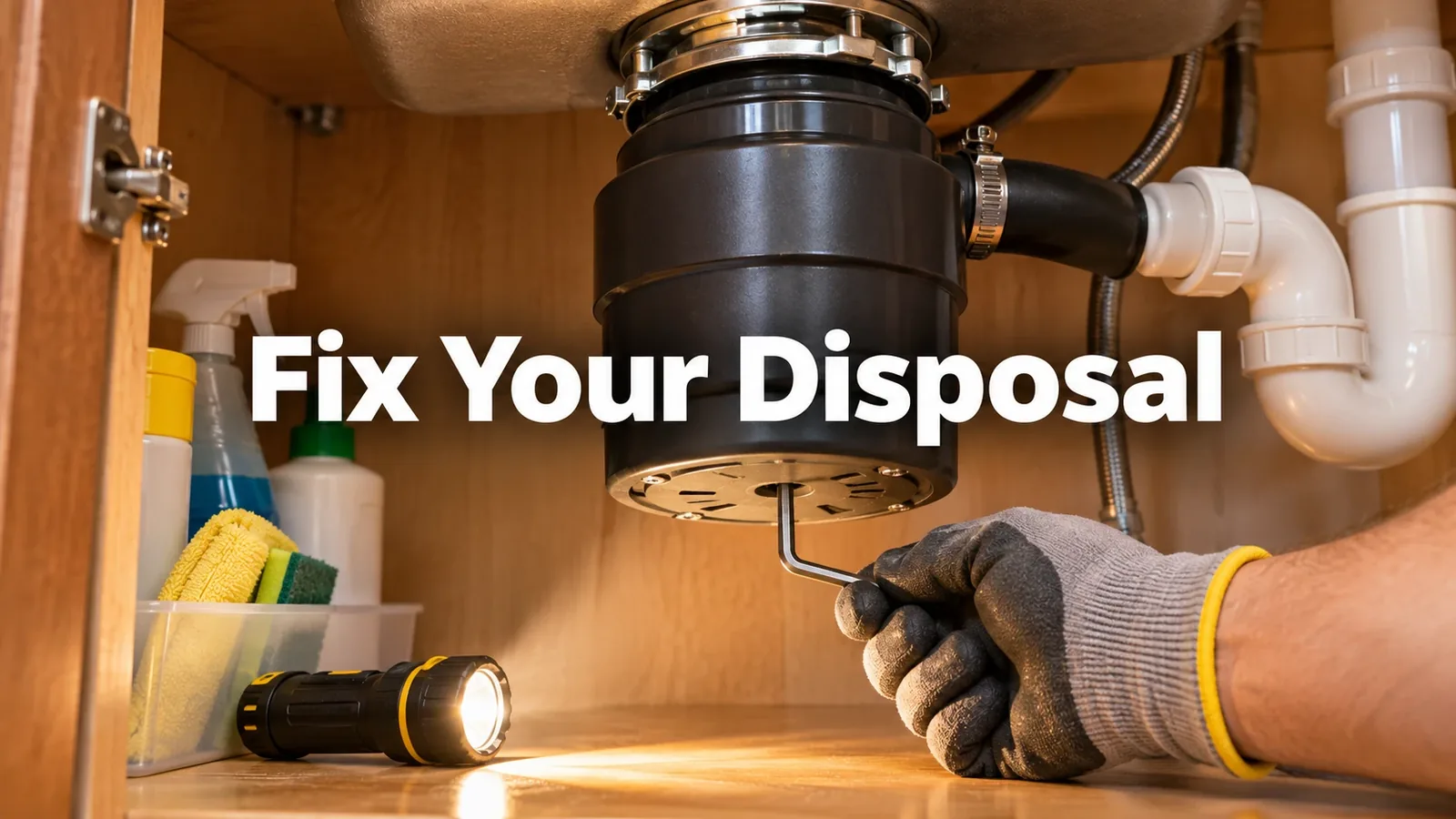
If your garbage disposal hums but doesn’t spin, it’s jammed: cut the power, insert a 1/4-inch hex key (Allen wrench) into the socket on the bottom of the unit and work it back and forth to free the grinding plate, then press the red reset button. If it makes no sound at all, press the reset button first, then check the wall switch, the circuit breaker and any GFCI outlet under the sink. Those two fixes solve most disposal problems in about 15 minutes, without a plumber.
Leaks and slow drains take a little more diagnosis, and some problems mean the unit is finished. A typical disposal lasts around 10 years, and a basic replacement runs roughly $200 to $625 installed. Below is how to troubleshoot each symptom, safely, and how to decide between repair and replacement.
Safety first
Never put your hand inside a disposal, even with the switch off. Someone can flip the switch by accident, and the plate can lurch when a jam clears. Before working on it, turn off the wall switch and unplug the unit under the sink, or switch off its circuit breaker if it’s hardwired. Use tongs or pliers to pull objects out, and a flashlight to see inside.
Don’t pour chemical drain cleaner into a disposal. It can damage seals and plastic parts, and if you later have to take the drain apart, you’ll be handling caustic water.
Troubleshooting by symptom
| Symptom | Most likely cause | DIY fix | When to replace or call a pro |
|---|---|---|---|
| Hums but won’t spin | Something wedged between the plate and grind ring | Free it with a hex key, remove the object, reset | Still hums after clearing: motor or capacitor failing |
| No sound at all | Tripped reset button, breaker or GFCI; bad switch | Press reset, check breaker, GFCI and plug | Has power but stays dead: motor failed |
| Runs, then stops | Overheating trips the thermal reset | Let it cool 10 minutes, feed food slowly with more water | Trips often with light loads: worn motor |
| Sink drains slowly | Clog in the drain trap or pipe below | Clean the P-trap; use a sink auger | Clog is deeper in the wall line |
| Leaks from top | Loose mounting ring or failed plumber’s putty | Tighten the mount; reset with fresh putty | Cracked sink flange |
| Leaks from side | Loose dishwasher hose or drain pipe connection | Tighten clamp or replace gasket | Rarely needs a pro |
| Leaks from bottom | Internal seal failure | None practical | Replace the unit |
| Bad smell | Food buildup on the baffle and grind chamber | Scrub the rubber baffle; grind ice and citrus peel | Smell persists: check for a partial clog |
How to fix a jammed disposal that hums
A humming disposal is getting power, but the motor can’t turn the plate. Leaving it on can burn out the motor, so turn it off right away.
- Turn off the wall switch and unplug the disposal or shut off its breaker.
- Look inside with a flashlight. Pull out any visible object (a bottle cap, fruit pit, bone or silverware) with tongs or needle-nose pliers.
- Find the hex socket in the center of the bottom of the unit. Most disposals take a 1/4-inch hex key, and many come with a small wrench for this.
- Insert the key and turn it back and forth until it rotates a full circle freely. That frees the grinding plate.
- If your disposal has no bottom socket, push a broom handle into the chamber and use it to turn the plate gently.
- Remove any loosened debris from the chamber with tongs.
- Wait a few minutes for the motor to cool, then press the red reset button on the bottom until it clicks.
- Restore power, run cold water, and switch it on.
Example: Nina’s disposal hummed after she scraped a plate with an olive pit on it. She cut the power, found the pit wedged against the grind ring, pulled it out with pliers, turned the hex key until it spun freely, and pressed reset. Total time: 10 minutes, cost: $0.
If the disposal won’t turn on at all
Silence usually means no power, not a broken motor. Work through it in this order:
- Press the reset button on the bottom of the unit. It pops out when the motor overheats and is the most common cause.
- Check that the disposal is plugged in under the sink, and that the outlet isn’t a switched outlet controlled by a different switch.
- Look for a GFCI outlet under the sink or on the countertop nearby, and press its reset button.
- Check the breaker panel for a tripped breaker, then reset it once. If it trips again, stop and call an electrician.
- If the wall switch feels loose or crackles, the switch itself may have failed. Replacing a switch is a basic electrical job, but turn off the breaker first.
If the unit has power at the outlet (test with a lamp) and the reset button won’t stay in, the motor has likely failed and replacement is the realistic fix.
Fixing slow drains and clogs
A disposal that runs but leaves standing water in the sink usually has a clog in the P-trap under the sink, not inside the unit. Put a bucket under the trap, unscrew the two slip nuts, remove the U-shaped section, and clean it out. If that doesn’t clear it, run a small hand auger (about $15 to $30) into the drain line through the opening.
Avoid a plunger if a dishwasher drains into the disposal, since plunging can push water back into the dishwasher. If you do plunge, clamp the dishwasher drain hose first.
Clogs often follow big cooking days. Grease, fibrous peels, starches and eggshells cause most of them.
What not to put in a garbage disposal
- Fats, oils and grease, which coat pipes and harden as they cool. Wipe pans with a paper towel first.
- Potato peels and pasta or rice, which turn into a sticky paste.
- Fibrous foods like celery, corn husks, onion skins and artichokes, which wrap around the plate.
- Coffee grounds and eggshells, which build up as sediment in the trap.
- Bones, fruit pits and shells, which jam the plate.
- Anything that isn’t food, including twist ties, paper towels and produce stickers.
Run cold water before, during and for about 15 seconds after grinding, and feed food in gradually. Compost or trash the rest. Composting also helps: food is the single largest category of material sent to municipal landfills, according to the EPA.
Repair or replace?
A jam, clog, reset or loose connection is worth fixing at any age. A failed motor, a bottom leak or a unit that trips constantly usually means replacement, especially if it’s more than about eight years old. Motors and internal seals aren’t practical to repair on most residential models.
Replacement disposals range from about $65 for a basic 1/3-horsepower unit to $500 or more for a 1-horsepower model, with stainless steel units higher still. A 1/2 or 3/4 horsepower unit suits most households. Plumber labor for a straight swap is often one hour or less, roughly $100 to $250 in many areas. Matching the same brand’s mounting system can make a DIY swap much easier.
Example: Carlos’s 11-year-old disposal started leaking from the bottom. He priced a 3/4-horsepower replacement at $180 and a plumber’s install at $175, for $355 total. Because the new unit uses the same mount, he installed it himself in about 90 minutes and spent only the $180 plus $6 for plumber’s putty.
Common questions
Where is the reset button on a garbage disposal?
It’s a small red or black button on the bottom of the unit, usually near the hex socket. Press it firmly until it clicks and stays in.
Why does my disposal hum but not work?
Something is jamming the grinding plate, or the motor is failing. Free the plate with a hex key and remove the obstruction; if it still hums afterward, the motor or starting capacitor is likely worn out.
Can I use drain cleaner in a garbage disposal?
It’s best to avoid chemical drain cleaners because they can damage the unit’s seals and plastic parts. Clean the P-trap or use a hand auger instead.
How long does a garbage disposal last?
Around 10 years with normal use and good habits. Grinding hard items, grease and fibrous food shortens that.
Is it worth repairing a garbage disposal?
Yes for jams, resets, clogs and loose connections. No for motor failure or leaks from the bottom of the housing, where replacement costs about the same as a repair and lasts longer.
Before you call a plumber
- Press the reset button and check the breaker, GFCI and plug.
- Free a humming unit with a 1/4-inch hex key, with the power off.
- Clean the P-trap if the sink drains slowly.
- Find exactly where a leak starts: top, side or bottom.
- Note the unit’s age and horsepower so you can price a replacement.
Editorial note: This article is general information. Prices were checked as of November 2026 and vary by region and model; follow your disposal manufacturer’s instructions, and call a licensed plumber or electrician for wiring or drain line work.