Gum disease treatment usually starts with a deep cleaning (scaling and root planing), which costs about $200 to $400 per quadrant, or roughly $800 to $1,600 for the whole mouth. After that, most patients move to periodontal maintenance visits every three or four months at about $150 to $300 each. Advanced cases that need surgery cost far more: around $1,500 to $3,000 or more per quadrant, and close to $7,900 on average for full-mouth surgery.
Gum disease is common. According to national survey data reported by the National Institute of Dental and Craniofacial Research, about 42% of U.S. adults 30 and older have periodontitis, and 7.8% have the severe form. The stage your dentist finds largely decides which treatments you need and what you will spend, so this guide walks through the stages first, then the price of each treatment, how insurance usually handles it, and the daily habits that lower the odds of needing the expensive options.
Gum disease stages in plain terms
Dentists separate gingivitis (inflamed gums with no bone loss) from periodontitis (infection that has destroyed some of the tissue and bone holding the teeth). Since 2018 the American Academy of Periodontology and the European Federation of Periodontology have graded periodontitis in four stages:
- Gingivitis: red, puffy gums that bleed when you brush. No attachment or bone loss, and it is reversible with better cleaning at home and a professional cleaning.
- Stage I (initial periodontitis): early loss of attachment, with pockets generally up to about 4 mm.
- Stage II (moderate): more attachment and bone loss, pockets up to about 5 mm.
- Stage III (severe): deeper pockets of 6 mm or more, bone loss reaching the middle of the root, and possibly some teeth already lost.
- Stage IV (advanced): similar damage plus problems chewing, drifting or loose teeth, and more tooth loss.
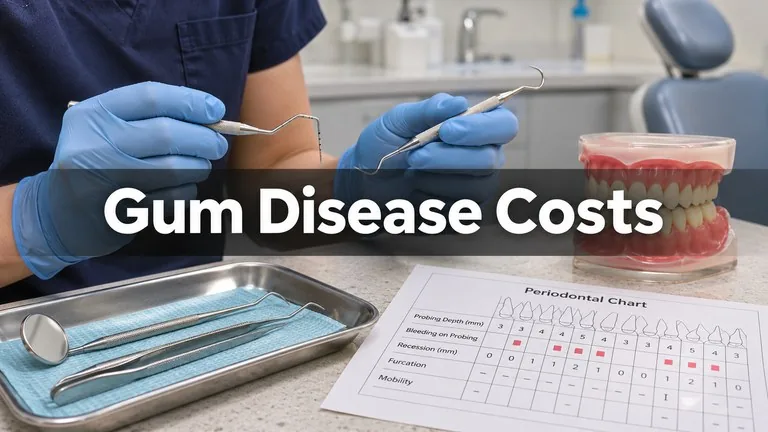
Your dentist or hygienist finds the stage by measuring pocket depth around each tooth with a small probe and comparing bone levels on X-rays. Healthy gum pockets are usually 1 to 3 mm. Ask for your numbers; they show whether treatment is working.
Gum disease treatment cost by procedure
The averages below are from the Synchrony/CareCredit cost study (2024 data) and Pearl’s ADA fee survey based ranges updated in May 2026.
| Treatment | Usually used for | Average cost | Typical range |
|---|---|---|---|
| Scaling and root planing, per quadrant | Stage I to III | $242 | $200 to $400 |
| Scaling and root planing, full mouth | Stage I to III | About $970 | $800 to $1,600 |
| Local antibiotic placed in a pocket | Stubborn sites after SRP | Not tracked | $50 to $100 per site |
| Periodontal maintenance, per visit | After SRP, ongoing | $167 | $150 to $300 |
| Pocket reduction (osseous) surgery, per quadrant | Stage III and IV | Not tracked | $1,500 to $3,000+ |
| Full-mouth periodontal surgery | Stage III and IV | $7,889 | Varies widely |
| Gum tissue graft | Recession | $2,742 per procedure | $1,000 to $2,500 per site |
The full-mouth deep cleaning figure of about $970 is four quadrants at the $242 average. Many patients are not charged for all four; if only a few teeth have deep pockets, the dentist may bill a “1 to 3 teeth” version of the procedure for that quadrant at a lower fee.
What a deep cleaning involves
Scaling removes hardened tartar and bacteria from above and below the gumline. Root planing smooths the root surfaces so the gum can reattach more tightly. Because work goes below the gumline, the area is numbed. Many offices treat two quadrants per visit, a week or so apart.
- Charting: the hygienist measures and records pocket depths and bleeding points around every tooth.
- X-rays: bitewings or a full set confirm how much bone has been lost.
- Numbing: local anesthetic is given for the quadrants being treated.
- Scaling and root planing: ultrasonic and hand instruments clean each root surface.
- Optional local antibiotic: placed in pockets that stay deep.
- Re-evaluation: about four to eight weeks later the pockets are measured again to see how much they shrank.
- Next step decided: periodontal maintenance if pockets improved enough, or a referral to a periodontist if deep pockets remain.
Gums are often tender for a few days afterward, and teeth can be sensitive to cold for a couple of weeks. Pockets of 4 to 5 mm often respond well. Pockets of 6 mm or more are harder to clean without surgery.
Periodontal maintenance: the ongoing cost
Once you have had periodontitis, routine six-month cleanings are usually replaced by periodontal maintenance every three or four months. These visits clean deeper than a regular cleaning and re-check pocket depths. They are the part of the budget people most often forget.
Example: Rachel, 48, is diagnosed with Stage II periodontitis. Her four-quadrant deep cleaning costs $968 (4 × $242). She then goes on a three-month maintenance schedule at $167 per visit, or $668 a year. Over five years her total is about $968 + $3,340 = $4,308, before any insurance. If she had kept two regular cleanings a year instead, she would have spent far less, but her dentist’s measurements showed her pockets needed the shorter interval.
Insurance often treats maintenance differently from a regular cleaning. Some plans pay it under preventive benefits, some under basic benefits (often 80%), and many limit the number of cleanings of any type to two per year. Check how your plan counts them before you schedule four visits.
When surgery is on the table
Periodontal surgery is generally considered when deep pockets remain after scaling and root planing, or when bone loss is advanced. The most common types are flap or pocket reduction surgery (the gum is folded back, roots cleaned, bone reshaped, and the gum sutured tighter), regenerative procedures that use bone grafts or membranes to rebuild support, and gum grafts to cover exposed roots.
A periodontist (a dentist with additional specialty training in gums and implants) usually does this work. Insurance commonly places periodontal surgery under major services, often at 50%, and the annual maximum can cap what it pays.
Example: Tom, 61, a former smoker, has Stage III periodontitis. After deep cleaning, two quadrants still have 7 mm pockets. His periodontist quotes $2,400 per quadrant for pocket reduction surgery, $4,800 total. His plan pays 50% of major services with a $1,500 annual maximum. The plan’s share would be $2,400, but it caps at $1,500, so Tom owes $3,300. Scheduling one quadrant this year and one next January would let two years of benefits apply, leaving him about $2,400 out of pocket, if his periodontist agrees the delay is safe.
Prevention that lowers the bill
Daily plaque removal and regular professional cleanings are what keep gingivitis from becoming periodontitis. General habits recommended by dental organizations include:
- Brushing twice a day with fluoride toothpaste, angling the bristles toward the gumline.
- Cleaning between teeth daily with floss, interdental brushes or a water flosser.
- Not smoking. In the NIDCR data, 62% of current smokers 30 and older had periodontitis, compared with 34% of nonsmokers.
- Keeping diabetes well controlled, since poorly controlled blood sugar is linked with more severe gum disease.
- Booking a visit if gums bleed regularly, recede, or teeth feel loose, rather than waiting for pain, which often comes late.
Caught at the gingivitis stage, the cost is often just a professional cleaning and better home care. Caught at Stage III, it can be thousands of dollars plus a lifetime of maintenance visits.
Common questions
Is a deep cleaning really necessary, or is it an upsell?
Insurers generally expect pockets of 4 mm or more with bone loss on X-rays before they pay for scaling and root planing. Asking for your pocket chart and X-rays is a fair way to check. If you are unsure, a second opinion from another dentist or a periodontist usually costs only an exam fee.
Does insurance cover gum disease treatment?
Most dental PPO plans cover scaling and root planing, often at 80% under basic services, and periodontal surgery at a lower rate, often 50%. Frequency limits (such as once per quadrant every 24 months) and annual maximums apply, so request a pre-treatment estimate.
Can gum disease be reversed?
Gingivitis can be reversed with professional cleaning and good home care. Periodontitis can be controlled, and pockets can shrink after treatment, but lost bone does not usually grow back without regenerative surgery.
How often will I need periodontal maintenance?
Every three months is the most common starting interval after a deep cleaning. Some patients with stable pockets later move to every four months or alternate between their general dentist and periodontist.
Is laser gum treatment cheaper?
Not usually. Laser-assisted procedures are often priced similar to or above traditional surgery, and insurance may pay them at the same rate as standard surgical codes. Ask the office for the specific procedure code and fee.
Before you schedule treatment
- Ask for your pocket depth chart and X-rays, and which stage your dentist assigned.
- Get a coded written plan showing how many quadrants and teeth are included.
- Submit a pre-treatment estimate and check how your plan counts maintenance visits.
- Budget for the deep cleaning plus three or four maintenance visits a year.
- If surgery is recommended, ask whether staging it across two plan years is reasonable.
For background on the condition, the National Institute of Dental and Craniofacial Research has a plain-language overview.
Editorial note: This article is general information, not dental or medical advice. Costs were checked as of November 2026 using published national survey data and vary by location and provider; confirm your diagnosis, treatment plan and fees with your dentist or periodontist.