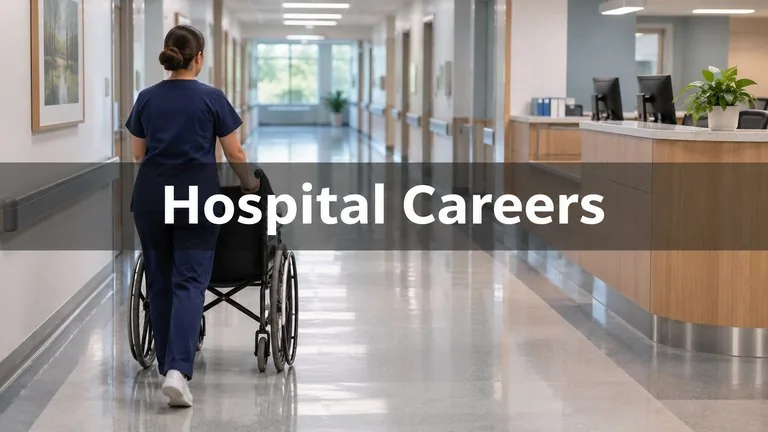
Hospitals hire many people without a college degree, and four of the most common entry points are patient transporter, sterile processing technician, phlebotomist and unit secretary (also called health unit coordinator). Patient transport usually needs only a high school diploma and on-the-job training, and BLS puts the median pay for orderlies, the category that includes transporters, at $38,290 a year. Sterile processing and phlebotomy need a short training program or certification and pay more: BLS medians of $47,700 and $45,230 a year, respectively, in May 2025.
These jobs are steady, come with hospital benefits in most cases, and give you a view of clinical careers before you spend money on school. Many hospitals also offer tuition help to employees, so a transporter job can become the way you pay for a nursing or imaging program later. Below is what each role involves, how long training takes, what it costs to get certified, and how hospital hiring works.
Hospital jobs you can get without a degree
Pay below is the BLS national median from the May 2025 wage survey. Hospital pay is often a bit higher than the overall median in large metro areas, and night, evening and weekend shifts usually add a differential.
| Role | BLS median pay (May 2025) | Training before hire | Certification |
|---|---|---|---|
| Patient transporter (orderly) | $38,290 a year (hospitals: $38,370) | High school diploma; on-the-job training of a few weeks | No license; CPR or BLS card often required |
| Sterile processing technician (medical equipment preparer) | $22.93 an hour ($47,700 a year) | Often a certificate course of a few months, or a trainee role | CRCST or CBSPD certification, required by some states and many hospitals |
| Phlebotomist | $21.75 an hour ($45,230 a year) | Certificate program, usually under one year | National certification preferred; state license in CA, LA, NV and WA |
| Unit secretary or health unit coordinator (medical secretary category) | $22.08 an hour ($45,930 a year) | High school diploma; medical terminology course helps | Optional; some hospitals prefer a health unit coordinator certificate |
Other hospital jobs that hire without a degree include environmental services (housekeeping), dietary aide, patient access or registration, emergency room technician (often requires EMT certification), monitor technician and certified nursing assistant. Pay and requirements for those vary widely by hospital.
Patient transporter
Transporters move patients by wheelchair or stretcher between rooms, imaging, surgery and discharge, and they often deliver specimens, equipment and paperwork too. You will walk most of the shift and help patients move safely, so the job is physical. BLS describes orderlies as needing a high school diploma and a short period of on-the-job training, with no license required, though most hospitals ask for a CPR or Basic Life Support card.
The job is one of the easiest ways into a hospital, and because transporters work with every department, it is a good way to see which clinical field interests you. BLS projects employment for orderlies to grow about 4 percent from 2025 to 2035.
Sterile processing technician
Sterile processing technicians clean, inspect, package and sterilize the surgical instruments and equipment that every operating room depends on. The work happens behind the scenes in a dedicated department with decontamination, assembly and sterilization areas. You need attention to detail and a strong stomach for handling used instruments while wearing protective gear.
The most common credential is the Certified Registered Central Service Technician (CRCST) from the Healthcare Sterile Processing Association. Its current requirements are:
- 400 hours of hands-on experience in a sterile processing department, paid or volunteer, including 120 hours each in decontamination, preparation and packaging, and sterilization, plus 24 hours in storage and distribution and 16 in quality assurance.
- A computer-based exam with 150 multiple-choice questions and a three-hour time limit.
- An exam fee of $140 per attempt.
- If you pass before finishing your hours, you hold provisional certification and have six months to complete and submit the 400 hours.
The 400-hour requirement is the catch for newcomers, which is why many people either take a course that includes a clinical externship or apply for trainee roles at hospitals that let them earn the hours on the job.
Example: Keisha works as a hospital dietary aide and sees a sterile processing trainee posting. She takes the CRCST exam after a self-study course, passes with provisional status, and gets hired as a trainee. Working 36 hours a week in the department, she reaches 400 hours in about 11 weeks, well inside the six-month window, and her pay steps up once her full certification is approved.
Phlebotomist
Phlebotomists draw blood for tests, transfusions and donations, label samples, and keep patients calm. Hospitals employ about 36 percent of phlebotomists, and medical and diagnostic labs employ another 33 percent, according to BLS. Hospital phlebotomists often start early in the morning, drawing blood on inpatient floors before doctors’ rounds.
Most people complete a phlebotomy certificate program at a community college or technical school, usually in less than a year. California, Louisiana, Nevada and Washington require a state license or certification. Elsewhere, employers often prefer a national certification. The National Healthcareer Association’s Certified Phlebotomy Technician exam, for example, requires a high school diploma or GED plus either a completed training program in the last five years or one year of supervised work experience, and documented proof of at least 30 venipunctures and 10 capillary sticks on live people. The exam takes two hours.
BLS projects phlebotomist jobs to grow 7 percent from 2025 to 2035, much faster than average, with about 18,000 openings a year.
Unit secretary or health unit coordinator
The unit secretary is the front desk of a nursing unit. You answer phones and call lights, enter or route orders, manage charts and admissions paperwork, schedule tests and transport, and keep track of where everyone is. Strong typing, comfort with electronic health records and a calm manner during busy shift changes matter more than a degree.
A medical terminology class (often a single community college course) makes your application stronger. BLS groups these workers with medical secretaries and administrative assistants, whose median pay was $22.08 an hour in 2025. The job is a common stepping stone to patient access supervisor, clinic coordinator or, with more school, nursing.
How hospital hiring works
Hospital hiring takes longer than retail or restaurant hiring, commonly a few weeks from offer to first shift. Expect these steps:
- Apply on the hospital system’s careers site. Large systems post entry-level roles there first, sometimes with “trainee” or “no experience” in the title.
- Complete a phone screen with a recruiter, then an interview with the department manager.
- Accept a conditional offer that depends on the next steps.
- Pass a background check and drug screen.
- Complete an occupational health visit: a TB test, proof of vaccinations or titers (often including measles, hepatitis B and a seasonal flu shot), and sometimes a physical ability test for transport roles.
- Get or renew your BLS or CPR card if the role requires it.
- Attend hospital orientation, then department training with a preceptor.
Example: Luis applies for a patient transporter job at a regional hospital, interviews a week later, and receives a conditional offer. His background check and occupational health visit take another 12 days because he has to track down his childhood vaccination records. He starts general orientation the following Monday, about four weeks after applying. Knowing that timeline, he keeps his current job until his start date is confirmed in writing.
Moving up from an entry-level hospital job
Many hospitals offer tuition assistance, internal-only job postings and paid training programs to employees. Common paths include transporter to radiology aide or surgical technologist, phlebotomist to medical laboratory technician, sterile processing technician to lead technician or operating room support, and unit secretary to nursing. Ask about tuition help during your interview; the amount, waiting period and any work commitment after graduation vary by employer.
Common questions
What is the easiest hospital job to get without experience?
Patient transporter, environmental services and dietary aide jobs usually need only a high school diploma and on-the-job training. Hospitals hire for these roles year-round. A CPR or BLS card and open weekend availability make an application stronger.
Which hospital job without a degree pays the most?
Among the four roles here, sterile processing technicians had the highest BLS median in May 2025 at $47,700 a year, followed by medical secretaries at $45,930 and phlebotomists at $45,230. Experienced and certified workers on night shifts can earn noticeably more.
Can I become a phlebotomist without going to school?
In some states, yes, because a few employers train high school graduates on the job and national exams allow a work-experience route. In California, Louisiana, Nevada and Washington you need a state license or certification, which requires approved training.
How long does it take to get CRCST certified?
It depends on how fast you can complete 400 hands-on hours. A full-time trainee can reach that in about 10 to 12 weeks. You can take the exam first and finish the hours within six months under provisional certification.
Before you apply
- Pick one role and check the hospital’s posting for required certifications.
- Get a BLS or CPR card from an approved provider.
- Gather vaccination records now to avoid onboarding delays.
- Check whether your state licenses phlebotomists or sterile processing technicians.
- Ask about shift differentials and tuition assistance during the interview.
- Review duties and pay on the BLS phlebotomist page and related healthcare support pages.
Editorial note: This article is general information. Pay figures are BLS May 2025 medians and certification details were checked as of November 2026; confirm current requirements with the hospital, your state health department and the certifying body, such as HSPA or the National Healthcareer Association.