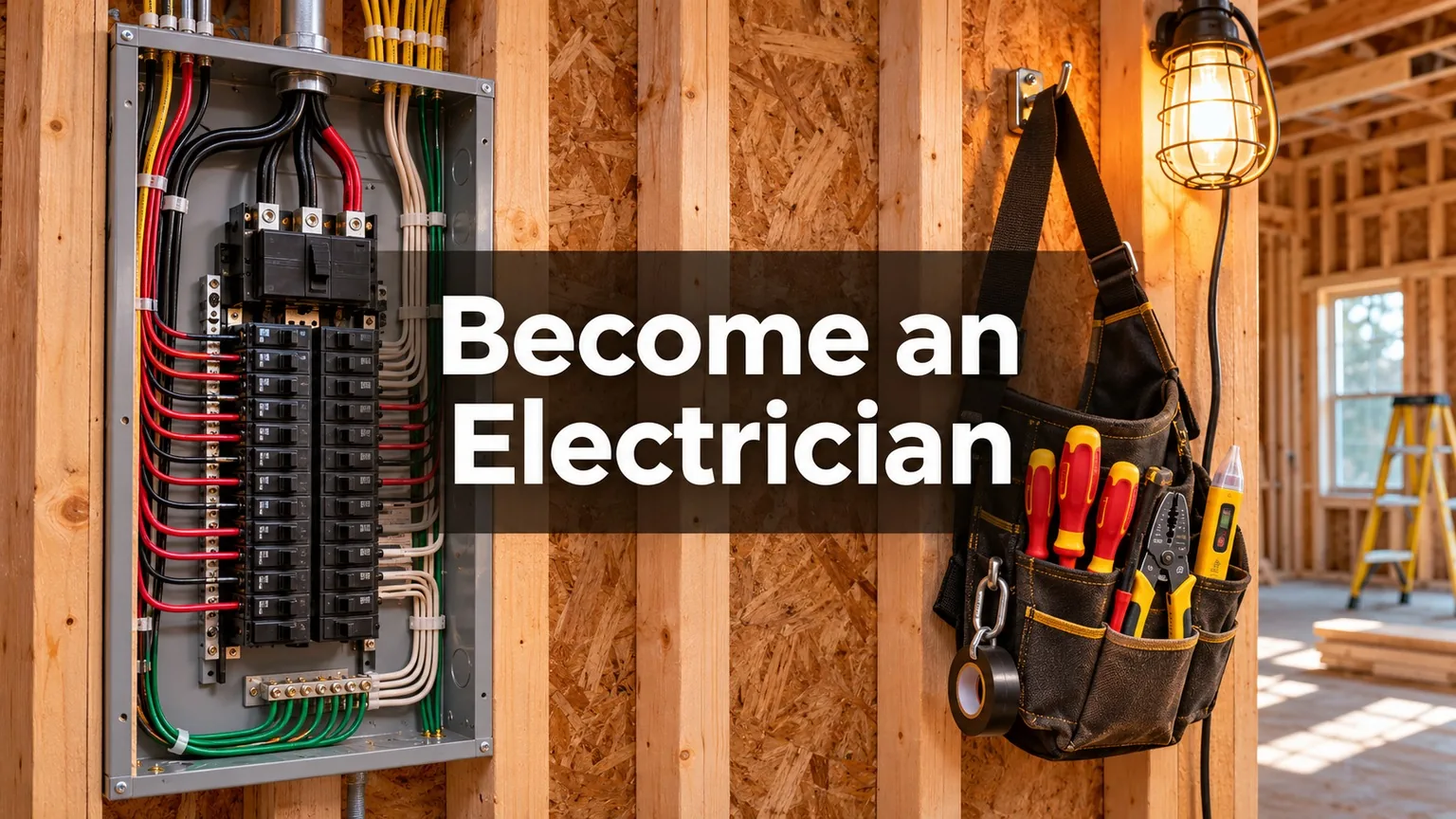
To become an electrician in the US, most people complete a paid apprenticeship of four to five years, which combines about 2,000 hours a year of on-the-job training with classroom instruction, and then pass a state or local licensing exam to work as a journeyman. You need to be at least 18 with a high school diploma or GED in most programs, and solid algebra helps. Trade school can shorten or strengthen the start, but it does not replace the required work hours in most states.
The pay is solid. The Bureau of Labor Statistics puts the median electrician wage at $63,190 a year, or $30.38 an hour, as of May 2025, with the top 10% earning more than $108,510. BLS projects 9% job growth from 2025 to 2035, much faster than average, with about 72,700 openings a year. Here is how each path works, what it costs, and what to expect while you train.
What electricians do and where they work
Electricians install, maintain and repair wiring, panels, lighting, outlets and control systems. Most specialize over time:
- Residential work covers new homes, remodels, service upgrades and repairs. More direct contact with homeowners.
- Commercial electricians wire offices, stores, schools and hospitals, often working in conduit and on larger crews.
- Industrial electricians maintain motors, controls and high-voltage equipment in plants and utilities.
- Specialty paths include solar installation, low-voltage and fire alarm systems, EV charger installation and electrical inspection.
The work is physical. Expect ladders, crawl spaces, attics, outdoor jobs in heat and cold, and the steady risk of shocks and falls, which is why training stresses safety and code from day one. Full-time schedules are typical, and overtime is common on construction deadlines and for service calls.
The main paths into the trade
| Path | Length | Cost to you | Paid while learning? | Best for |
|---|---|---|---|---|
| Union apprenticeship (joint labor and contractor program) | 4 to 5 years | Low; often books and modest fees | Yes, with raises on a set scale and benefits | People who want structured training, benefits and a pension |
| Non-union apprenticeship (contractor association programs) | 4 years typical | Low to moderate tuition, sometimes paid by employer | Yes | Areas with fewer union jobs, or people who want more flexibility in employers |
| Trade school or community college certificate | 9 months to 2 years | Roughly a few thousand to $20,000 or more | No, unless you work part time | People who need basics first, or want an associate degree |
| Hired as a helper, then registered apprentice | Varies | Little to none | Yes | Getting started fast where contractors are hiring |
Registered apprenticeship programs can be found through the Department of Labor’s Apprenticeship.gov finder. Many states require apprentices to register with the state licensing board before their hours count toward a license, so check that first, even if you start as a helper.
Steps to become a licensed electrician
- Finish high school or a GED, with at least one year of algebra. Physics, shop and drafting classes help on entrance tests.
- Look up your state’s licensing rules. Requirements vary a lot, and a few states license at the city or county level instead.
- Apply to apprenticeship programs. Many open applications once or twice a year and require an aptitude test (often algebra and reading comprehension), an interview, a valid driver’s license and a drug screen.
- Register as an apprentice or electrician trainee with your state, if required.
- Complete the training hours, commonly about 8,000 hours on the job over four years plus classroom hours each year on the National Electrical Code, theory, blueprints and safety.
- Pass the journeyman exam. It covers the NEC, state amendments and electrical theory, usually open book with a time limit.
- Keep the license current with continuing education, often a set number of code hours every renewal cycle.
- Optionally, after several more years as a journeyman, take the master electrician or contractor exam to pull permits, run jobs or own a business.
What apprentices earn
Apprentices are paid from the first day. Starting pay is usually a percentage of the local journeyman wage, often around 40% to 50%, with raises every six months or year as you complete hours and classes. By the final year many apprentices earn 80% to 90% of the journeyman rate.
Example: Tyler joins an apprenticeship where the local journeyman wage is $40 an hour. His first-year rate is 45%, or $18 an hour, about $37,400 a year at 40 hours a week. Raises bring him to 60% ($24) in year two, 70% ($28) in year three and 80% ($32) in year four. Over the four years he earns roughly $212,000 before overtime, while his classroom tuition is a few hundred dollars a year. A friend who chose a $16,000 trade school program first earns nothing during nine months of school, then still needs to log on-the-job hours as an apprentice, although some states give partial credit for the coursework.
After licensing, pay depends heavily on region, specialty and union status. BLS lists median pay of $79,820 for electricians working for government and $74,550 in manufacturing, compared with $61,570 at electrical contractors. Overtime, travel work and on-call service can add meaningfully to the base.
Costs to plan for
Even on a paid apprenticeship, budget for:
- Hand tools, often $300 to $800 to start, adding more over time. Many contractors provide power tools and testers.
- Work boots, safety glasses and hearing protection.
- Textbooks and code books, especially the current National Electrical Code edition.
- Apprentice registration and exam fees, commonly in the range of $50 to a few hundred dollars depending on the state.
- Reliable transportation, because job sites change and start early.
Some states and workforce boards help pay for pre-apprenticeship classes or tools, and veterans can often use GI Bill benefits for approved apprenticeship programs.
How to stand out when you apply
Good apprenticeship programs can be competitive, with more applicants than slots in some cities. What helps:
- Refresh algebra before the aptitude test. Free practice tests for electrical apprenticeship exams are widely available.
- Get any construction or maintenance experience, even as a laborer or helper.
- Earn an OSHA 10-hour construction card, which costs little and shows you take safety seriously.
- Keep a clean driving record and be ready for a drug test.
- Apply to more than one program and reapply if you are not selected the first time. Rankings often reset each cycle.
Example: Monique, 27, works in retail and wants a career change. She takes an eight-week pre-apprenticeship course at her community college, paid for by her local workforce board, and earns her OSHA 10 card. She studies algebra for a month, scores well on the aptitude test, and is accepted into a non-union apprenticeship. Her first-year wage of $19 an hour is about what she made in retail, with a clear path to more than $35 an hour.
Common questions
How long does it take to become an electrician?
Most people need four to five years to reach journeyman status through an apprenticeship. Becoming a master electrician typically takes several more years of experience, depending on the state.
Can you become an electrician without an apprenticeship?
In most states you still need documented on-the-job hours under a licensed electrician before you can test for a license. Trade school can count toward some of those hours in certain states, but it rarely replaces them entirely.
How much do electricians make?
The national median was $63,190 a year in May 2025, according to BLS. The lowest 10% earned under $42,640 and the top 10% more than $108,510, with pay varying by region, specialty and union status.
Is it too late to become an electrician at 30 or 40?
No. Apprenticeships generally have a minimum age but no maximum, and many apprentices start after another career. The physical demands are real, so consider specialties like controls, low-voltage or inspection over time.
Is a license required everywhere?
Most states require a license to work as a journeyman electrician. A few leave licensing to cities or counties, and apprentices usually work under the license of a supervising electrician.
Before you start
- Look up your state electrical licensing board’s apprentice and journeyman requirements.
- Search for registered apprenticeships near you and note application windows.
- Brush up on algebra and reading for the aptitude test.
- Get an OSHA 10 card and any hands-on experience you can.
- Budget for tools, boots and transportation for the first year.
Editorial note: This article is general information. Pay and job figures come from the Bureau of Labor Statistics and were checked as of November 2026; licensing rules vary by state, so confirm requirements with your state electrical licensing board.