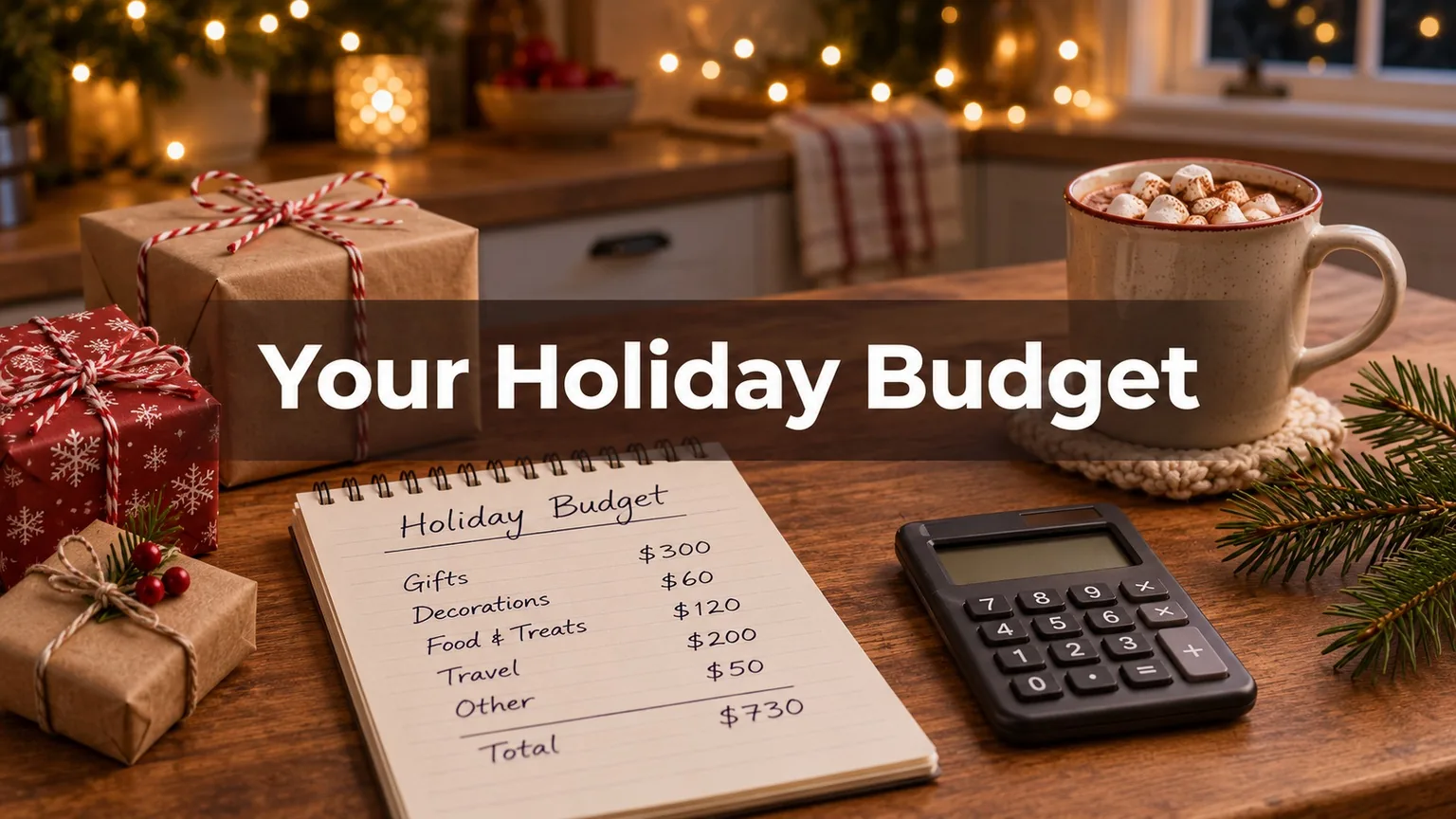
To make a holiday budget, start with one total number based on cash you actually have or can set aside before the bills arrive, not on what you spent last year. Split that total into categories (gifts, food and hosting, travel, decorations, and extras like tips and donations), then list every person you are buying for with a dollar cap next to each name. Track every purchase against the list until the season ends.
The reason to bother: a LendingTree survey after the 2024 season found that 36% of Americans took on holiday debt, averaging $1,181, and the most common answer for how long it would take to pay off was five months or more. This guide walks through how to set your number, a sample budget, the costs people forget, and the habits that keep the plan from falling apart in mid-December.
Set your total from cash, not hopes
The most common budgeting mistake is picking a number first and figuring out how to pay for it later. Work the other way around. Add up:
- Money already saved for the holidays, if any.
- What you can realistically set aside from each paycheck between now and late December after regular bills and savings.
- Any expected extra income, such as a year-end bonus, but only once it is confirmed.
That sum is your ceiling. For reference, the National Retail Federation’s 2025 survey found shoppers planned to spend about $890 per person on gifts, food, decorations and other holiday items. You do not need to match that, and plenty of households spend far less.
Example: Keisha and Andre have $250 in a holiday savings account and get paid every two weeks. Between November 7 and December 19 they have four paychecks, and after rent, bills and their regular savings they can move $150 from each into the holiday fund. That gives them $250 + $600 = $850. Their budget is $850, even though they spent about $1,100 last year, much of it on a credit card they finished paying off in April.
Divide it by category
Once you have the total, give every dollar a job. Gifts tend to grab the biggest share, but food, travel and small extras add up faster than most people expect.
| Category | Share of budget (starting point) | On an $850 budget | What it covers |
|---|---|---|---|
| Gifts | 50% to 60% | $470 | Family, friends, kids, gift exchanges, teachers |
| Food and hosting | 15% to 20% | $150 | Holiday meals, baking, party contributions, drinks |
| Travel | 0% to 25% | $80 | Gas, flights, parking, pet sitting while away |
| Decorations | 3% to 8% | $40 | Tree, lights, replacement ornaments |
| Tips and thank-yous | 3% to 8% | $50 | Childcare, mail carrier, cleaners, service workers |
| Wrapping, cards and shipping | 2% to 5% | $30 | Paper, tape, cards, stamps, shipping fees |
| Cushion | About 3% | $30 | Last-minute gifts, forgotten items |
Adjust the shares to your life. If you are flying across the country, travel might take a third of the budget, and gifts shrink to fit. If you are hosting 20 people, food goes up.
Make a gift list with a cap per person
A gift total without names attached tends to drift. Write down everyone you plan to buy for, put a dollar limit next to each name, and make sure the column adds up to your gift category.
- Group people into tiers: immediate family, extended family, friends, coworkers and teachers, and gift exchanges.
- Set a cap for each tier, for example $60 for each child, $35 for parents and siblings, $15 for friends, and $10 for teachers.
- Check the list for people you might cut or combine, such as one family gift instead of separate ones for each cousin.
- Write the actual amount spent next to each name as you shop.
Proposing a family gift exchange or a spending limit is easier in early November than in mid-December. Many relatives are relieved when someone brings it up.
Plan for the costs people forget
A budget that only covers gifts will usually be blown by everything else. Watch for:
- Shipping to out-of-town family, especially if you wait until the last week and pay for faster delivery.
- Holiday tips for regular service providers.
- Office parties, potlucks and gift swaps that each need a dish or a $20 gift.
- New clothes or outfits for events and photos.
- Higher grocery bills for several weeks when kids are home from school, on top of the big meal.
- Charitable giving and year-end donations.
- Batteries, gift receipts, extension cords and the other small purchases that slip through.
- Subscription free trials started for holiday streaming or shopping perks that renew in January.
Steps to build and run your holiday budget
- Calculate your total from savings plus what you can set aside from each paycheck before mid-December.
- Split the total into categories using the table above as a starting point.
- List every gift recipient with a per-person cap, and confirm the caps add up to the gift category.
- Choose a payment method. Paying with debit, cash or a card you pay in full each month keeps the budget honest.
- Open or label a separate account or envelope for the holiday money so it does not mix with bills.
- Track each purchase the day you make it, in a notes app, spreadsheet or budgeting app.
- Check your totals each weekend and shift money between categories only by cutting somewhere else.
- Close out the budget in early January: note what you actually spent, and use it to set next year’s savings goal.
Paying without creating January debt
How you pay matters as much as how much you spend. A credit card is fine if you pay the full balance when the statement arrives, and its purchase protections can help with returns and disputes. Problems start when the balance carries over at typical credit card rates of 20% or more.
Buy now, pay later plans split purchases into installments, often four payments over six weeks. They are easy to stack, and several small plans across different apps can add up to a big chunk of a January paycheck. If you use them, put each payment date on your calendar and count the full purchase price against your budget on the day you buy.
Store credit cards offered at checkout with a one-day discount usually carry high interest rates. Some use deferred interest, where all the interest from the purchase date is charged if the full balance is not paid by the end of the promotion.
Example: Sam puts $1,200 of holiday spending on a card at 24% APR and pays $100 a month. It takes about 14 months to pay off and costs roughly $185 in interest. If he had saved $100 a month starting in January, he would have had the same $1,200 in December and paid nothing extra.
Ways to stretch the budget
- Shop with a list and the per-person caps, especially on big sale days. Discounts on things not on the list are not savings.
- Compare prices online before buying in store, and check return policies, which are often extended for holiday purchases.
- Use cash-back or rewards you have already earned toward gifts.
- Give experiences or time, such as a homemade dinner, babysitting or a planned outing.
- Host potluck style and ask guests to bring a dish.
- Reuse decorations and buy replacements after the holidays, when seasonal items are deeply discounted.
The NRF’s October 2026 survey found 56% of holiday shoppers expect the economy to affect their spending this year, and many plan to shop sales and compare prices more often. Those habits work best when they serve a plan you already made.
Common questions
How much should I spend on Christmas gifts?
There is no right number. A practical rule is to spend only what you can pay off with cash or by the first statement after the holidays. Many households keep total holiday spending to a small percentage of annual take-home pay, then set per-person caps that fit within that amount.
When should I start saving for the holidays?
Ideally in January, by setting aside a fixed amount each month into a separate savings account. Dividing next year’s holiday budget by 12 shows what to save monthly; $900 works out to $75 a month.
What if I already overspent?
Stop adding to the total, return unopened items you can do without, and make a payoff plan for any card balance before the first statement arrives. Focus extra payments on the highest-interest balance first.
Should I use a separate account for holiday spending?
A separate savings account or a labeled envelope makes it easy to see how much is left. Many banks let you create named savings buckets for free, which also works well for saving toward next year.
How do I tell family I am cutting back on gifts?
Be direct and do it early. Suggest an alternative, such as a name draw, a spending cap, gifts only for kids, or a shared experience. Most people appreciate the clarity and many are relieved.
Before you start shopping
- Know your total and where every dollar of it is coming from.
- Write the category amounts down.
- Finish your gift list with a cap beside each name.
- Decide how you will pay and how you will track spending.
- Add the forgotten costs: shipping, tips, events and travel.
- Set a January date to review what you spent and start next year’s fund.
Editorial note: This article is general information, not financial advice. Survey figures and rates were checked as of November 2026; for help with budgeting tools and credit card terms, see the Consumer Financial Protection Bureau or your card issuer.