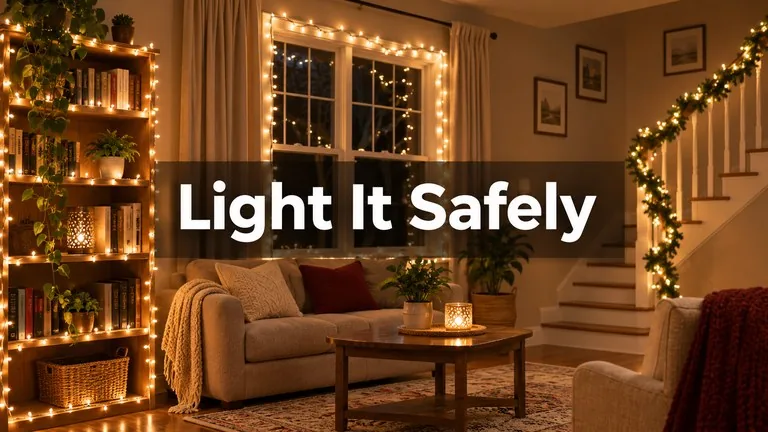
The best indoor Christmas lights ideas put light where people actually look: around windows, along the stair rail, across bookshelves and mantels, and in soft battery strings in bedrooms. For almost all of it, LED mini lights are the right choice. A 100-light LED string uses roughly 5 to 7 watts against about 40 watts for the same incandescent string, stays cool to the touch, and costs well under a dollar to run for the whole season.
The safety side is mostly about cords and labels. Use sets certified by a recognized lab (UL, Intertek or CSA), connect no more than three incandescent strings end to end, keep cords out from under rugs and doorways, and turn everything off at bedtime. Here is how to light each room, how much power you are drawing, and the cord habits that prevent problems.
LED vs incandescent for indoor lights
LED sets win on nearly every count indoors. They draw a fraction of the power, run cool enough to sit against fabric and paper decor, and you can usually connect many more of them end to end. Incandescent sets still appeal to people who want the warm, slightly golden glow of older lights, though warm white LEDs come close.
| Light type | Watts per string | Cost per string for the season | Heat | End-to-end connections |
|---|---|---|---|---|
| Incandescent mini, 100 lights | About 40 W | About $1.97 | Warm to hot bulbs | No more than 3 strings |
| LED mini, 100 lights | About 5 to 7 W | About $0.34 or less | Cool to the touch | Per the label, often many more |
| Incandescent C7, 25 bulbs | About 125 W | About $6.14 | Hot | Per the label, usually few |
| LED C7, 25 bulbs | About 5 W | About $0.25 | Cool | Per the label |
| Battery LED fairy lights | Under 1 W | Battery cost only | Cool | Not connectable |
Costs assume 6 hours a night for 45 nights at 18.2 cents per kilowatt-hour, the US Energy Information Administration’s 2026 forecast for the average residential price. Your utility’s rate may be higher or lower.
Example: Jordan runs 12 old incandescent mini strings indoors: tree, mantel and two windows. That is 480 watts, or about $23.59 for the season at 18.2 cents. Swapping to 12 LED strings at about 7 watts each cuts the load to 84 watts and the cost to about $4.13. At $8 to $12 per LED string, the new lights cost more upfront than they save in one year, so the better reasons to switch are lower heat and fewer tripped breakers.
Check the label before you buy
Every light set sold by reputable stores should carry a mark from a nationally recognized testing lab. On UL-certified decorative strings, a green holographic label means the set is for indoor use only, and a red holographic label means it is rated for both indoor and outdoor use. Indoor-only sets are fine for every idea in this article. Do not take them outside.
Also check the tag near the plug for the maximum number of sets you can connect end to end and the fuse rating. ESFI and the Consumer Product Safety Commission both say to connect no more than three incandescent strings together. LED strings usually allow more, but the number on the tag is the limit for that specific set.
Indoor Christmas lights ideas by room
Windows: outline the inside of the window frame with clear adhesive light clips, one every 12 to 24 inches, or hang a curtain light (a row of vertical strands) from a tension rod inside the frame. From outside, warm white looks cozy; from inside, a curtain light behind sheer drapes glows without glare.
Stairs: wrap lights through a garland on the stair rail, or run them along the outside of the balusters with soft twist ties. Keep the top of the handrail clear enough to grip, and put the plug end at the bottom of the stairs where you can reach it without stepping over the cord.
Living room: tuck a string along the top of a bookcase, behind books on a shelf, or around a large mirror. Lights that bounce off glass and pale walls look brighter than they are.
Kitchen: a short battery string inside a glass-front cabinet or along open shelves adds glow without a cord on the counter. Keep plug-in strings away from the sink and range.
Bedrooms: use battery-powered or USB LED fairy lights on copper wire. They stay cool and use tiny amounts of power. Drape them on a headboard, a canopy frame or a curtain rod, not inside bedding, and set them to a timer so they are not on all night.
Kids’ rooms: mount lights high, out of reach of toddlers, and avoid sets with small removable bulbs. Battery packs with screw-closed covers are safer around small children.
How to plan the power for your lights
A standard household circuit is 15 amps, which works out to 1,800 watts. For a load that runs for hours, electricians plan on using no more than 80 percent of that, about 1,440 watts. Christmas lights rarely hit that alone, but they share the circuit with lamps, a TV, a space heater or a vacuum.
- Add up the watts of every light set you plan to use in a room. The wattage is on the tag or the box.
- Find which outlets share a circuit. Plug a lamp into each outlet and switch breakers off one at a time, or check your panel labels.
- Add the other devices on that circuit. A space heater alone can draw 1,500 watts, which means it should not share a circuit with anything else.
- Keep the total under about 1,440 watts for a 15-amp circuit. If you are close, move some lights to another circuit.
- Pick an extension cord or power strip rated for at least the load you will put on it, and use a power strip with a built-in circuit breaker for clusters of decorations.
- Put the lights on a timer or smart plug so they turn off by bedtime automatically.
Example: Sam’s living room circuit already runs a TV (about 100 watts), two lamps (about 20 watts in LED bulbs) and a 1,500-watt space heater. Adding a tree with 400 watts of incandescent lights puts that circuit over 2,000 watts, and the breaker trips every evening. Moving the heater to a different circuit fixes it, and switching the tree to LED drops the lights to about 70 watts.
Cord and fire safety habits
- Inspect every set before it goes up. Throw away strings with cracked sockets, bare wire or loose connections rather than taping them.
- Never run cords under rugs or furniture legs, where they overheat and get crushed. Run them along baseboards with clear clips or a cord cover instead.
- Keep cords out of doorways and walkways. A cord taped across a hallway is a trip hazard, and doors pinch insulation.
- Use insulated clips or hooks. Nails and staples can pierce the wire.
- Keep lights and decorations at least 3 feet from space heaters, fireplaces and candles, as ESFI recommends.
- Turn lights off when you leave home or go to bed.
The CPSC reported about 14,900 emergency room visits for holiday decorating injuries from November 2022 through January 2023, and nearly half of decorating injuries involve falls. Indoors that usually means standing on a chair or the arm of a couch to reach a curtain rod. A sturdy step stool is cheaper than a sprained wrist.
Damage-free hanging on walls and windows
Most indoor light ideas can go up without a single hole. Clear adhesive light clips hold on smooth painted walls, trim and glass; press each one for 30 seconds and wait an hour before loading it. One major brand suggests one clip every 2 feet of light string. They do not hold on textured plaster, wallpaper or brick.
Other no-hole options: tension rods inside window frames, existing curtain rods, over-the-door hooks, and light strings woven through garland that rests on a shelf. Remove adhesive clips by pulling the tab slowly and straight down along the wall, which keeps the paint from lifting.
Common questions
Can indoor Christmas lights be used outside?
No. Indoor-only sets are not built to handle rain, snow or temperature swings. On UL-certified lights, a green holographic label means indoor only, and a red label means indoor and outdoor.
How many strings of lights can I connect together?
For incandescent sets, ESFI and the CPSC recommend no more than three. LED sets usually allow more, but the maximum is printed on the tag near the plug and varies by product.
Is it safe to leave Christmas lights on overnight?
Safety groups including ESFI recommend turning decorative lights off when you go to bed or leave home. A plug-in timer makes this automatic and also trims your electric bill.
Are battery fairy lights safe for a child’s bedroom?
Generally yes, because they run cool on low voltage, but mount them out of reach and choose battery packs with screw-closed covers. Button batteries in some small sets are dangerous if swallowed, so avoid those around young children.
Why do my lights keep tripping the breaker?
The circuit is overloaded, usually because lights share it with a space heater, hair dryer or vacuum. Add up the watts on that circuit, move some decorations to another one, and consider switching incandescent sets to LED.
Before you plug in
- Choose LED sets with a testing lab mark and check the indoor or outdoor label.
- Read the maximum connections on the tag and stay under it.
- Add up watts per circuit and keep 15-amp circuits under about 1,440 watts.
- Route cords along baseboards, never under rugs or across doorways.
- Use a step stool, not furniture, to reach high spots.
- Put everything on timers that shut off at bedtime.
Editorial note: This article is general information. Electricity prices and safety guidance were checked as of November 2026; your utility rate will differ, and you should follow the instructions on each light set. See the Electrical Safety Foundation International, UL Solutions and the US Energy Information Administration for current details.