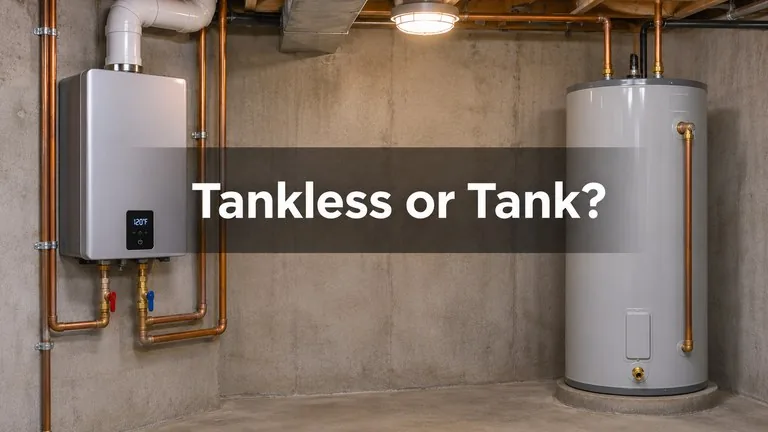
A tank water heater costs less to buy and install, usually about $600 to $2,500, and handles several showers at once without trouble. A tankless unit costs more up front, typically $1,400 to $3,900 installed and more when gas lines or venting need upgrades, but it lasts about 20 years and wastes less energy keeping water hot. For many homes with electric water heating, the best value is neither: a heat pump water heater costs about $2,000 to $5,500 installed and can cut the electric bill for hot water by roughly two-thirds.
The right choice depends on your fuel (gas or electric), how many people shower in the same hour, where the heater sits, and how long you’ll stay in the house. Below are the costs, operating differences, sizing math and a simple decision guide by household type.
Upfront cost: tank, tankless and heat pump compared
| Type | Typical installed cost | Typical lifespan | Main strength | Main drawback |
|---|---|---|---|---|
| Electric tank (40 to 50 gal) | $900 to $2,000 | About 10 to 15 years | Cheapest to install, simple | Highest operating cost of the group |
| Gas tank (40 to 50 gal) | $1,200 to $2,500 | About 10 to 15 years | Fast recovery, low gas cost | Standby heat loss, needs venting |
| Gas tankless | $1,400 to $3,900 and up with gas or vent upgrades | About 20 years | Endless hot water at rated flow, compact | Higher install cost, needs annual descaling in hard water |
| Electric tankless | Lower unit cost than gas, but may need panel or wiring upgrades | About 20 years | No venting, tiny footprint | Limited flow in cold climates, heavy electrical load |
| Heat pump (hybrid) tank | $2,000 to $5,500 | About 12 to 15 years | Lowest operating cost for electric homes | Needs space and air volume, slower recovery |
Switching from a tank to tankless almost always costs more than a like-for-like swap. NerdWallet’s figures put the extra labor for the switch at roughly $150 to $2,500. Gas tankless units often need a larger gas line (many fire at around 150,000 to 199,000 Btu/h versus about 40,000 for a gas tank), new stainless or PVC venting, and an electrical outlet for controls. Whole-house electric tankless models commonly draw 100 amps or more, which many older panels can’t spare.
Operating cost and efficiency
A tank heater keeps 40 to 80 gallons hot around the clock, losing heat through the tank walls even when no one uses water. A tankless unit heats water only as it flows. According to the US Department of Energy, that makes tankless heaters about 24% to 34% more efficient than tanks in homes using 41 gallons or less of hot water a day, and about 8% to 14% more efficient in homes using around 86 gallons a day. The savings shrink as household use grows, because a busy tank has less idle time to lose heat.
Heat pump water heaters work differently. They move heat from the surrounding air into the water, the way a refrigerator works in reverse, and the best models are rated at a uniform energy factor (UEF) above 4.0. A standard electric tank is about 0.9 to 0.95, and a top gas tankless unit is up to about 0.97. At an electric rate of $0.16 per kWh, one estimate puts a standard 50-gallon electric tank at roughly $720 to $800 a year to run and a 50-gallon heat pump model at about $215 to $255.
Example: The Garcias, a family of four with an aging 50-gallon electric tank, compare a new electric tank at $1,400 installed with a heat pump model at $3,600. At about $500 a year in lower electric bills, the extra $2,200 pays back in roughly four and a half years. If their state rebate program covers part of the heat pump unit, the payback gets shorter still.
Gas, electric or heat pump: what fits your house
- Gas tank: a solid default if you have natural gas, a large family, and an existing vent. Lowest risk and quick replacement.
- Gas tankless: good for small to midsize households with gas, limited space, and plans to stay ten years or more so the longer lifespan pays off.
- Electric tank: the cheapest to install, but the most expensive to run. It makes sense mainly for vacation homes or very low use.
- Electric tankless: works well for a single bathroom, an addition, or a small home in a warm climate where incoming water is warmer.
- Heat pump: the best match for electric homes with the heater in a garage, basement or large utility room in a climate that stays above about 40°F there. Many models fall back to slower electric resistance heating when the air is colder.
Heat pump units are taller than standard tanks, make a fan noise similar to a dehumidifier, cool and dry the room around them, and need a condensate drain. Many models list a minimum air space, so a heater in a tight closet may need louvered doors or ducting. Newer 120-volt plug-in models can replace a gas tank without a new 240-volt circuit, though they recover more slowly.
How to size a tank or tankless water heater
Tanks and tankless units are sized differently. Tanks are sized by first-hour rating (FHR), the amount of hot water a tank can deliver in one hour starting full. Tankless units are sized by flow rate in gallons per minute (GPM) at a given temperature rise. The DOE guide on sizing a new water heater walks through both.
- Pick your busiest hour of the day, usually the morning.
- For a tank, add up hot water use in that hour: about 20 gallons per shower, 7 per dishwasher load, 25 for a top-loading washer (15 for a front-loader), and 3 for hand dishwashing.
- Choose a tank with a first-hour rating at or above that total. It’s printed on the yellow EnergyGuide label.
- For tankless, list the fixtures that run at the same time and add their flow rates. A 2.5 GPM shower and a 0.75 GPM faucet need 3.25 GPM.
- Find your temperature rise: desired output (usually 120°F) minus incoming water temperature. Assume 50°F if you don’t know, which means a 70°F rise. Northern well water in winter can be colder.
- Choose a unit rated for your GPM at that rise. DOE notes a 70°F rise is commonly rated around 5 GPM for gas units and 2 GPM for electric units.
Example: Sam and Lee run two showers and the dishwasher on weekday mornings. For a tank, that’s 20 + 20 + 7 = 47 gallons, so they need an FHR of at least 47; many 40-gallon gas tanks meet that, and a 50-gallon model gives margin. For tankless, two 2.0 GPM low-flow showers plus a 1 GPM dishwasher need 5 GPM at a 70°F rise, which points to a larger gas tankless unit. A single electric tankless unit would fall short.
Lifespan and maintenance
Tank water heaters usually last about 10 to 15 years with care, less in hard-water areas where sediment builds up. Flushing a few gallons from the drain valve once a year and checking the anode rod every few years extends tank life. Tankless units last about 20 years, but hard water scales up the heat exchanger, so most manufacturers call for descaling (flushing with vinegar or a descaling solution) about once a year. Heat pump models need the air filter cleaned every few months and the condensate drain kept clear, plus the usual tank care.
Warranty length is a good clue to expected life. Compare the tank or heat exchanger warranty, and check whether it’s voided without proof of annual maintenance or professional installation.
Incentives in 2026
The federal tax credit for heat pump water heaters and efficient gas water heaters (part of the Section 25C credit) ended for equipment placed in service after December 31, 2025, so 2026 installs don’t qualify. In states that have launched Home Electrification and Appliance Rebate programs, income-qualified households can get up to $1,750 toward a heat pump water heater. Many electric utilities also offer instant or mail-in rebates on heat pump models. Check your state energy office and utility before you buy, since some programs require pre-approval or a participating contractor.
Common questions
Is a tankless water heater worth it?
It’s usually worth it if you have natural gas, a household that uses moderate amounts of hot water, and plans to stay ten years or more. For large families running several showers at once, a properly sized tank or heat pump unit often costs less over its life.
Do tankless water heaters really give endless hot water?
They supply hot water as long as demand stays within the unit’s rated flow. If you exceed it, for example three showers at once in winter, the water temperature drops. Size the unit for your peak simultaneous use and your coldest incoming water.
How long do tank and tankless water heaters last?
Tanks usually last about 10 to 15 years and tankless units about 20, with annual maintenance. Hard water shortens the life of both.
Are heat pump water heaters good in cold climates?
They work well in basements and conditioned spaces in cold regions. In an unheated garage that drops below about 40°F, they run mostly on backup electric elements, which cuts the savings.
What size water heater does a family of four need?
Many families of four do well with a tank that has a first-hour rating of about 60 to 70 gallons, or a gas tankless unit that delivers 5 to 7 GPM at a 70°F rise. Your own peak-hour count matters more than family size.
Before you buy
- Check the age and label of your current heater; anything near 10 to 12 years is worth planning for before it fails.
- Do the peak-hour math and note your incoming water temperature.
- Confirm gas line size, vent type and electrical panel capacity with the installer.
- For a heat pump model, measure the room and confirm the temperature range there.
- Look up state and utility rebates before the install date.
- Compare warranty terms and maintenance requirements, not just price.
Editorial note: This article is general information. Costs, efficiency figures and incentive status were checked as of November 2026 and vary by region and product, so confirm sizing and installation requirements with a licensed plumber and rebate rules with your utility or state energy office.