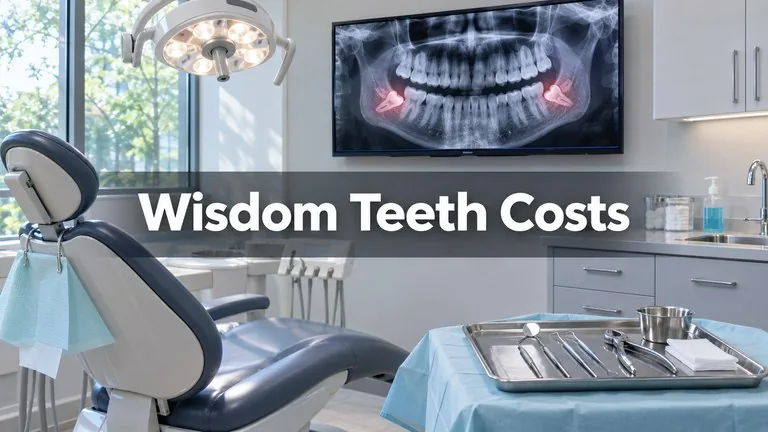
Wisdom teeth removal usually costs about $175 to $835 per tooth before sedation, depending on how deeply the tooth is stuck in the gum and bone. Taking out all four commonly totals around $1,200 to $4,200 once you add sedation or general anesthesia, X-rays and the consult. A fully erupted wisdom tooth that comes out like any other tooth sits at the low end. A lower tooth lying sideways in the jawbone sits at the high end.
The price on your treatment plan is built from a few separate line items, and each one can move the total by hundreds of dollars. The sections below break down what each impaction type costs, what sedation adds, how insurance usually handles it, and what the first two weeks of recovery look like, including how to recognize dry socket.
Wisdom teeth removal cost by impaction type
Oral surgeons and dentists bill each tooth by how hard it is to remove. The national averages below come from the Synchrony/CareCredit cost study (2024 data, which CareCredit still publishes) and include local anesthetic but not sedation.
| Type of removal (per tooth) | What it means | Average cost | Typical range |
|---|---|---|---|
| Simple extraction | Tooth fully erupted, removed with forceps | $177 | $137 to $335 |
| Surgical extraction | Gum is opened, tooth may be sectioned | $363 | $281 to $702 |
| Soft tissue impaction | Crown covered by gum only | $423 | $325 to $829 |
| Full bony impaction | Tooth encased in jawbone | $532 | $413 to $1,041 |
| Complicated bony impaction | Deep, angled, or near the nerve or sinus | $835 | $639 to $1,620 |
| IV sedation (per visit) | Awake but deeply relaxed | $349 | $273 to $675 |
| General anesthesia (per visit) | Fully asleep, monitored | $639 | $494 to $1,253 |
Pearl’s dental cost data, which is built on ADA fee survey numbers and was updated in May 2026, puts the national average for a wisdom tooth extraction at $615, with most fees between $400 and $1,055. That lines up with the middle rows above, since most wisdom teeth that need removal are at least partly impacted.
Two things are easy to miss when reading a quote. First, sedation is billed per visit (often in time increments), not per tooth, so removing all four in one appointment spreads that cost. Second, the impaction category is decided from your X-ray, so two people with “four wisdom teeth out” can get quotes $2,000 apart.
What else shows up on the bill
The extraction fee is the biggest line, but several smaller ones are common:
- Panoramic X-ray: about $200 on average. Some surgeons also order a cone-beam CT scan (around $466 on average) when a lower root sits close to the nerve.
- Consultation exam: a separate fee at many surgical offices, sometimes waived or credited if you book surgery there. Ask when you call.
- Nitrous oxide, if used instead of IV sedation: often under $150.
- Prescriptions: pain medicine and sometimes an antibiotic or a prescription rinse.
- Follow-up visit: frequently included in the surgical fee, but ask, because a dry socket visit may be billed separately.
Example: Maya, 19, has two upper teeth with soft tissue impaction and two lower teeth with full bony impaction. Using the averages above: 2 × $423 + 2 × $532 = $1,910 for the teeth, plus $349 for IV sedation and $200 for the panoramic X-ray, for an estimated $2,459 before insurance. If her surgeon recommends general anesthesia instead, the estimate rises to about $2,749.
How sedation choice changes the price
Local anesthetic numbs the area and is included in the extraction fee. It works well for one or two erupted teeth. For impacted teeth, most patients choose IV sedation or general anesthesia, which oral surgeons are trained and licensed to provide in the office.
A practical rule: if your surgeon says local anesthetic alone is reasonable for your case, that option can save $350 to $650. If you are very anxious, have a strong gag reflex, or have four deeply impacted teeth, sedation tends to make the visit shorter and easier, and many surgeons will only do complicated impactions that way. You will need an adult to drive you home after IV sedation or general anesthesia, and you should not eat for a set number of hours beforehand (your surgeon will give the exact window).
Does insurance cover wisdom teeth removal?
Most dental plans cover extractions, including impacted wisdom teeth, when removal is needed rather than purely preventive. Many PPO plans pay 50% to 80% of oral surgery after the deductible, but the annual maximum is often $1,000 to $2,000, and four impacted teeth can use up most of it in one day.
Sedation is the line most likely to be denied. Some plans pay for IV sedation or general anesthesia only for bony impactions, or only when several teeth are removed. Medical insurance occasionally picks up part of the cost, for example when the removal is tied to a cyst, an infection that spread, or a hospital procedure, but it is not the norm.
Example: Jordan’s plan pays 80% of oral surgery after a $50 deductible and has a $1,500 annual maximum, but excludes IV sedation. His estimate is $2,300 for four teeth plus $350 for sedation. The plan would owe 80% of $2,250 ($1,800), but the cap limits it to $1,500. Jordan pays $800 for the teeth plus the full $350 for sedation, or $1,150. If his surgeon agrees it is safe to wait, splitting the upper and lower teeth across two plan years could bring his share down, though it means two recoveries and paying for sedation twice.
How to get an accurate quote
- Get a panoramic X-ray first, either from your general dentist or the surgeon. The impaction type on each tooth drives the price.
- Ask for a written treatment plan that lists each tooth with its CDT code (D7140 for simple, D7210 for surgical, D7220 for soft tissue, D7230 for partial bony, D7240 for full bony) plus the sedation code.
- Send that plan to your insurer as a pre-treatment estimate. It takes a week or two but shows exactly what will be paid and whether sedation is covered.
- Compare at least two offices using the same coded plan, so you are comparing like for like.
- Ask what the fee includes: post-op visit, a dry socket visit, stitches removal and prescriptions.
- If cost is the barrier, ask about cash discounts, payment plans, or a dental school oral surgery clinic, which often charges less but takes longer to schedule.
Recovery timeline: the first two weeks
Most people return to school or a desk job within two to three days and feel close to normal in about a week. The gum surface usually closes over in roughly two weeks, while the bone underneath takes a few months to fill in fully. A typical timeline:
- First 24 hours: oozing and bleeding are normal. Bite on gauze, rest with your head raised, and use cold packs on the cheeks. Stick to cool, soft foods.
- Days 2 and 3: swelling usually peaks, then starts to go down. Pain is often managed with the medication plan your surgeon gives you.
- Days 4 to 7: many surgeons recommend gentle warm salt water rinses starting the day after surgery. Soft foods like eggs, pasta and mashed potatoes become easier. Bruising on the jaw can show up and fade.
- Week 2: most soreness is gone. Non-dissolving stitches, if used, come out around now.
Plan for the first few days off from sports, heavy lifting and hard workouts. Younger patients often heal faster, which is one reason surgeons tend to recommend removing problem wisdom teeth in the late teens or early twenties, when roots are not fully formed.
Dry socket: what it is and how often it happens
Dry socket (alveolar osteitis) happens when the blood clot in the empty socket breaks down or dislodges early, leaving bone exposed. It shows up as pain that gets worse instead of better, usually one to five days after surgery, often spreading toward the ear, sometimes with a bad taste or smell. Across all extractions it is uncommon, generally under 5%, but systematic reviews summarized in StatPearls put the rate for impacted lower wisdom teeth at about 30%.
The best-supported risk factors are smoking or other tobacco use, oral contraceptives, a difficult surgical extraction, and poor oral hygiene. Common advice to protect the clot includes avoiding straws, forceful spitting and smoking for the first several days. If you think you have dry socket, call the office. Treatment is usually quick: the surgeon rinses the socket and may place a medicated dressing, and pain often eases within a day or so. It can add a visit fee, so ask about that when you book.
Example: Priya had two lower bony impactions removed on a Friday. By Sunday she felt better, but on Tuesday the pain on one side jumped and spread to her ear. She called, was seen that afternoon, and had the socket rinsed and dressed. Her office charged $95 for the extra visit, which she had not budgeted for.
Common questions
How much does it cost to remove all four wisdom teeth?
Using national averages, four teeth removed with local anesthetic run about $700 for easy erupted teeth to over $3,300 for four complicated impactions. Add $349 to $639 on average for IV sedation or general anesthesia. Most quotes for four impacted teeth with sedation land between $2,000 and $4,000.
Is wisdom teeth removal cheaper at a general dentist than an oral surgeon?
Fees for simple extractions are often similar. General dentists commonly refer bony or complicated impactions and IV sedation cases to oral surgeons, so the “cheaper” option may not be available for harder cases. A dental school clinic is often the lowest-cost route for impacted teeth.
Do I have to remove wisdom teeth that are not causing pain?
Not always. Teeth that are fully erupted, cleanable and in a healthy position can often be monitored with X-rays. Removal is more commonly recommended for teeth causing infection, decay on the neighboring molar, cysts or gum problems, and your dentist or surgeon can explain the reasoning for your specific X-ray.
How long does wisdom teeth surgery take?
The surgery itself usually takes under an hour for four teeth, though complicated cases can run longer. Plan on one and a half to two hours at the office when sedation, check-in and recovery time are included.
Can I use HSA or FSA money for wisdom teeth removal?
Yes. Extractions and the related anesthesia are eligible medical expenses for health savings accounts and flexible spending accounts. Using pre-tax money effectively lowers the cost by your tax rate.
Before you book
- Get the panoramic X-ray and ask which impaction category each tooth falls into.
- Request a coded written plan and submit it for a pre-treatment estimate.
- Check your plan’s annual maximum and whether it covers IV sedation.
- Line up a driver and two or three days off, and stock soft foods and ice packs.
- Ask what follow-up or dry socket visits cost so nothing on the final bill surprises you.
Editorial note: This article is general information, not dental or medical advice. Costs were checked as of November 2026 using published national survey data and vary by location and provider; confirm your treatment plan and fees with your dentist or oral surgeon and your coverage with your insurer.