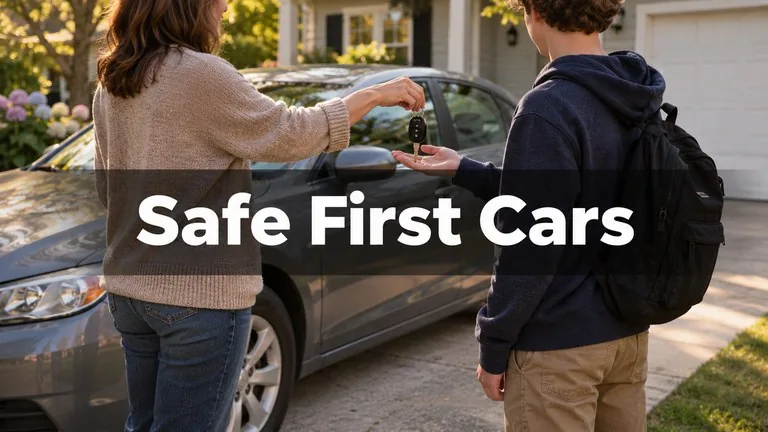
The safest cars for new drivers are midsize or small SUVs and sedans that are big enough to protect occupants, have modest horsepower, include electronic stability control and earn top crash test ratings. The Insurance Institute for Highway Safety (IIHS) and Consumer Reports publish a list built on exactly those rules, last updated May 27, 2026. Its used “best choices” cost about $13,100 to $19,700, and its “good choices” about $4,600 to $9,800, so a safe first car does not have to be new or expensive.
The stakes are real. IIHS data shows the fatal crash rate per mile driven for 16 to 19 year olds is just over three times the rate for drivers 20 and older, with the highest risk at 16 and 17. A safer car will not make an inexperienced driver skilled, but it changes how badly a mistake ends. Below are the criteria IIHS uses, example vehicles at each price level, the safety features worth paying for, and a step-by-step way to shop.
The four rules behind safe cars for teens
IIHS builds its teen vehicle recommendations on a few principles that apply to any new driver, whatever their age:
- Avoid high horsepower. More power tempts inexperienced drivers to test the limits, so IIHS leaves out vehicles with high power for their weight or performance-focused trims, and favors base engines.
- Bigger and heavier is safer, up to a point. Small, light cars give less protection in crashes, so the list excludes minicars and anything under 2,750 pounds. It also leaves out large SUVs and large pickups, which are harder to handle and pose more risk to people in other vehicles.
- Electronic stability control is a must. ESC helps a driver keep control on curves and slick roads. It has been standard on passenger vehicles since the 2012 model year, which is one reason older cars are a harder sell.
- Choose vehicles with the best safety ratings. Every used vehicle on the list earns a good rating in the IIHS driver-side small overlap front test.
Consumer Reports adds its own checks: braking and emergency handling scores of at least 3 out of 5, and controls and displays that score at least 2 out of 5. That last point matters more than it sounds, since a confusing touchscreen pulls a new driver’s eyes off the road.
Best choices vs good choices
The 2026 used list has two tiers. Both require more than 2,750 pounds of curb weight, a good small overlap test rating and acceptable Consumer Reports braking, handling and usability scores. The difference is crash avoidance technology.
Best choices also need standard automatic emergency braking (AEB) that performed well in IIHS pedestrian tests, plus headlights rated good or acceptable. Good choices do not require those two items. In practice, best choices tend to be newer (roughly 2018 and later), and good choices reach back to the early 2010s.
The prices IIHS lists are Black Book median retail prices from April 2026 for the earliest model year in each range. A newer year of the same model will cost more.
| Tier | Size | Example model and years | Median price (earliest year) |
|---|---|---|---|
| Best choice | Small SUV | Mazda CX-5, 2018 to 2025 | $13,100 |
| Best choice | Small car | Mazda 3 hatchback 2019 to 2025, sedan 2020 to 2025 | $13,200 |
| Best choice | Small SUV | Subaru Forester, 2019 to 2025 | $15,900 |
| Best choice | Midsize car | Toyota Camry, 2019 to 2025 | $17,300 |
| Best choice | Midsize SUV | Ford Explorer, 2020 to 2024 | $18,400 |
| Good choice | Small car | Nissan Sentra, 2015 to 2025 | $4,700 |
| Good choice | Small SUV | Chevrolet Equinox, 2014 to 2024 | $5,700 |
| Good choice | Midsize car | Chevrolet Malibu, 2014 to 2025 | $5,800 |
| Good choice | Small car | Honda Civic, 2014 to 2025 | $8,100 |
| Good choice | Midsize car | Honda Accord sedan, 2013 to 2025 | $8,300 |
These are only examples. The full list on the IIHS safe vehicles for teens page has dozens more, plus a separate list of 22 new 2026 models that earned an IIHS Top Safety Pick or Top Safety Pick+ award and a Consumer Reports Safety Verdict of Best.
Safety features that matter most for a new driver
If you are shopping off the list, or comparing two cars that are both on it, prioritize features in this order:
- Structure and crash ratings. Good IIHS ratings and a vehicle above 2,750 pounds come first, because they protect the driver when everything else fails.
- Electronic stability control. Standard from the 2012 model year, but confirm it on anything older.
- Automatic emergency braking with pedestrian detection. New drivers are more likely to misjudge following distance, and AEB can prevent or soften a rear-end crash.
- Headlights rated good or acceptable. Headlight performance often varies by trim on the same model, so check the exact trim, not just the model.
- Blind spot and rear cross-traffic warnings. These help with lane changes and backing out of parking spaces, two common trouble spots for beginners.
- A backup camera. Federal rules have required one on new passenger vehicles built since May 2018.
Some automakers also offer teen driver settings. Ford’s MyKey and General Motors’ Teen Driver system, for example, let parents cap top speed, limit audio volume, keep safety systems switched on and, on GM models, see a report of the trip. If two otherwise equal cars differ here, these settings are a reasonable tiebreaker.
Vehicles to avoid for a first car
Some popular choices for teens work against them:
- Sports cars and performance trims, including V8 muscle cars and turbocharged “sport” versions of regular models.
- Very old hand-me-downs without ESC or with poor crash ratings, even if they seem solid.
- Minicars and very light subcompacts under 2,750 pounds.
- Large pickups and full-size SUVs, which take longer to stop, are harder to park and have larger blind zones.
- Any vehicle with unrepaired safety recalls. Check the VIN on NHTSA’s recall lookup before buying.
How to set a budget for a safe first car
Start with the full cost, not the purchase price. Insurance for a new driver is usually the largest yearly expense, and it varies a lot by vehicle, so get quotes on two or three specific models before you commit. Midsize sedans and small SUVs from mainstream brands often quote lower than sporty or luxury models.
Leave room for a pre-purchase inspection, new tires if the current ones are worn, and a small repair fund. On a $9,000 car, setting aside $800 to $1,000 for tires, brakes and first-month fixes is a realistic cushion.
Example: The Nguyen family has $10,000 total. Rather than spend all of it on a car, they target the good choices list, find a 2016 Honda Civic LX with average mileage for about $8,800, pay $150 for an independent inspection, and keep the rest for two new tires and an oil change. The Civic meets every good choice requirement, and the family stays within budget.
Example: Rachel is 19, buying her own first car with an $18,000 budget. She narrows it to a 2019 Toyota Camry and a 2020 Mazda CX-5. Both are best choices with AEB and good or acceptable headlights. Her insurance quotes come in about $35 a month lower on the Camry, and it gets better highway mileage for her commute, so she buys it and puts the remaining money toward a winter tire set.
How to shop for a safe car for a new driver
- Pull up the current IIHS teen vehicle list and shortlist three to five models in your budget.
- Confirm the exact model year and trim qualifies, especially for headlights and standard AEB.
- Get insurance quotes for each finalist with the new driver listed.
- Run the VIN through NHTSA’s recall tool and a vehicle history report.
- Have an independent mechanic inspect the car, including tires, brakes and suspension.
- Let the new driver test drive it, and check that they can reach the pedals comfortably, see well and use the controls without hunting through menus.
- After purchase, set up any teen driver settings and go over how the safety warnings sound and what they mean.
Common questions
What is the safest type of car for a teenager?
A midsize car or a small to midsize SUV with good IIHS crash ratings, modest horsepower and standard electronic stability control. IIHS excludes minicars and anything under 2,750 pounds, as well as large SUVs and pickups, from its teen recommendations.
Is it safe for a teen to drive an old car?
It depends on the car. A vehicle from 2012 or later has standard ESC, and many 2013 to 2016 models with good small overlap ratings appear on the IIHS good choices list. Cars from before 2012 often lack ESC and the newer crash structures, so they are a weaker choice even if they run well.
How much should I spend on a safe first car?
IIHS’s 2026 used list includes good choices from about $4,600 and best choices from about $13,100, based on the earliest qualifying model year. Many families find a solid option between $8,000 and $15,000, plus a few hundred dollars for an inspection and tires.
Are SUVs safer than sedans for new drivers?
Not automatically. Small and midsize SUVs are well represented on the IIHS list, but so are midsize sedans like the Toyota Camry and Honda Accord. Ratings, weight and handling matter more than body style, and large SUVs are left off the list entirely.
Are electric cars a good choice for teen drivers?
Some electric vehicles appear on the IIHS used list. Many EVs accelerate very quickly, so check whether the specific model and trim meets the horsepower guidance, and look for any drive mode that softens acceleration.
Before you buy
- Check that the exact year and trim is on the current IIHS list.
- Confirm ESC, AEB and headlight ratings for that trim.
- Get insurance quotes before negotiating.
- Look up open recalls by VIN.
- Pay for an independent inspection.
- Keep money aside for tires and early repairs.
Editorial note: This article is general information. Vehicle criteria and prices come from the IIHS and Consumer Reports list updated May 2026 and were checked as of November 2026; confirm ratings for the exact model year and trim at IIHS.org and check recalls at NHTSA.gov before buying.