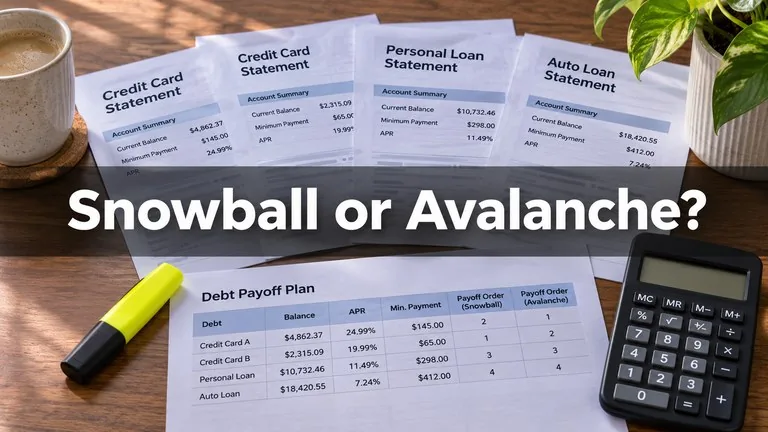
The debt avalanche saves the most money because it sends every extra dollar to the debt with the highest interest rate first. The debt snowball pays off the smallest balance first, which costs more in interest but gives you a paid-off account sooner, and that early win keeps many people going. If your rates are close together, the two methods end up nearly the same. If one large balance carries a much higher rate than the rest, the avalanche can save you hundreds or thousands of dollars.
Both methods follow the same basic plan: pay the minimum on every debt, put all extra money toward one target debt, and when that debt is gone, roll its payment into the next one. Only the order changes. Below are two worked examples with real payoff math, a way to decide which order fits you, and the free tools that do the calculations for you.
How the two methods work
Both methods start the same way. You list every debt, decide on a fixed total amount you can pay each month, and keep paying that total until everything is paid off. The amount you put toward debt each month stays the same even as debts disappear, so the payment on your current target keeps growing. That snowballing payment is what makes either method faster than paying minimums alone.
- Snowball: sort debts from smallest balance to largest. Ignore interest rates when choosing the order.
- Avalanche: sort debts from highest interest rate to lowest. Ignore balance size when choosing the order.
Mortgages are usually left out of either plan because their rates are lower and their terms are long. Most people apply these methods to credit cards, store cards, personal loans, medical payment plans, car loans and private student loans.
Worked example 1: four debts, $800 a month
Example: Jordan has four debts and can put $800 a month toward them. The minimums add up to $615, so there is $185 extra each month. Interest is calculated monthly, and the payments are assumed to stay fixed at $800 until everything is paid.
| Debt | Balance | APR | Minimum | Snowball order | Avalanche order |
|---|---|---|---|---|---|
| Store card | $1,200 | 29.99% | $40 | 1st | 1st |
| Personal loan | $4,000 | 11% | $130 | 2nd | 3rd |
| Visa card | $6,500 | 24.99% | $165 | 3rd | 2nd |
| Car loan | $9,000 | 6.9% | $280 | 4th | 4th |
| Result | $20,700 total | $615 | 32 months, about $4,440 interest | 31 months, about $3,970 interest |
Both plans clear the store card in month 6 because it is both the smallest balance and the highest rate. After that they split. The snowball pays off the personal loan in month 17, then the Visa in month 30. The avalanche goes after the Visa and clears it in month 26, with the personal loan following in month 29. The avalanche finishes a month earlier and saves about $470.
The trade-off is the long middle stretch. With the snowball, Jordan sees a second account hit zero in month 17. With the avalanche, the second payoff comes in month 26, which means nine more months of sending money to the same Visa bill. For someone who has quit debt plans before, that gap is a real risk. For someone motivated by the interest saved, it isn’t.
Worked example 2: when the avalanche clearly wins
Example: Priya owes $3,000 on a student loan at 5% (minimum $60) and $14,000 on a credit card at 26.99% (minimum $350). She can pay $700 a month. With the snowball, the student loan is gone in month 9 and everything is paid off in month 35, with about $7,320 in total interest. With the avalanche, the card is paid off in month 31 and everything is done in month 33, with about $5,790 in interest. Picking the avalanche saves her about $1,530 and two months.
That pattern repeats whenever the biggest balance also has the highest rate. Every month the large high-rate balance waits while you clear a small cheap one, it keeps charging interest on thousands of dollars. Average credit card rates on accounts that pay interest were about 22.4% in August 2026, according to Federal Reserve data, so a large card balance is usually where the money leaks.
Which method suits whom
A plan you follow for three years will beat a cheaper plan you abandon in month eight. These rules of thumb help you choose.
- Choose the avalanche if your highest-rate debt is also one of your larger balances, if rates differ by more than about 10 percentage points, or if seeing interest saved motivates you.
- Choose the snowball if you have several small balances you could clear within a few months, if you have started and dropped a payoff plan before, or if fewer bills to track would reduce stress.
- Either works if your rates are within a few points of each other. The cost difference may be under $100.
- Consider a hybrid. Clear one or two tiny balances first for quick wins (under $500 each, for example), then switch to the avalanche for the rest.
There are a few exceptions to both methods. Prioritize any debt where falling behind has bigger consequences than interest: past-due rent or mortgage, a car loan you need to get to work, tax debt, or child support. Watch for 0% promotional balances, too. A deferred-interest store card can charge all the interest back to the purchase date if the balance isn’t paid by the deadline, so it may belong at the top of the list even though its current rate shows 0%.
How to set up a payoff plan
- List every debt with its current balance, APR, minimum payment and due date. Your statements or online account pages show all four.
- Find your monthly debt budget. Add up the minimums, then decide how much extra you can add without skipping essential bills. Even $50 extra speeds things up.
- Keep a small cash buffer first, usually $1,000 or so, so a surprise expense doesn’t go on a card you’re trying to pay off.
- Choose the order: smallest balance first (snowball) or highest rate first (avalanche).
- Set every minimum to autopay so nothing is ever late. A single late payment can trigger a fee and a penalty APR.
- Make the extra payment to the target debt each month, ideally right after payday.
- When a debt is paid off, add its full former payment to the next target. Don’t let it slip back into everyday spending.
- Check the plan every three months. Update balances and see if any rates have changed.
Stop adding new charges to the cards you’re paying off. If you keep using a card for convenience, pay that month’s new spending in full separately so it doesn’t eat into the payoff amount.
Ways to lower the interest while you pay
Either method gets faster when the rates drop. Call each card issuer and ask for a lower APR, especially if you have a record of on-time payments. Some issuers also offer hardship programs that cut rates for a set period, though they may freeze the card while you’re enrolled.
Nonprofit credit counseling agencies can set up a debt management plan, which bundles your card payments into one monthly payment, often at reduced interest rates. Look for agencies approved by the U.S. Trustee Program or affiliated with the National Foundation for Credit Counseling, and expect a small monthly fee that varies by state. Avoid any company that charges fees before it settles or reduces a debt, which federal rules prohibit for telemarketed debt relief.
Free tools that do the math
You don’t need special software. A spreadsheet with one row per debt and one column per month works fine, and many free templates exist for both methods. Online calculators such as Undebt.it and Unbury.me let you enter your debts and compare snowball and avalanche payoff dates and interest side by side. Many banks and credit unions offer similar calculators on their websites.
Whatever tool you use, enter real APRs from your statements instead of guessing, and rerun it after any balance transfer, rate change or new debt. The Consumer Financial Protection Bureau also has worksheets for tracking debts and explains your rights if an account has gone to collections.
Common questions
Is the debt snowball or avalanche faster?
The avalanche is never slower and is often a little faster, because less of each payment goes to interest. In many real-world cases the difference is a month or two. The gap grows when a large balance has a much higher rate than your smaller debts.
How much money does the avalanche method save?
It depends on the gap between your rates and balances. In the four-debt example above it saved about $470, and in the two-debt example about $1,530. If your rates are similar, the savings may be negligible.
Should I include my car loan or student loans?
Include any debt you want gone, but low-rate loans usually end up last in the avalanche order anyway. Federal student loans have income-driven repayment and other options that private debt doesn’t, so many people pay them on schedule and focus extra money on higher-rate debts first.
Will paying off debt raise my credit score?
Paying down credit card balances usually helps because it lowers your credit utilization, the share of your available credit you’re using. Paying off an installment loan may cause a small, temporary dip, which is normal and isn’t a reason to keep the debt.
Can I switch methods partway through?
Yes. Many people start with the snowball to get a quick win, then switch to the avalanche once the small balances are gone. All that matters is that the total monthly payment stays the same and every extra dollar goes to a single target.
Before you start paying down debt
- Gather balance, APR, minimum and due date for every debt.
- Set a fixed monthly debt budget you can keep for at least a year.
- Build or keep a $1,000 buffer so a surprise doesn’t land on a card.
- Put all minimums on autopay.
- Run your own numbers in a free calculator to see the real cost difference between methods.
- Flag any deferred-interest promotions and their deadlines.
Editorial note: This article is general information, not financial advice. Rates were checked as of November 2026 using Federal Reserve consumer credit data; payoff figures are illustrative and your results depend on your lenders’ terms, so confirm details with each lender.