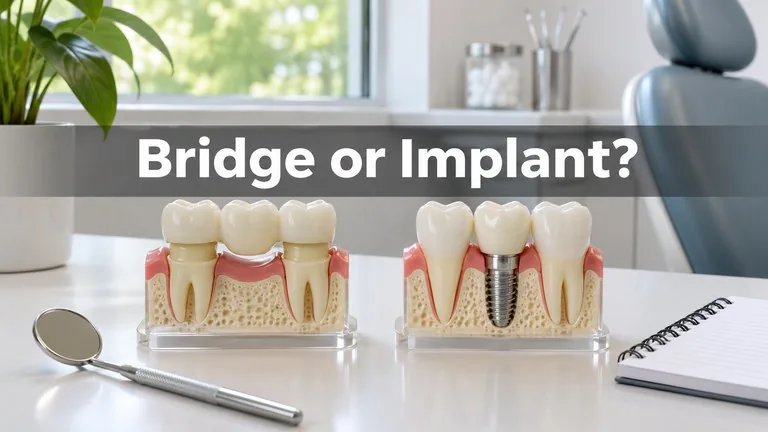
For a single missing tooth, a traditional three-unit bridge usually costs less up front (about $4,600 on average), while an implant with its crown usually costs a bit more on day one but less over 15 years, because bridges are more likely to need replacing in that time. Long-term studies put the 10-year survival of tooth-supported bridges at about 89%, against about 95% for single implants. When a bridge fails from decay or a fracture, one of its supporting teeth is sometimes lost too.
That does not make an implant the right answer for everyone. A bridge is faster, needs no surgery, and makes good sense when the neighboring teeth already need crowns or when bone, health or timing rule out an implant. Below is a side-by-side comparison, a 15-year cost example, what each procedure involves, and a set of decision rules to bring to your dentist.
Bridge vs implant at a glance
Cost figures come from Pearl’s ADA fee survey based averages (updated May 2026) and CareCredit’s national cost study (2024 data). Survival figures come from published systematic reviews.
| Factor | Traditional 3-unit bridge | Single implant with crown |
|---|---|---|
| Typical upfront cost | About $4,620 average; range $3,010 to $7,900 | Implant placement about $3,075 average, plus abutment and crown (a porcelain crown averages about $1,399) |
| Ten-year survival in reviews | About 89% | About 95% for the implant; about 89.5% for the original crown |
| Usual lifespan quoted | About 10 to 15 years | Implant often 20+ years; crown may need replacing sooner |
| Treatment time | About 2 to 3 weeks | Often 4 to 8 months including healing |
| Surgery | No | Yes, minor oral surgery |
| Effect on neighboring teeth | Both are filed down for crowns | Left untouched |
| Bone in the gap | Continues to shrink slowly | Implant helps preserve it |
| Cleaning | Floss threader or water flosser under the false tooth | Brush and floss like a natural tooth |
What the long-term studies show
A widely cited systematic review of tooth-supported fixed bridges (Tan and colleagues, 2004) found a 10-year survival of about 89% but a “success” rate of only about 71%, meaning many bridges that stayed in the mouth still needed repairs along the way. The most common problems were loss of retention (the bridge coming loose), decay under a crown, and supporting teeth needing root canals or fracturing.
For implants, a systematic review of single implants followed for at least 10 years found 95% of implants survived, while about 89.5% of the original crowns on them were still in place. In practice, the implant post tends to last; the crown on top may need replacing, which costs much less than redoing a whole bridge.
Pearl’s data summary and CareCredit both quote a typical bridge lifespan of 10 to 15 years, with implants often lasting 20 years or longer with good care. Individual results depend heavily on gum health, smoking, grinding and how well the area is cleaned.
Cost over 15 years: a worked example
Upfront price is only part of the comparison. What matters more is the chance you will pay again within your planning window.
Example: Marcus, 45, loses a lower first molar. Option one is a three-unit bridge at the $4,620 national average. If it lasts 12 years and is then replaced at the same price, his 15-year cost is about $9,240, and more if one of the supporting teeth needs a root canal (about $1,337 for a molar on CareCredit’s 2024 data) along the way. Option two is an implant: $3,075 for placement, $1,399 for the crown, and an abutment that he assumes at $600 for this exercise (his office’s fee will differ), or about $5,074. If the crown is replaced once at year 14, his 15-year total is about $6,473. Even if he also needs a $558 socket graft at the start, the implant comes out about $2,200 ahead.
Example: Elena, 58, is missing an upper premolar, and both neighboring teeth already have large old fillings and one is cracked. Her dentist recommends crowns on both regardless. In her case a bridge uses those crowns as its anchors, so the bridge’s “extra” cost over the two crowns she needed anyway is mainly the false tooth. The implant route would mean paying for two crowns plus an implant, so the bridge is the more economical choice for her mouth.
The pattern holds broadly: the more likely you are to keep the result for 15 years or longer, and the healthier the neighboring teeth, the more the math favors an implant.
How each procedure works
A traditional bridge takes two visits. At the first, the dentist numbs the area, shapes the two neighboring teeth for crowns, takes a scan or impression, and places a temporary bridge. At the second visit, usually two to three weeks later, the permanent bridge is cemented.
A single implant takes longer because the bone has to fuse to the post. A typical sequence:
- Exam and 3D imaging (often a cone-beam CT scan) to measure bone height and width and locate nerves and sinuses.
- Bone grafting if needed, either at the time of extraction or as a separate step, which can add a few months of healing.
- Implant placement: the surgeon places a titanium post in the jaw under local anesthetic, with sedation optional.
- Healing and integration: the bone bonds to the implant over roughly two to six months, often with a temporary tooth in place for visible areas.
- Abutment and impression: a connector is attached and the crown is designed.
- Final crown: the crown is screwed or cemented onto the abutment and the bite is adjusted.
In some cases, an implant can be placed on the same day as the extraction, which shortens the overall timeline.
Who each option suits
A bridge is often the better fit if:
- The teeth on either side already have large fillings, cracks or crowns and would need crowns anyway.
- There is not enough bone for an implant and you prefer to avoid grafting.
- Health factors raise implant risk, such as uncontrolled diabetes, heavy smoking, head and neck radiation, or certain bone medications. Your dentist and physician will weigh these case by case.
- You need the tooth replaced within a few weeks, for example before an event or a move.
- The patient is a teenager whose jaw is still growing; implants are usually delayed until growth is complete.
An implant is often the better fit if:
- The neighboring teeth are healthy and unfilled, so filing them down for a bridge would remove sound enamel.
- You have adequate bone (or are willing to graft) and healthy gums.
- You do not smoke, or are willing to stop around the time of surgery.
- You want the longest expected lifespan and can wait several months for the final tooth.
Two lower-cost bridge types also exist. A resin-bonded (Maryland) bridge averages about $1,569 and attaches with small wings bonded to the backs of the neighbors, with little drilling, but it debonds more often and suits front teeth best. A cantilever bridge, anchored on one side only, averages about $1,041 on CareCredit’s 2024 data and is used in limited situations where the bite forces are low.
How insurance treats each option
Most dental plans list both bridges and implants under major services, often paid at 50% after the deductible, but implants are excluded or limited on more plans than bridges are. Watch for three plan features: the annual maximum (often $1,000 to $2,000, which a single implant can exceed), waiting periods for major services, and a “missing tooth clause” that refuses to pay to replace a tooth lost before your coverage began. Some plans pay an “alternate benefit,” covering an implant only up to what they would have paid for a bridge.
Common questions
Is a bridge or implant better for one missing tooth?
With healthy neighboring teeth and enough bone, implants generally last longer and do not require reshaping the adjacent teeth. When the neighbors already need crowns or an implant is not possible, a bridge is a well-established, faster option.
How long does a dental bridge last?
Typical estimates are 10 to 15 years, and a major review found about 89% of bridges still in place at 10 years. Lifespan depends on cleaning under the false tooth, gum health and decay risk in the supporting teeth.
Can you replace a bridge with an implant later?
Often, yes, if there is enough bone in the gap. Because the bone under a bridge’s false tooth slowly shrinks, a graft may be needed first. The former supporting teeth would then need their own crowns.
Which hurts more, a bridge or an implant?
Both are done with local anesthetic. Implant placement usually brings a few days of soreness similar to an extraction. Bridge preparation may leave the teeth sensitive for a short time.
Why is an implant sometimes quoted at only $3,000?
Many quotes cover only the surgical placement of the post. The abutment and crown are often billed separately and can add well over $1,500, so ask for the total for a finished tooth.
Before you decide
- Ask your dentist about the condition of the two neighboring teeth and whether they need crowns anyway.
- Get the total quote for a finished implant tooth, including imaging, graft, abutment and crown.
- Compare that with the bridge quote and estimate a second bridge within 15 years.
- Check your plan for implant coverage, an alternate benefit clause and a missing tooth clause.
- Ask what cleaning routine each option requires and whether you are likely to keep it up.
Editorial note: This article is general information, not dental advice. Costs and study figures were checked as of November 2026 and vary by provider and patient; confirm treatment options, risks and fees with your dentist or a prosthodontist or oral surgeon.