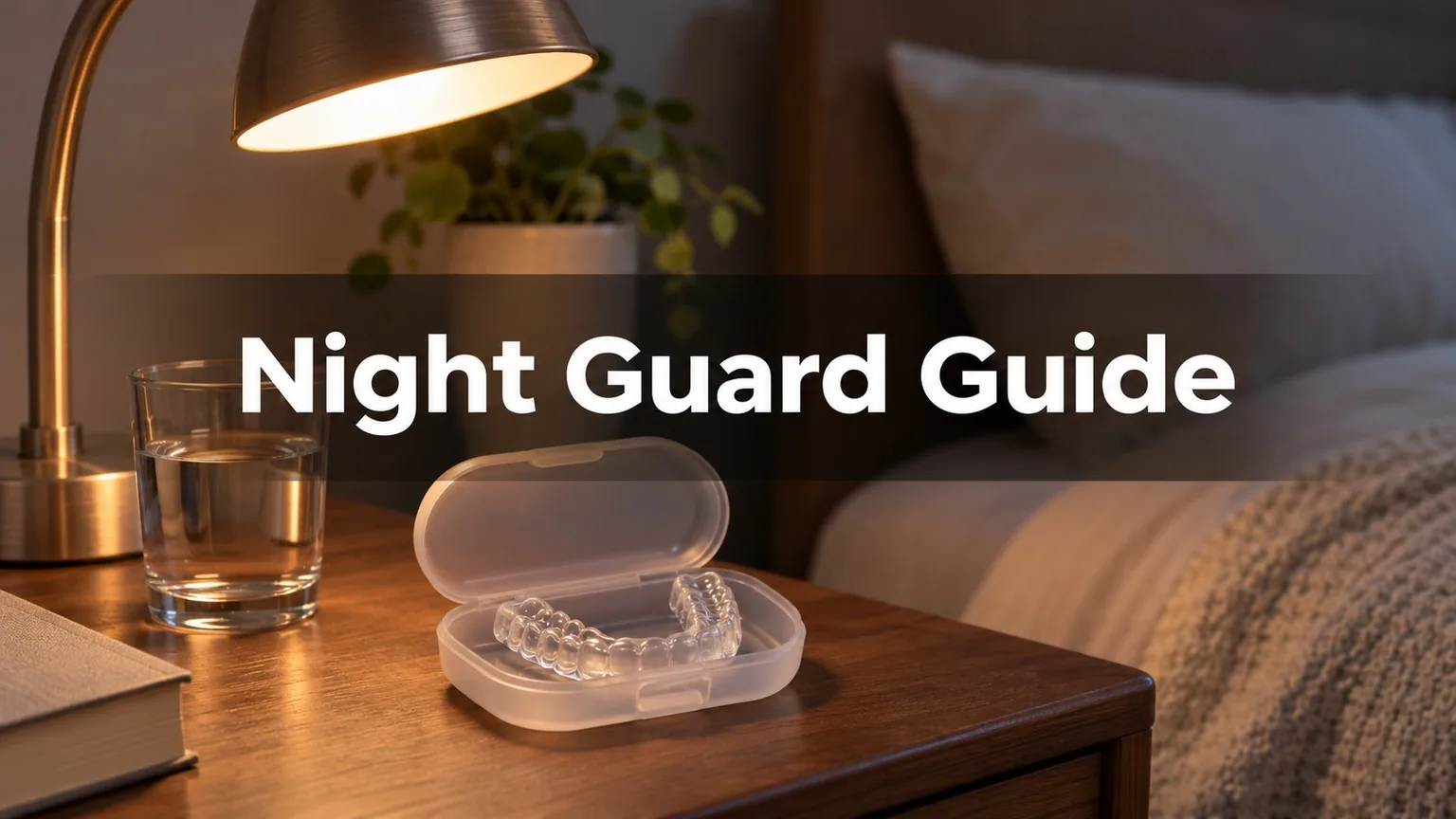
A night guard for teeth grinding comes in two main forms: a custom guard made by your dentist from a scan or impression of your teeth, and a store-bought guard you fit at home. A custom guard costs about $655 on average in the US, with a typical range of $430 to $1,125, based on ADA fee survey data updated in May 2026. Store-bought boil-and-bite guards usually cost $15 to $50. The custom guard fits better and lasts longer, while the store-bought one is a cheap way to test whether a guard helps at all.
For someone who grinds hard, has visible tooth wear or jaw pain, or has crowns and implants to protect, a custom guard is usually worth the cost. For mild or occasional clenching, a well-fitted over-the-counter guard can be a reasonable start. This guide covers how the options compare, what insurance pays, and how to tell which group you are in.
Signs you are grinding at night
Most people who grind their teeth in their sleep (sleep bruxism) do not know it until a partner hears it or a dentist spots the wear. Common signs include:
- A sore or tired jaw, or a dull headache near the temples, when you wake up
- Teeth that look flatter, shorter or chipped at the edges
- New sensitivity to cold without an obvious cavity
- Scalloped marks along the sides of your tongue or a ridge on the inside of your cheek
- Cracked fillings or crowns that keep breaking
Stress, caffeine, alcohol, smoking and some medications (including certain antidepressants) are linked to more grinding. Grinding also often shows up alongside sleep apnea. If you snore loudly, wake up gasping or feel exhausted after a full night, tell your dentist or doctor. A guard protects teeth but does not treat apnea, and some appliance designs are not a good fit for people with untreated apnea.
Types of night guards compared
There are four main options. Prices are typical ranges and vary by office, region and brand.
| Type | Typical cost | Fit | Typical lifespan | Best for |
|---|---|---|---|---|
| Stock (ready to wear) | About $10 to $30 | Loose, one size | Weeks to a few months | Short-term use only |
| Boil-and-bite | About $15 to $50 | Molded at home, fair | A few months to a year | Mild clenching, testing whether a guard helps |
| Mail-order from a home impression | Roughly $100 to $300 | Good if the impression is good | About 1 to 3 years | Mild to moderate grinding without other dental issues |
| Custom from a dentist | About $430 to $1,125 (average $655) | Precise, adjusted in the chair | Several years for hard acrylic | Heavy grinding, jaw pain, crowns, implants, bridges |
Material matters too. Soft guards feel comfortable at first, but some people chew on them, which can increase clenching. Hard acrylic guards are thinner, last longer and let the jaw slide smoothly, which is why dentists usually choose them for heavy grinders. Dual-laminate guards have a soft inner layer and a hard outer layer and sit in between.
The Colgate oral health team points out that guards bought online or over the counter are not made to fit your teeth exactly, and a study in the British Dental Journal linked poorly fitting online guards to gum irritation and teeth shifting. Fit is the main thing you pay for with a custom guard.
What insurance pays
Coverage for night guards is uneven. Some PPO dental plans pay about 50% when your dentist documents grinding-related tooth wear. Others exclude guards completely. Plans that cover them often limit replacement to one guard every few years. Medical insurance occasionally covers an oral appliance for a diagnosed jaw joint (TMJ) disorder, but that usually requires paperwork from your doctor or dentist.
Ask the office to send a pre-treatment estimate to your insurer before ordering a custom guard. The common billing code for a hard full-arch guard is D9944; a soft guard is D9945. Knowing the code lets you check coverage in your plan documents or with a quick call.
You can also pay for a night guard with HSA or FSA funds, since it treats a dental condition. That effectively lowers the cost by your tax rate.
Example: Priya’s dentist quotes $700 for a hard custom guard. Her plan covers night guards at 50% when wear is documented, and she has already met her deductible. The plan pays $350 and she pays $350. Because she uses her FSA, and her combined federal and state tax rate is about 25%, the real cost to her is closer to $263.
Is a custom guard worth the money?
Compare the guard’s cost to what grinding can break. A single crown commonly costs $1,000 or more, and a cracked molar can lead to a root canal plus a crown. If your dentist already sees cracked enamel, worn edges or broken fillings, a guard that lasts several years costs less than one repair.
Example: Marcus clenches mainly during stressful weeks and has no visible wear. He buys a $30 boil-and-bite guard and replaces it twice a year, about $60 a year. Over five years that is $300, less than half the price of a custom guard. His dentist checks his teeth at each cleaning, and he plans to upgrade if wear shows up. For him the cheaper route makes sense. Someone with three crowns and morning jaw pain would come out ahead with the custom guard almost immediately.
A simple rule of thumb: start with an over-the-counter guard if your grinding is mild and your dentist sees no damage. Move to custom if you bite through store-bought guards within a few months, if your jaw pain does not improve, if you have expensive dental work to protect, or if your dentist recommends it after an exam.
How to get a custom night guard
- Book an exam and tell the dentist about your symptoms. They will look for wear facets, cracks and jaw muscle tenderness.
- Ask for a pre-treatment estimate if you have insurance, and confirm the guard type (hard, soft or dual laminate) and whether it is upper or lower.
- The office takes a digital scan or putty impression of your teeth. This takes about 10 to 15 minutes.
- A dental lab makes the guard, usually in one to three weeks.
- At the fitting visit, the dentist checks that it seats fully and adjusts the surface so your bite is even when you close.
- Wear it every night. Mild drooling or tightness is normal for the first week or two. If any tooth aches or your bite feels off in the morning after that, go back for an adjustment, which is usually included.
Caring for your guard
Rinse the guard after you take it out, brush it gently with a soft toothbrush and cool water, and let it air dry in its ventilated case. Hot water can warp it. Avoid toothpaste with harsh abrasives, which scratch the surface and hold bacteria. Once a week, soak it in a non-alcohol denture or retainer cleaner. Keep the case away from dogs, which are known for chewing guards.
Bring the guard to each dental cleaning. Your dentist can check for thinning or cracks and see the wear pattern, which shows how hard you are grinding.
Common questions
How much does a night guard cost at the dentist?
A custom night guard averages about $655 in the US, with most fees between $430 and $1,125. The price usually includes the impression or scan, the lab work and the fitting visit. Ask whether follow-up adjustments are included.
Are boil-and-bite night guards safe?
They are fine for many people as a short-term or mild-case option. A poor fit can cause gum irritation, a sore jaw or minor tooth movement over time, so stop using one that causes new pain and have your dentist look at your bite.
Should a night guard go on the upper or lower teeth?
Either can work. Upper guards are more common and tend to be more stable. Lower guards can be more comfortable for people with a strong gag reflex. Your dentist chooses based on your bite and any missing teeth.
How long does a night guard last?
Boil-and-bite guards often last a few months to a year. Hard acrylic custom guards commonly last several years, and heavy grinders wear through them faster. Replace any guard that is cracked, thin or no longer fits snugly.
Will a night guard stop me from grinding?
Usually not. It protects your teeth and can ease jaw strain, but the grinding itself often continues. Cutting late caffeine and alcohol, managing stress and getting checked for sleep apnea are the steps that address the causes.
Before you buy
- Get a dental exam first to confirm grinding and check for existing damage.
- Ask your insurer whether code D9944 is covered and how often.
- If you start with an over-the-counter guard, follow the fitting instructions closely and stop if your bite changes.
- Mention snoring or daytime sleepiness to your dentist or doctor.
- Plan to use HSA or FSA funds if you have them.
Editorial note: This article is general information, not medical advice. Costs were checked as of November 2026 and vary by office and plan; ask your dentist which guard suits you and confirm coverage with your dental insurer.