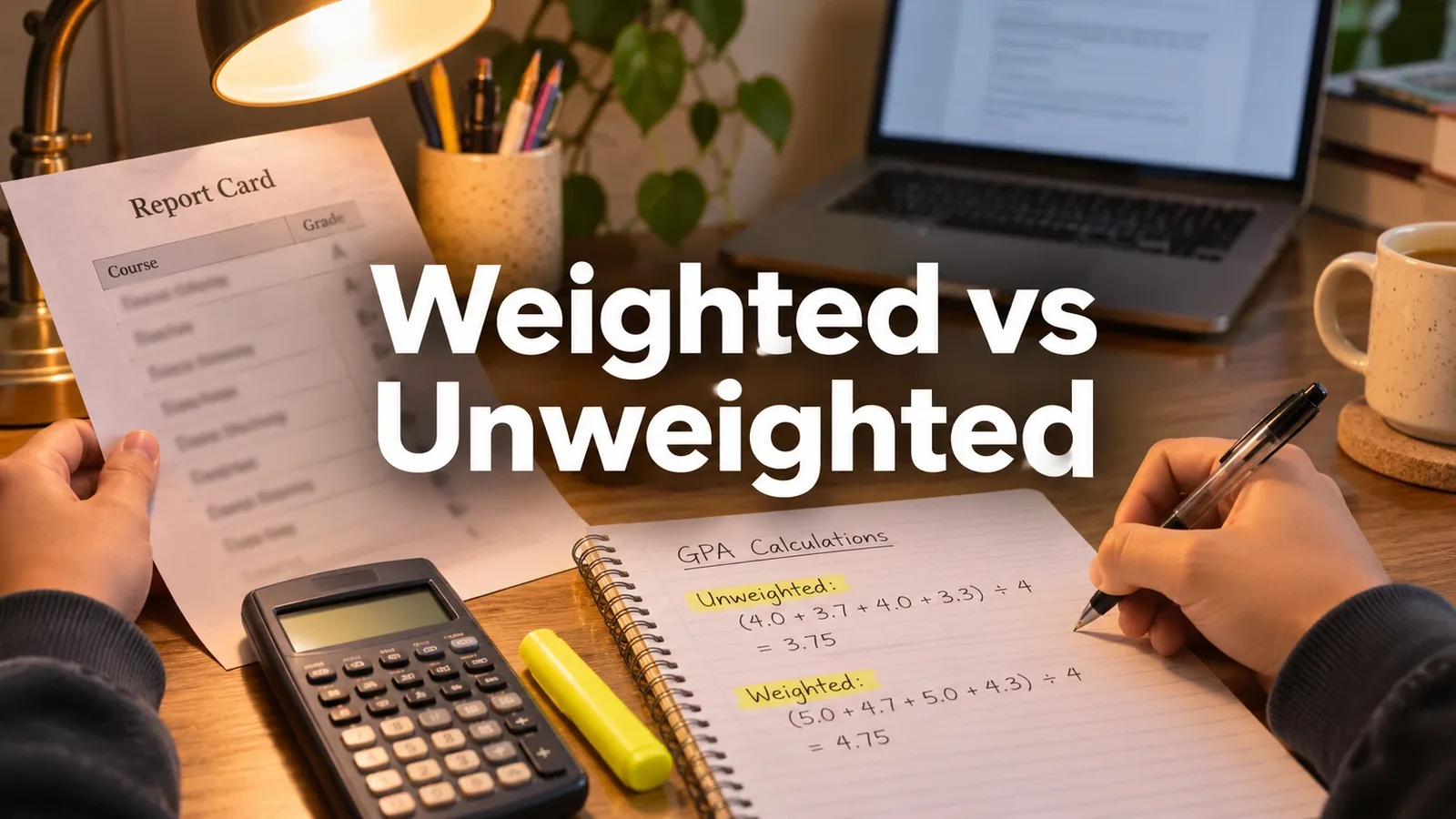
An unweighted GPA uses a 4.0 scale where every class counts the same: an A is 4 points, a B is 3, a C is 2 and a D is 1, whether the class is regular or AP. A weighted GPA gives extra points for harder classes, usually one extra point for AP, IB and dual enrollment courses and half a point for honors, so an A in AP Chemistry counts as 5.0 and the scale can go above 4.0. Colleges see both on many transcripts, but most admissions offices look at the courses themselves and many recalculate GPA using their own formula.
That last point is why comparing your 4.3 to a friend’s 3.9 at another school tells you very little. High schools weight GPAs differently, and some don’t weight at all. Below is how to calculate each version, how colleges use them, and how to report your GPA on applications so nothing looks inconsistent.
Weighted and unweighted GPA side by side
| Grade | Unweighted (any class) | Weighted: regular class | Weighted: honors (+0.5) | Weighted: AP, IB or dual enrollment (+1.0) |
|---|---|---|---|---|
| A | 4.0 | 4.0 | 4.5 | 5.0 |
| B | 3.0 | 3.0 | 3.5 | 4.0 |
| C | 2.0 | 2.0 | 2.5 | 3.0 |
| D | 1.0 | 1.0 | 1.0 to 1.5 | 1.0 to 2.0 |
| F | 0 | 0 | 0 | 0 |
These are common values, not universal ones. Some schools give a full point for honors, some add weight only for grades of C or better, and some use plus and minus grades (an A-minus might be 3.7). Your school’s student handbook or counselor will have the exact scale.
How to calculate your GPA
- List every graded course on your transcript with its final grade for each semester or year, and the credits for each course (often 0.5 per semester, 1.0 per full year).
- Convert each grade to points on the 4.0 scale. That gives your unweighted values.
- For the weighted version, add the bonus for each honors, AP, IB or dual enrollment course according to your school’s rules.
- Multiply each course’s points by its credits.
- Add up all the points, then add up all the credits.
- Divide total points by total credits. Do this once with unweighted points and once with weighted points.
Example: Sofia’s junior year has six full-year classes: an A in AP U.S. History, a B in AP Calculus, an A in Honors English, an A in Spanish 3, a B in Chemistry and an A in Health. Unweighted points are 4 + 3 + 4 + 4 + 3 + 4 = 22, divided by 6 = 3.67. Weighted, with +1 for AP and +0.5 for honors: 5 + 4 + 4.5 + 4 + 3 + 4 = 24.5, divided by 6 = 4.08.
Which GPA do colleges care about?
Admissions officers mainly look at two things: your grades and the difficulty of your schedule compared with what your school offers. They see your transcript course by course, so they know whether an A was in AP Biology or regular biology. The GPA number on your application is a starting point, not the final word.
Many selective colleges recalculate GPA for every applicant to compare students from different high schools fairly. Common approaches include using only core academic courses (English, math, science, social studies and world language), dropping 9th grade, dropping electives like PE and health, and applying the college’s own weighting or none at all.
Your school profile, a document your counselor sends with your transcript, explains your school’s grading scale, how many AP or IB courses it offers, and sometimes the GPA distribution of your class. That context is how a college knows a 3.8 at a school with harsh grading might be stronger than a 4.2 elsewhere.
How the University of California calculates GPA
UC is a good example of a college system with its own formula. It uses only A-G courses taken from the summer after 9th grade through the summer after 11th grade. An A is 4 points, a B 3, a C 2 and a D 1, and pluses and minuses don’t count. Each semester of a UC-approved honors, AP or IB course earns one extra point, capped at 8 semesters across 10th and 11th grade, with no more than 4 from 10th grade. A D or F gets no extra point.
California residents need at least a 3.0 GPA in A-G courses to meet the minimum requirement, and nonresidents need at least a 3.4. Meeting the minimum doesn’t mean admission to competitive campuses.
Example: Marcus took 6 AP semesters and 4 honors semesters in 10th and 11th grade. Even though he has 10 weighted semesters, UC counts only 8 extra points, and only 4 of them can come from 10th grade. Students with heavy AP loads often find their UC-weighted GPA is lower than the weighted GPA their high school reports, because of that cap.
What counts as a good GPA?
It depends on the colleges you’re considering. Federal transcript studies have found the average high school GPA is a little above 3.0 unweighted. Rough benchmarks:
- 3.0 unweighted or higher meets minimum requirements at many state universities.
- 3.5 or higher unweighted makes you competitive at a wide range of four-year colleges.
- 3.8 to 4.0 unweighted with a demanding schedule is typical for admitted students at highly selective colleges.
Check each college’s Common Data Set or admissions profile, which often lists the GPA range of admitted students. Note whether the figures are weighted or unweighted before comparing them to yours.
Should you take harder classes for a weighted GPA?
Usually yes, if you can do well in them. Colleges consistently say rigor matters, and a B in AP Calculus often looks better than an A in a regular math class to selective schools. But a string of C’s in AP classes can hurt more than it helps, and burning out in junior year affects every grade on your transcript.
A sensible approach is to take advanced courses in subjects you’re strong in or plan to study, and regular sections in your weaker areas. Taking every AP your school offers is not required to look rigorous; colleges judge your schedule against what was available to you.
How to report your GPA on applications
The Common App asks for your GPA, the scale and whether it’s weighted, and these should match your transcript exactly. Don’t recalculate your own number using a different method. If your school reports only a weighted GPA, give that and select “weighted.” If your school doesn’t calculate GPA at all, you can leave it blank, and your counselor will explain in the school report. Some colleges’ own applications ask you to self-report every course and grade, and use that to calculate GPA themselves.
Common questions
Is a 4.0 weighted GPA good?
It depends on your unweighted grades and course load. A 4.0 weighted could mean straight A’s in regular classes or a mix of A’s and B’s in AP courses; colleges look at the transcript to tell which.
Can a weighted GPA be higher than 5.0?
At most schools no, since 5.0 is the maximum for an A in an AP or IB course. A few schools use different scales, such as a 6.0 scale, so check the scale on your transcript.
Do colleges prefer weighted or unweighted GPA?
Many look at both, and many recalculate using their own method. What they care about most is your actual grades and how challenging your courses were compared with what your school offered.
Does freshman year count toward GPA?
It counts in your high school’s GPA, but some colleges, including the University of California, leave out 9th grade grades when calculating GPA. Your 9th grade courses still appear on your transcript.
How can I raise my GPA as a senior?
Strong first-semester senior grades raise your cumulative GPA slightly and show an upward trend. Colleges often see midyear grades, and admission offers can be reconsidered if senior grades drop sharply.
Before you apply
- Get your official weighted and unweighted GPA and scale from your counselor or transcript.
- Read your school profile so you know how your school’s grading is explained to colleges.
- Recalculate a UC-style or core-course GPA if you’re applying to schools that use one.
- Compare your unweighted GPA with each college’s admitted student range.
- Report GPA on applications exactly as it appears on your transcript.
Editorial note: This article is general information. Admission rules were checked as of November 2026 and differ by college; confirm GPA policies with your school counselor and each college’s admissions office, such as the University of California.