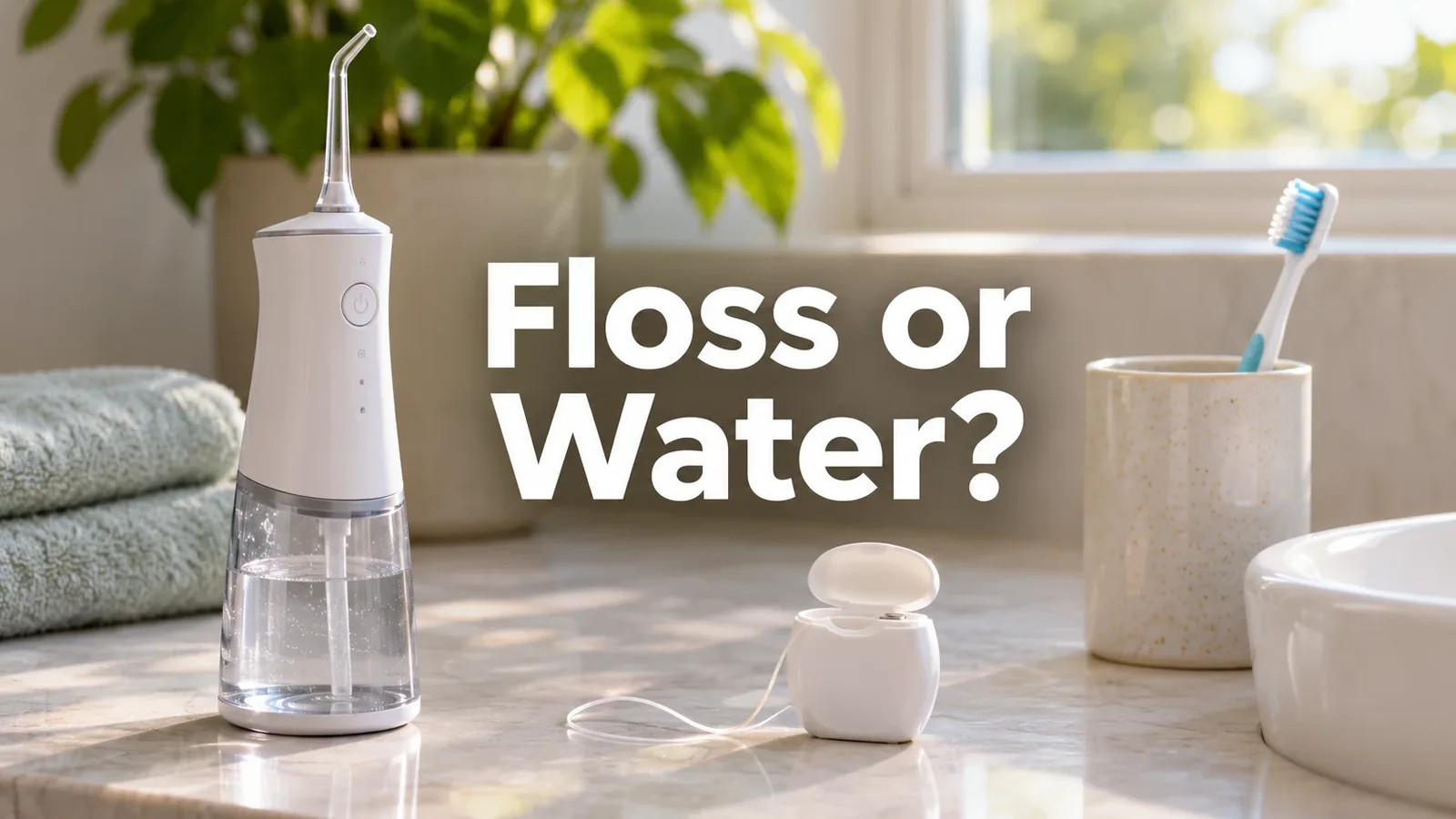
For most adults with healthy gums and no dental work, string floss and a water flosser both do the job, and the better choice is the one you will use every day. String floss scrapes sticky plaque off the side of each tooth. A water flosser flushes food and loose plaque from between teeth and along the gumline, and it is much easier for people with braces, bridges, implants, arthritis or tight budgets of patience.
The research is closer than the marketing suggests. A Cochrane review of 35 trials found that both devices, added to brushing, may reduce gum inflammation, with low or very low certainty evidence for most comparisons. Below is what the evidence says, what each option costs over a year, and simple rules for picking one.
What each tool actually does
String floss is a thin strand of nylon or PTFE that you slide between two teeth, curve into a C shape around one tooth, and move up and down below the gumline. The friction is the point. Plaque is a biofilm that sticks to enamel, and floss physically wipes it off the flat contact surfaces a toothbrush cannot reach.
A water flosser (also called an oral irrigator) pumps a pulsing stream of water through a narrow tip. You trace the tip along the gumline and pause between teeth. The pulses knock loose food, rinse out bacteria from shallow gum pockets, and disturb plaque. Countertop models hold a reservoir of roughly 20 to 30 ounces and plug into the wall. Cordless models are smaller, charge by USB, and hold enough water for about a minute of use.
The American Dental Association says cleaning between your teeth once a day is part of good oral hygiene, and it lists both floss and water flossers as acceptable ways to do it. Water flossers that carry the ADA Seal of Acceptance have been tested to show they remove plaque and help reduce gingivitis.
What the research says
The largest independent summary is the 2019 Cochrane review on interdental cleaning, which pooled 35 randomized trials with 3,929 adults. Its findings, simplified:
- Floss plus brushing vs brushing alone: probably reduces gingivitis at one month, possibly at three and six months. Results for plaque were inconsistent.
- Water flosser plus brushing vs brushing alone: may reduce gingivitis at one month. No clear reduction in plaque or bleeding sites.
- Water flosser vs floss: two small studies suggested the water flosser may reduce gingivitis a little more at one month, with no clear difference in plaque.
- Interdental brushes vs floss: brushes reduced gingivitis more than floss at one and three months, across nine studies.
Most of that evidence was rated low or very low certainty, mainly because trials were short and small. A 2023 systematic review published in the Journal of the Indian Society of Periodontology leaned toward water flossers removing somewhat more plaque, but its authors also called the evidence moderate and the studies varied a lot. Many water flosser trials are funded by manufacturers, which is worth keeping in mind.
The practical reading: neither tool is a clear winner for a typical mouth. Cleaning between teeth every day matters more than which device you use, and people who quit flossing after a week get no benefit from the “better” method.
Water flosser vs string floss at a glance
| Factor | String floss | Water flosser |
|---|---|---|
| Upfront cost | $2 to $6 per pack | About $30 to $100 (cordless or countertop) |
| Yearly running cost | About $15 to $35 | About $15 to $40 in replacement tips, plus electricity or charging |
| Time per session | 2 to 4 minutes once learned | 1 to 2 minutes |
| Removes sticky plaque from tooth contacts | Yes, by scraping | Partly, by pulsing water |
| Braces, bridges, implants | Hard; needs threaders or special floss | Easy with orthodontic or implant tips |
| Limited hand dexterity | Difficult | Much easier |
| Travel and portability | Fits in a pocket | Cordless travels; countertop does not |
| Mess | None | Some splashing while learning |
Prices are typical US retail ranges for late 2026 and vary by store and model. Most manufacturers suggest replacing water flosser tips every three to six months, which is where the running cost comes from.
Who should pick a water flosser
The ADA notes that water flossers can help people who have trouble flossing by hand and people with dental work that makes flossing hard. In practice, that covers several groups:
- Anyone with braces. Threading floss under an archwire for 28 teeth takes most teenagers 10 minutes or more, and most stop doing it. An orthodontic tip clears food around brackets in about two minutes.
- People with fixed bridges or implants. Food packs under a bridge, and a water stream reaches under the false tooth where floss needs a threader.
- Adults with arthritis, tremors or reduced grip strength. Wrapping floss around fingers is the hardest part of flossing for many older adults.
- People whose gums bleed and who stop flossing because of it. A low pressure setting is gentler while gums heal, though bleeding that lasts more than a week or two should be checked by a dentist.
- People who simply will not floss. If a water flosser is the only thing you will do daily, it beats floss sitting in a drawer.
Example: Marcus, 15, just got braces. His parents buy a $60 countertop water flosser with an orthodontic tip and a three-pack of replacement tips for about $15. Over two years of braces, they spend roughly $105 total, versus about $40 on floss threaders and orthodontic floss that Marcus admits he used twice a week. His orthodontist reports less swelling around his brackets at the six-month check, which is the outcome they paid for.
Who should stick with string floss
String floss is still the better default for some people:
- Adults with tight contacts and no dental work who already floss without trouble. If it works, there is no reason to switch.
- Anyone on a strict budget. A $3 pack lasts about a month.
- People prone to cavities between teeth. Those cavities start on the contact surfaces, where floss scrapes plaque away directly and water mainly rinses.
- Frequent travelers, people in dorms or shared bathrooms, and anyone without counter space or an outlet near the sink.
Floss picks are a middle option. They are easier for some people than wrapping floss around fingers, but they make it harder to curve around each tooth, and each pick is used for the whole mouth. If you use picks, rinse the pick between teeth and use a fresh one when the floss frays.
Interdental brushes deserve a mention too. If your teeth have visible gaps or your gums have receded, these tiny brushes did better than floss for gingivitis in the Cochrane review. A hygienist can tell you which sizes fit.
Using both
Plenty of dentists suggest a combination for people with gum disease or a lot of dental work: floss once a day to scrape the contact surfaces, and use a water flosser to flush pockets and under bridges. That costs more time, so it makes sense mainly when your dentist says your gums need extra help.
Example: Linda, 58, has a three-unit bridge and early gum disease after a deep cleaning. Her hygienist suggests string floss in the evening for her natural teeth and a cordless water flosser on low-medium pressure around the bridge. Her routine goes from 4 minutes to about 6 minutes a day. At her three-month periodontal maintenance visit, her bleeding points drop from 22 to 9, and her hygienist keeps her on the same plan.
How to use each one correctly
Technique matters more than the tool. Here is the short version for each.
String floss:
- Break off about 18 inches and wind most of it around your middle fingers, leaving 1 to 2 inches to work with.
- Guide the floss between two teeth with a gentle back-and-forth motion. Do not snap it into the gums.
- Curve it into a C around one tooth and slide it just under the gumline, then rub up and down a few times.
- Curve it the other way around the neighboring tooth and repeat, then move to a clean section of floss for the next space.
- Finish the backs of the last molars, which people skip most often.
Water flosser:
- Fill the reservoir with lukewarm water and start at the lowest pressure setting for the first week.
- Lean over the sink, put the tip in your mouth, then turn it on. Keep your lips partly closed so water drains into the sink.
- Aim the tip at a 90 degree angle to the gumline. Trace along the outside and inside of every tooth, pausing a second or two between teeth.
- Work up to a pressure that feels firm but not painful. Total time is usually about one minute.
- Empty the reservoir after use and let parts dry. Replace the tip every three to six months or sooner if it looks worn.
Example: Priya tries a cordless water flosser and finds it messy for the first few days. Switching to the lowest setting, keeping her lips closed around the tip, and using it in the shower solves the splashing. After two weeks she uses it every night, which she never managed with floss.
Common questions
Can a water flosser replace string floss completely?
For many people, yes. The ADA accepts water flossers as a way to clean between teeth, and short trials show similar or slightly better gingivitis results than floss. If you get frequent cavities between teeth, ask your dentist whether to keep floss in the routine.
Should I floss before or after brushing?
Either order works, as long as you do both thoroughly. Some dentists prefer cleaning between teeth first so fluoride toothpaste can reach the spaces afterward. Pick an order you will stick with.
Is it normal for gums to bleed when I start?
Mild bleeding in the first week or two is common when gums are inflamed, and it usually decreases as they heal with daily cleaning. Bleeding that continues past two weeks, or comes with pain or swelling, is worth a dental visit because it can be a sign of gum disease.
Can I put mouthwash in a water flosser?
Some manufacturers allow a small amount of diluted mouthwash, while others warn it can damage seals or void the warranty. Check your model’s manual. Plain lukewarm water is all the device needs to work.
Are water flossers safe for implants and crowns?
Yes, at an appropriate pressure. Many models sell tips designed for implants and bridges. Start low and ask your dentist what setting suits your restorations.
Before you buy
- Decide what problem you are solving: braces, a bridge, hand trouble or simple consistency. If none apply and floss works for you, keep using floss.
- Check counter space and an outlet for a countertop model, or choose cordless if space is tight.
- Look for the ADA Seal of Acceptance and adjustable pressure, and price out replacement tips before buying.
- Ask your hygienist at your next cleaning to watch your technique with whichever tool you choose, and whether interdental brushes would fit your gaps.
The ADA’s MouthHealthy page on water flossers and the Cochrane summary on interdental cleaning are good places to read more.
Editorial note: This article is general information, not medical or dental advice. Figures and prices were checked as of November 2026; confirm the right cleaning routine for your mouth with your dentist or hygienist.