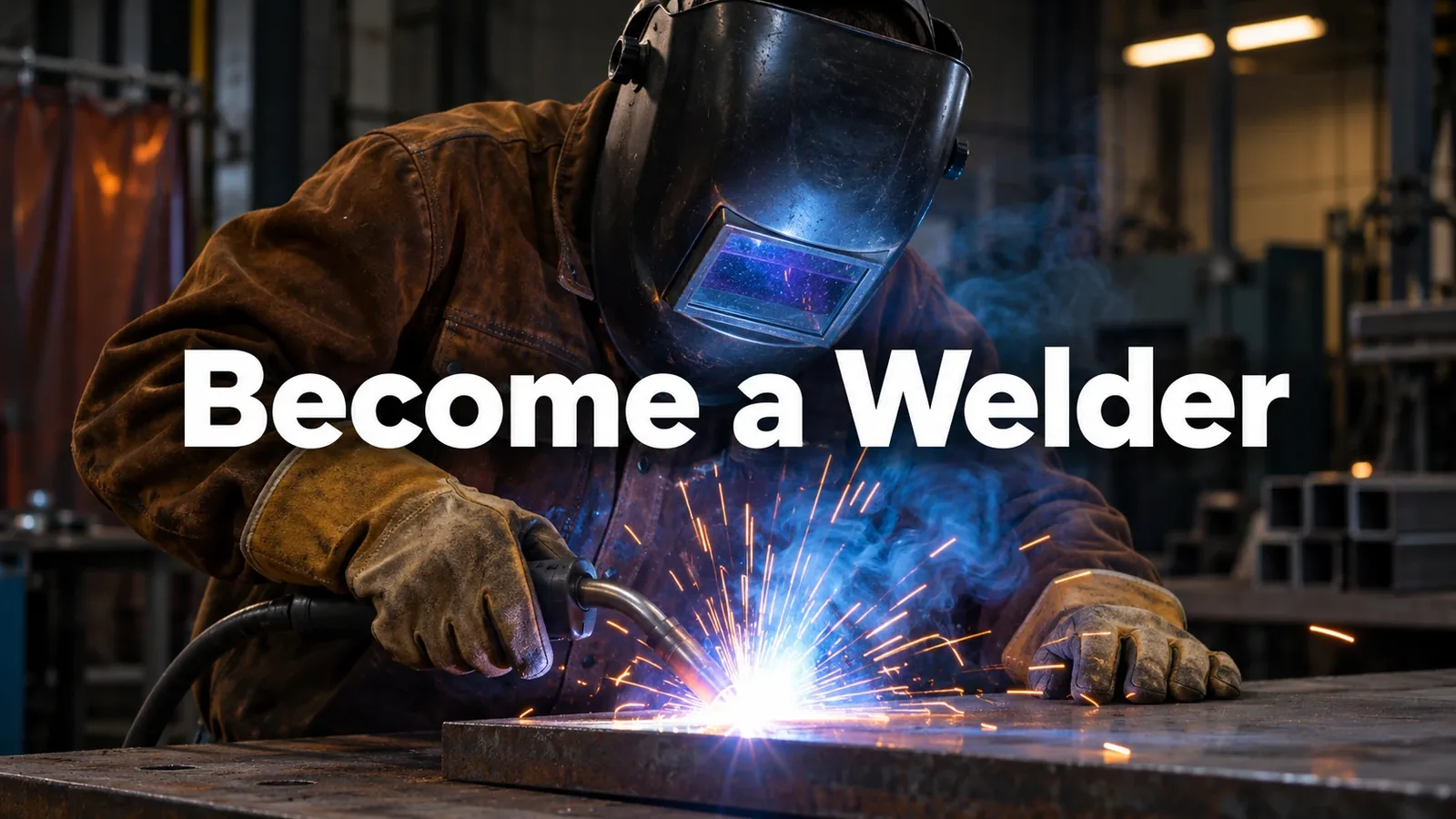
Most people become welders by completing a welding certificate program (about 6 to 18 months at a community college or trade school), passing a hands-on weld test such as the American Welding Society’s Certified Welder test, and then getting hired into an entry-level job or a paid apprenticeship. You do not need a college degree, and no state requires a general welding license, though some cities and job types require specific certifications.
The median pay for welders, cutters, solderers and brazers was $53,750 a year ($25.84 an hour) in 2025, according to the Bureau of Labor Statistics. Pay rises quickly with skill: welders who pass pipe and structural tests, travel for industrial work, or join union trades often earn well above that. Here is the full path, the costs, and how to choose the training that fits the job you want.
What welders actually do
Welders join metal parts using heat, filler metal and shielding gas. On a given day that might mean fabricating trailer frames in a shop, welding structural steel on a building site, repairing farm equipment, or running pipe welds at a refinery. Most entry-level jobs are in manufacturing and fabrication shops, where you weld the same kinds of joints repeatedly and build speed.
The four processes you will hear about most:
- Stick (SMAW): simple equipment, works outdoors and on dirty metal; common in construction, repair and pipeline work.
- MIG (GMAW): fastest to learn; the main process in production and fabrication shops.
- Flux-core (FCAW): similar to MIG but works better outdoors and on thicker steel; common in structural work and shipbuilding.
- TIG (GTAW): slow and precise; used for stainless steel, aluminum, aerospace and pipe root passes. Hardest to master and often best paid.
The work is physical. Expect heat, noise, sparks, fumes, awkward positions and long hours on your feet. Good ventilation, a quality helmet and fire-resistant clothing are part of the job every day.
Step-by-step path to becoming a welder
- Finish high school or a GED. Shop class, geometry and basic blueprint reading help. Many high schools and career centers offer welding courses that count toward a later certificate.
- Try it before paying tuition. A short evening intro class at a community college (often a few hundred dollars) shows whether you can tolerate the heat, the hood and the repetition.
- Enroll in a welding program. Choose a certificate or diploma program that includes structured practice time in the booth and prepares you for AWS or employer weld tests.
- Learn blueprint reading and weld symbols. Employers test this alongside welding skill, and it separates fitters from helpers.
- Pass a weld certification test. Most schools are AWS Accredited Test Facilities or work with one. You weld a test plate in a given process and position, and it is bent or X-rayed to check for defects.
- Apply for entry-level jobs or apprenticeships. Expect a hands-on weld test at most interviews, even if you already hold a certification.
- Add certifications as you go. Moving from flat-position plate to vertical, overhead and then pipe tests is how welders raise their pay.
Training options and what they cost
There are four main routes. Costs below are typical ranges for late 2026 and vary by state, school and how much of your gear and test fees are included.
| Route | Typical length | Typical cost | Best for |
|---|---|---|---|
| Community college certificate | 6 to 12 months | About $3,000 to $15,000 | Lowest cost, financial aid eligible, local shop jobs |
| Associate degree (AAS) in welding technology | About 2 years | About $8,000 to $25,000 | Inspection, supervision or fabrication roles later |
| Private welding school | 7 to 12 months, often full time | About $15,000 to $35,000+ | Fast, intensive booth time; pipe welding focus |
| Union or employer apprenticeship | 3 to 5 years | Usually no tuition; you earn wages | Pipefitting, ironwork, boilermaking, shipyards |
Many community college and accredited private programs qualify for federal student aid through the FAFSA, including Pell Grants for eligible students. State workforce programs funded by the Workforce Innovation and Opportunity Act (WIOA) can also cover training for unemployed or low-income adults. Ask the school’s financial aid office before you sign anything.
Budget for gear too. A decent auto-darkening helmet, gloves, jacket, boots, grinder and hand tools commonly run $300 to $800 for a student.
Example: Carlos, 24, works in a warehouse and wants a trade. He enrolls in a two-semester welding certificate at his community college for about $5,500 in tuition and fees, plus $500 in gear. A Pell Grant covers about half. He keeps working weekends, passes a 3G (vertical) flux-core plate test through the college’s accredited test facility for about $120, and is hired at a trailer manufacturer for $21 an hour. After a year, he passes a 6G pipe test and moves to a pipe fabrication shop paying $27 an hour.
Welding certifications explained
Welding certifications are tied to a specific process, metal, thickness and position. You might be certified for stick welding on carbon steel plate in the vertical position, which does not certify you for TIG on stainless pipe.
- AWS Certified Welder (CW): a performance test at an AWS Accredited Test Facility. Typical costs run about $70 to $150 per test including plate and registration fees, though facilities set their own prices. To keep it active, you must document that you have used the process at least every six months.
- Positions: 1G and 2G (flat and horizontal) are the entry point; 3G (vertical) and 4G (overhead) on plate are what structural employers want; 6G pipe tests cover all positions and are the benchmark for pipe welders.
- Employer and code tests: many employers test you to their own procedure under codes such as AWS D1.1 (structural steel) or ASME Section IX (pressure vessels and piping). These are usually paid by the employer.
- Certified Welding Inspector (CWI): a later-career credential from AWS for experienced welders who move into quality control. The exam costs over $1,000, plus seminar fees, and requires years of work experience.
How much welders make
BLS data for 2025 put median pay at $53,750 a year. Median pay was $59,440 in specialty trade contracting and $51,210 in manufacturing. Entry-level shop jobs often start in the high teens to low twenties per hour depending on the region.
Factors that push pay higher:
- Pipe welding certifications, especially 6G and TIG root passes.
- Union membership in pipefitting, boilermaking or ironworking, where apprentices earn a rising percentage of journeyman scale.
- Travel and shutdown work at refineries and power plants, which often includes overtime and per diem.
- Specialties such as underwater welding, aerospace TIG or nuclear work, which require extra training and come with more risk or stricter quality rules.
BLS projects about 2% employment growth from 2025 to 2035, slower than average, but about 40,300 openings each year as welders retire or change careers. In practice, employers in many regions still report trouble finding welders who can pass a vertical or pipe test.
Example: Shanice finishes a private 9-month pipe welding program that costs about $22,000. She takes a helper job at $20 an hour while practicing 6G on weekends. Eight months later she passes an employer’s pipe test and joins a mechanical contractor at $30 an hour. Her first year with overtime comes to roughly $66,000. Her tuition paid off quickly, but she also notes that half her classmates who did not keep practicing were still in helper roles.
Is welding a good career for you?
Welding suits people who like working with their hands, can focus on detail for long stretches, and do not mind physical conditions. It is a weaker fit if you have respiratory problems, cannot work in heat, or want a job you can do from home.
Health and safety deserve real attention. Fumes, ultraviolet light and burns are everyday hazards. Employers are required to follow OSHA rules on ventilation and protective equipment, and good shops take them seriously. Ask about fume extraction and safety training when you interview.
Common questions
How long does it take to become a welder?
Most people are job ready after a 6 to 12 month certificate program. Reaching higher-paying pipe or structural work usually takes another one to three years of practice and testing. Union apprenticeships run three to five years but pay you while you learn.
Do you need a license to weld?
There is no general state welding license in most of the US. Instead, employers and building codes require you to pass certification tests for specific processes and positions. Some cities require a separate certification for structural steel work.
Can you become a welder without going to school?
Yes. Some shops hire helpers and train them, and union apprenticeships accept people with no experience after an aptitude test. Formal training usually gets you hired faster and at a higher starting wage.
Which welding process should I learn first?
Most programs start with stick and MIG because they cover the majority of entry-level jobs. Add flux-core for structural work and TIG if you want stainless, aluminum or pipe work.
Is welding hard on your body?
It can be. Welders often work bent over, kneeling or overhead, in heat, with exposure to fumes and noise. Good protective gear, ventilation and stretching help, and many welders move into inspection or supervision later in their careers.
Before you enroll
- Visit the shop and ask how many hours of actual booth time students get each week.
- Ask whether the school is an AWS Accredited Test Facility and whether test fees are included.
- Ask for job placement rates and which local employers hire graduates.
- Compare the community college price with private schools and check aid through StudentAid.gov.
- Check local union apprenticeship openings, which usually post application windows once or twice a year.
- Review the BLS outlook for welders for national pay and job data.
Editorial note: This article is general career information. Pay, costs and certification rules were checked as of November 2026; confirm current requirements with the American Welding Society, your training program and local employers.