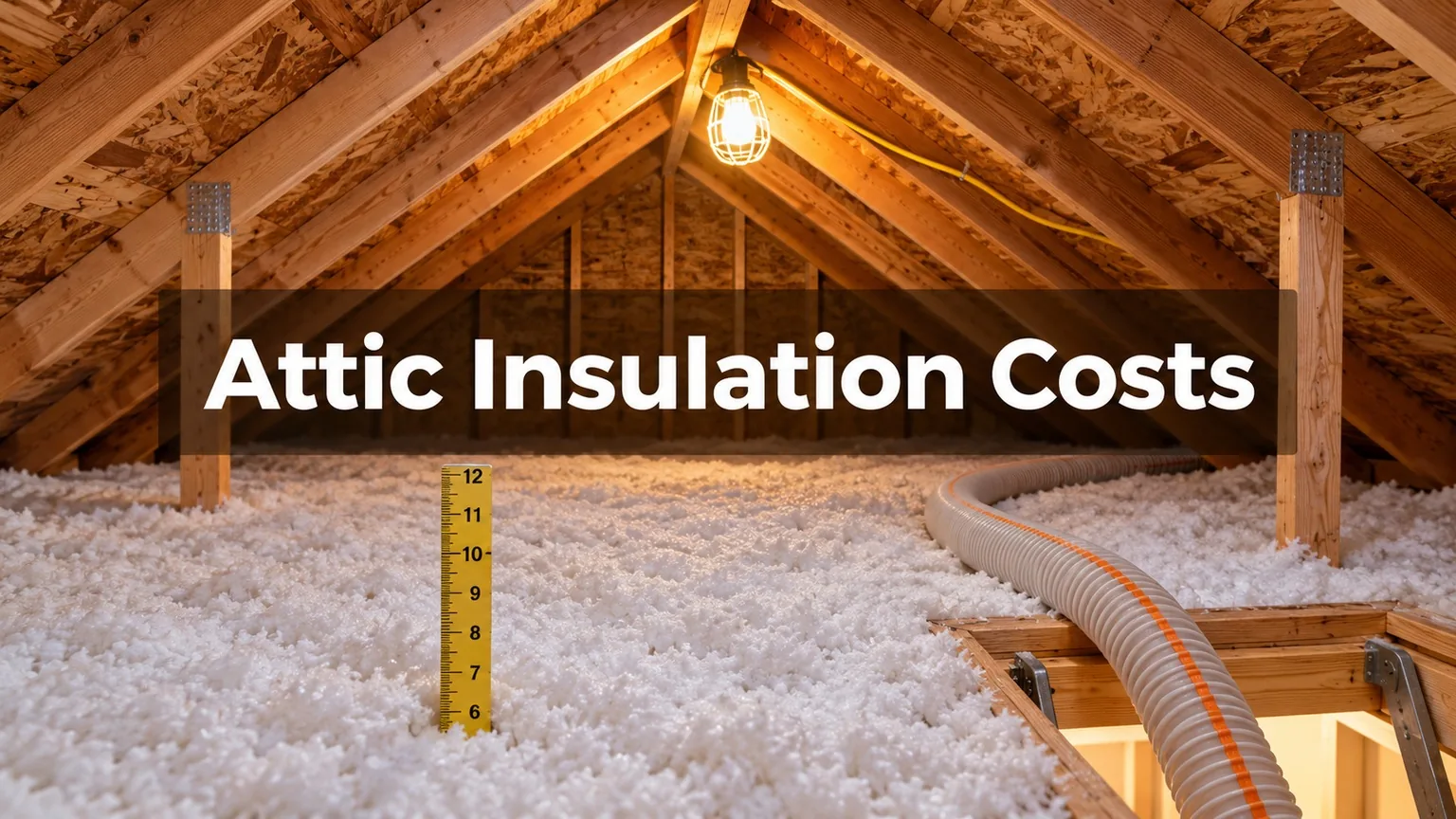
Most homeowners pay between $1,500 and $4,500 to have a contractor insulate an attic, with a national average around $2,500. Blown-in fiberglass and cellulose are the cheapest per square foot at roughly $1 to $3 installed, while spray foam on the roof deck can push a job past $7,000. The biggest swing factors are attic size, the depth you are adding, and whether the old insulation has to come out first.
Below you will find 2026 price ranges by material, the R-value Energy Star recommends for your climate, what removal and air sealing add to the bill, and how to tell if your attic needs more insulation at all. There are also two worked examples so you can sanity check a quote before you sign it.
What attic insulation costs by material
Contractors price attic work per square foot of attic floor, and the material you choose sets the baseline. These ranges include labor for a standard, accessible attic. Expect the high end in large metro areas, in attics with low clearance, and for jobs that add a lot of depth.
| Material | Installed cost per sq ft | R-value per inch (approx.) | Best fit |
|---|---|---|---|
| Blown-in fiberglass | $1.00 to $2.50 | 2.2 to 2.7 | Topping up an open attic floor, budget jobs |
| Blown-in cellulose | $1.20 to $3.00 | 3.2 to 3.8 | Filling around wiring and framing, better air resistance |
| Fiberglass batts | $0.80 to $2.50 | 2.9 to 3.8 | DIY, unobstructed joist bays, attics with flooring planned |
| Spray foam (open or closed cell) | $1.50 to $5.00+ | 3.5 to 7.0 | Sealing the roof deck to make a conditioned attic, odd spaces |
| Removing old insulation | $1.00 to $2.00 extra | None | Wet, moldy, rodent-damaged or vermiculite-era material |
Air sealing is usually quoted separately at about $200 to $1,500 depending on how many gaps the crew has to chase down. It is worth paying for. Warm air leaking through recessed lights, plumbing stacks and the attic hatch carries moisture into the attic and undercuts whatever insulation you add.
How much insulation your attic needs
Energy Star sets its targets by climate zone. In most of the country, the recommendation for an attic with little or no insulation is R49 to R60. Here is the short version:
- Zone 1 (South Florida, Hawaii): R30 for an uninsulated attic, R25 if you already have 3 to 4 inches.
- Zones 2 and 3 (Gulf Coast, most of Texas, the Southeast, Southern California): R49, or R38 if you already have 3 to 4 inches.
- Zones 4 through 8 (mid-Atlantic, Midwest, Northeast, mountain states, Alaska): R60, or R49 if you already have 3 to 4 inches.
Translated into depth, R49 is about 13 to 15 inches of cellulose or 18 to 22 inches of blown fiberglass. R60 means roughly 16 to 19 inches of cellulose or 22 inches or more of fiberglass. That is why fiberglass, which is cheaper per inch, does not always come out cheaper per R-value. Ask each contractor to quote the finished R-value and the number of bags they will install, then check the bag label, which lists bags needed per 1,000 square feet for each R-value.
You can find your climate zone and the full chart on the Energy Star insulation R-values page.
Signs your attic needs more insulation
A quick look from the hatch tells you most of what you need to know. Take a tape measure and a flashlight, and do not step between joists unless there is a board to stand on.
- You can see the tops of the ceiling joists. Standard 2×6 joists are about 5.5 inches tall, so visible joists mean you are well under R30.
- The insulation is uneven, with bare patches near the eaves or packed down where someone walked or stored boxes.
- Upstairs rooms run several degrees warmer in summer and colder in winter than the floor below.
- Icicles and ice dams form along the roof edge in winter, a sign that heat is escaping and melting snow on the roof.
- The material is gray-brown and pebbly. That may be vermiculite, which can contain asbestos. Do not disturb it, and have it tested before any work.
What pushes the price up or down
Two attics of the same size can produce quotes that differ by $2,000 or more. The usual reasons:
- Removal. Vacuuming out old insulation roughly doubles the labor and adds disposal fees. If the existing layer is dry and clean, most installers blow new material right over it.
- Access. A walk-up attic with a full stairway is faster than a 22-inch scuttle hole in a closet ceiling. Low-slope roofs with tight eaves also slow the crew down.
- Prep work. Baffles at the eaves (to keep soffit vents clear), dams around the hatch, and covers or clearance around older recessed lights add materials and time.
- Depth. Going from R11 to R60 costs much more than going from R30 to R49, simply because there is more material.
- Spray foam on the roof deck. Foaming the underside of the roof turns the attic into conditioned space, which helps when ductwork or an air handler lives up there, but it costs several times more than blowing loose fill on the floor.
Example: Dana has a 1,200 sq ft ranch house in Ohio (zone 5) with about 4 inches of old fiberglass that is dry and in decent shape. Energy Star suggests R49 when 3 to 4 inches already exist. A contractor quotes 12 inches of cellulose at $1.60 per sq ft ($1,920) plus $600 to air seal the top plates, light boxes and hatch. Total: $2,520. Removal is not needed, so that line stays off the bill.
Example: Marcus has a 1,500 sq ft attic in Georgia (zone 3) where a raccoon got in two winters ago and soiled half the insulation. The crew has to vacuum it all out at $1.50 per sq ft ($2,250), sanitize, air seal ($900), and blow in R49 cellulose at $2.00 per sq ft ($3,000). His total lands near $6,150, more than double Dana’s for an attic only 25% larger.
DIY vs. hiring a contractor
Blowing loose fill yourself is one of the more realistic DIY energy projects. Big box stores often lend the blowing machine free or at a low daily rate when you buy a minimum number of bags. Material alone usually runs about $0.50 to $1.20 per sq ft for a top-up, so a 1,200 sq ft attic could cost $700 to $1,400 in bags.
The savings are real, but so are the downsides. It is a two-person job (one feeding the hopper, one in the attic), attics are hot and dusty, and the air sealing step is where most DIY jobs fall short. Hire out if the attic has knob-and-tube wiring, possible vermiculite, signs of mold, very low clearance, or a bathroom fan that vents into the attic instead of outdoors. Those all need fixing before any insulation goes in.
How a typical installation goes
Whether you hire it out or do it yourself, the order of work matters. A good contractor follows roughly these steps:
- Inspect the attic for moisture stains, mold, pests, damaged wiring and vermiculite, and confirm bath and kitchen fans vent outdoors.
- Remove old insulation if it is wet, contaminated or hazardous. Otherwise leave it in place.
- Air seal from above: foam or caulk around plumbing and wiring holes, top plates of interior walls, chimney gaps (with fire-rated material) and light fixtures.
- Install baffles at every rafter bay along the eaves so insulation does not block soffit ventilation.
- Build a dam around the attic hatch and weatherstrip and insulate the hatch cover itself.
- Set depth markers (rulers stapled to joists) across the attic so the finished depth can be checked.
- Blow in the insulation evenly to the target depth, working from the far end back toward the hatch.
- Walk you through the finished job and leave a certificate on the framing that lists the material, depth, R-value and bag count.
That certificate matters. It is how you, a home inspector or a future buyer can confirm what you paid for.
Savings and incentives in 2026
Energy Star estimates that air sealing and adding insulation can cut a home’s total energy costs by around 11%, with bigger gains in older homes that started with little or nothing in the attic. On a $2,400 yearly utility bill, that is roughly $260 a year, which puts payback for a $2,500 job at about 9 to 10 years. Homes with very thin existing insulation often see faster payback.
One change to know about: the federal Energy Efficient Home Improvement Credit (Section 25C), which covered 30% of insulation material costs up to $1,200 a year, ended for improvements made after December 31, 2025. Insulation installed in 2026 does not qualify. Many electric and gas utilities still offer rebates for attic insulation and air sealing, sometimes $0.25 to $1.00 per sq ft or a flat amount, and some states run their own programs. Check your utility’s rebate page before you schedule the work, since many require a pre-inspection.
Common questions
How much does it cost to insulate a 1,000 sq ft attic?
Expect about $1,500 to $3,000 with blown-in insulation and basic air sealing, assuming the old material can stay. If it has to be removed, add roughly $1,000 to $2,000. Spray foam on the roof deck for the same space can run $5,000 or more.
Is blown-in or batt insulation better for an attic?
For most open attic floors, blown-in is the better choice because it fills gaps around wires, pipes and framing that batts leave open. Batts make sense when the bays are clean and unobstructed, or when you plan to lay storage flooring on raised supports. Both perform well when installed to full depth without gaps or compression.
Can you put new insulation over old insulation?
Yes, if the old insulation is dry, free of mold and pest waste, and not vermiculite. You can lay fiberglass or cellulose over either type. If you add batts over existing material, use unfaced batts so you do not trap a vapor barrier in the middle of the layer.
How long does attic insulation last?
Fiberglass and cellulose can last for decades if they stay dry and undisturbed. Cellulose settles somewhat over the first few years, which is why installers blow it slightly deeper than the target. Roof leaks, pests and foot traffic are what shorten its life.
How long does the job take?
A blown-in top-up on a typical attic takes a crew about half a day to a full day, including air sealing. Removal jobs and spray foam can take two to three days.
Before you hire anyone
- Measure your attic floor area and existing insulation depth so you can compare quotes on the same basis.
- Get at least three quotes that each list the material, the finished R-value, the bag count and the air sealing scope as separate lines.
- Ask whether baffles, a hatch dam and hatch insulation are included.
- Have suspected vermiculite tested before anyone enters the attic to work.
- Check your utility and state energy office for 2026 rebates and their pre-approval rules.
- Get the attic insulation certificate and a copy of the invoice for your home records.
Editorial note: This article is general information for homeowners. Prices and program details were checked as of November 2026 and vary by region and contractor, so confirm R-value guidance with Energy Star and your local building department, and rebate rules with your utility.