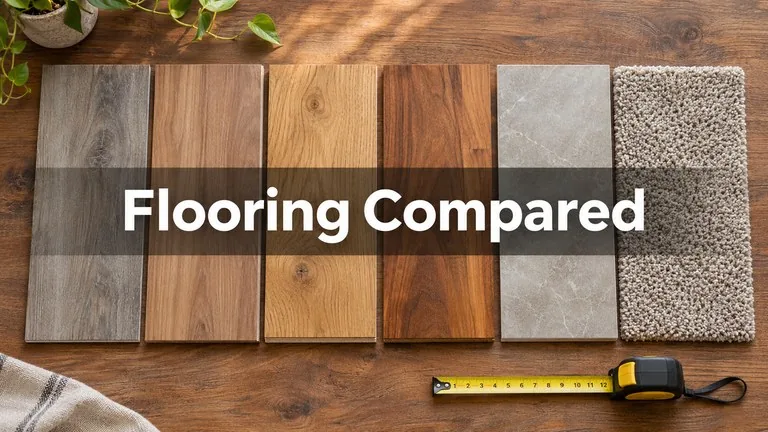
For most busy households in 2026, luxury vinyl plank is the best all-around flooring: it costs about $5 to $12 per square foot installed, shrugs off spills, and handles pets and kids well. Engineered hardwood ($8 to $20 installed) is the pick if you want real wood with some moisture tolerance, solid hardwood ($12 to $25) lasts the longest because it can be refinished many times, and porcelain tile ($10 to $20) is the most water-proof and durable choice for wet rooms. Laminate is the low-cost scratch-resistant option, and carpet (about $4 to $6.50) is still the cheapest and quietest for bedrooms.
No single floor wins every room. A good plan often uses two or three materials: something waterproof for the kitchen, baths and entry, and something warmer or more traditional for living spaces and bedrooms. The comparison below covers installed costs, lifespan, water resistance, how each holds up to dogs and children, and what to choose room by room.
Flooring options compared side by side
Installed prices include materials and basic installation but not removing old flooring (about $1 to $3 per square foot) or subfloor repairs. They’re national ranges compiled from 2026 retailer and installer data, so local quotes can vary.
| Flooring | Installed cost per sq ft | Typical lifespan | Water resistance | Pets and kids |
|---|---|---|---|---|
| Luxury vinyl plank (LVP) | $5 to $12 | About 15 to 20 years | Waterproof planks; seams and subfloor can still be damaged by standing water | Very good; scratch resistance depends on wear layer |
| Laminate | $4 to $12 | About 15 to 25 years | Water-resistant at best on most lines; swells if water sits on seams | Very good scratch resistance; can be loud and slippery |
| Engineered hardwood | $8 to $20 | About 25 to 40 years | Moderate; more stable than solid wood but not waterproof | Fair; dents and scratches like wood, limited refinishing |
| Solid hardwood | $12 to $25 and up | 50 years or more with refinishing | Low; cups and stains with repeated moisture | Fair; harder species resist dents better |
| Ceramic tile | $7 to $15 | 50 years or more if well installed | Excellent; grout needs sealing | Excellent for wear; hard and cold, dropped items break |
| Porcelain tile | $10 to $20 | 50 years or more if well installed | Excellent; denser than ceramic | Excellent; most scratch-resistant option |
| Carpet | $4 to $6.50 | About 5 to 15 years depending on traffic | Poor; pads hold spills and odors | Soft for kids; stains and wears fastest with pets |
What each floor is really like to live with
Luxury vinyl plank is a layered vinyl product with a printed wood or stone look and a clear wear layer on top. Rigid-core types (SPC, a stone-plastic composite, and WPC, a wood-plastic composite) click together over most subfloors. Look at the wear layer thickness, measured in mils: 12 mil is fine for bedrooms, while 20 mil or more is the better pick for kitchens, hallways and homes with large dogs. Cheap LVP with a thin wear layer scuffs quickly and can’t be refinished.
Laminate has a fiberboard core with a photographic layer and a very hard melamine top. That top makes it more scratch-resistant than many vinyl floors, which is why some dog owners prefer it. Its weak point is water at the seams, though newer water-resistant lines hold up to spills for many hours. Check the AC rating: AC3 suits all residential rooms, and AC4 handles heavy household traffic.
Engineered hardwood is a real hardwood veneer glued over a plywood or composite core. The core makes it more stable than solid wood in humid climates and allows installation over concrete and in basements, which solid wood doesn’t handle well. A wear layer of 2 to 3 mm or more allows at least one full sanding and refinishing. Very thin veneers can only be screened and recoated.
Solid hardwood is three-quarter-inch boards of a single species, nailed to a wood subfloor. It can be sanded and refinished several times over its life, which is why it can outlast every other option on this list. Hardness varies by species. On the Janka hardness scale, red oak rates about 1,290, white oak about 1,360, hard maple about 1,450 and hickory about 1,820, so hickory and maple hide dog claws and dropped toys better than oak.
Porcelain and ceramic tile are fired clay. Porcelain is denser and absorbs less water, so it’s the safer choice for showers, entries in snowy climates and outdoor-adjacent rooms. Tile lasts for decades but is cold and hard underfoot, and labor is a large part of the cost because layout, cutting and grouting take time.
Carpet costs the least and makes rooms quieter and warmer. It wears in traffic lanes, can trap allergens, and is a poor match for pets that have accidents. Buying a better pad and a higher-density carpet adds more life than buying the thickest pile.
Best flooring by room
- Kitchen: LVP or porcelain tile. Both handle spills, and LVP is softer if you stand to cook for long stretches. Engineered wood works if you wipe up spills promptly.
- Bathrooms: porcelain or ceramic tile first, LVP second. Avoid solid hardwood and most laminate where water splashes daily.
- Living and dining rooms: hardwood or engineered hardwood for long-term value, LVP or laminate for busy households on a budget.
- Bedrooms: carpet for warmth and quiet, or wood or LVP with area rugs.
- Basements: LVP, or engineered hardwood rated for below-grade use. Do a moisture test on the concrete first. Avoid solid wood and standard laminate.
- Entry and mudroom: porcelain tile or a thick-wear-layer LVP.
Best options for pets and kids
For dogs, the main threats are claws, accidents and water bowls. Porcelain tile and laminate resist scratches best. LVP with a 20 mil or thicker wear layer comes next and is quieter than tile and less slippery than many laminates, which matters for older dogs. If you want wood, choose a harder species like hickory or maple, a matte or wire-brushed finish that hides scratches, and engineered boards if you want more moisture tolerance.
For young children, softness and easy cleanup matter more. LVP is warm, quiet and wipes clean. Carpet is softest for crawling but harder to keep clean. Tile is easy to clean but hard on falls, so many families use rugs on tile and wood in play areas.
Example: The Patels have two large dogs and a toddler. They put 20-mil LVP through the kitchen, hallway and family room (800 square feet at about $8 installed, or $6,400) and keep carpet in the bedrooms. Engineered white oak for the same 800 square feet was quoted at $13 installed, or $10,400. The vinyl saves $4,000 and stands up better to the dogs, and they plan to revisit wood when the dogs are older.
How to estimate flooring cost and order the right amount
- Measure each room’s length and width and multiply to get square feet. Add closets and halls you’ll cover.
- Add waste: about 10% for most plank floors and 10% to 15% for tile, diagonal layouts or rooms with many corners.
- Price removal of the old floor: roughly $1 to $1.50 per square foot for carpet and $2 to $3 for tile or hardwood, more for glued-down products.
- Have the subfloor checked. Floating floors need a flat surface, commonly within about 3/16 inch over 10 feet, and leveling compound or plywood repairs add cost.
- Budget for transitions, baseboard or quarter-round, underlayment and moving furniture and appliances.
- Let wood and some laminates acclimate in the house for the time the manufacturer requires before installing.
- Keep a box or two of extra planks or tile from the same lot for future repairs.
Example: Jordan wants porcelain tile in a 9-by-10-foot bathroom (90 square feet). With 15% waste he orders about 104 square feet. Removal of the old vinyl runs about $180, a new cement board underlayment about $250, and tile installed at $14 per square foot about $1,260 on the 90 square feet laid. His total is close to $1,700 before baseboard and the new toilet seal.
Resale value and long-term cost
Hardwood floors have long been a selling point in listings for living areas. Laminate and LVP have closed much of the gap in appearance and are widely accepted by buyers, especially in kitchens and basements. Over a 30-year span, solid hardwood often costs less per year than cheaper floors, since one install plus a refinish every decade or so can outlast two or three replacements of carpet or entry-level vinyl. If you plan to move within five years, a quality LVP or laminate usually makes more sense than paying the hardwood premium.
Common questions
What is the most durable flooring for a house?
Porcelain tile is the most durable against scratches, water and wear. Solid hardwood lasts the longest overall because it can be sanded and refinished many times. For a balance of durability and cost, LVP with a 20 mil wear layer is the common choice.
Is LVP better than laminate?
LVP is better in wet areas because the planks are waterproof. Laminate usually resists scratches better and can feel more like wood. Both cost about the same installed.
What flooring is best with dogs?
Porcelain tile and laminate resist scratches best, and LVP with a thick wear layer handles accidents and water bowls well. If you want hardwood, choose a hard species like hickory or maple with a matte finish.
What is the cheapest flooring to install?
Carpet is typically the cheapest at about $4 to $6.50 per square foot installed. Entry-level laminate and LVP can come in around $4 to $6 installed, and click-together planks are easy for DIY installation.
Can you put hardwood in a kitchen?
Yes, many kitchens have hardwood, but it needs prompt cleanup of spills and a mat at the sink and dishwasher. Engineered hardwood handles humidity changes better than solid boards in a kitchen.
Before you buy
- List each room’s main risk: water, scratches, noise or cold.
- Check wear layer (LVP), AC rating (laminate), veneer thickness (engineered) or species hardness (solid wood).
- Take samples home and test them with a scratch from a house key, a puddle of water left overnight and your actual lighting.
- Add 10% to 15% waste and order everything from one production lot.
- Get the subfloor checked and include removal and leveling in quotes.
- Read the warranty terms on water exposure, pets and installation requirements.
Editorial note: This article is general information. Prices and product details were checked as of November 2026 and vary by brand and region, so confirm costs with local installers and follow the flooring manufacturer’s installation and warranty instructions.