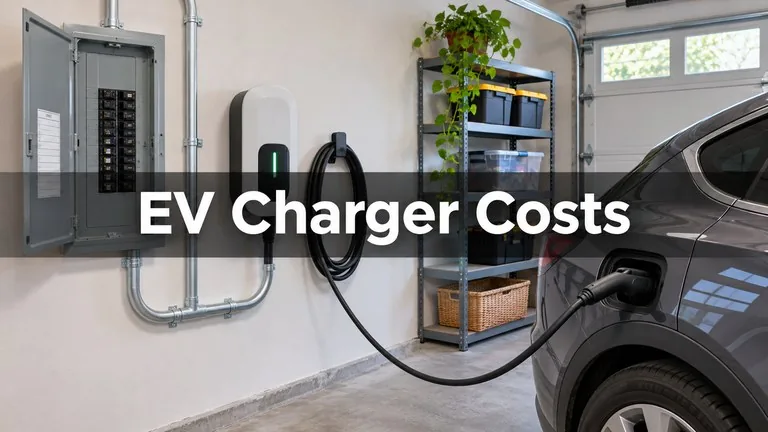
A Level 2 home EV charger costs about $1,700 installed on average in 2026, with most jobs landing between roughly $750 and $2,500, according to installer network Qmerit. That typically covers the charger (around $800 in Qmerit’s example), labor and permit (about $600) and wire, conduit and breaker (about $300). If your electrical panel needs an upgrade, add roughly $1,500 to $3,000. Level 1 charging uses an ordinary 120-volt outlet and the cord that comes with most EVs, so it often costs nothing to start.
The federal home charger tax credit is no longer available for new installs. The IRS limits the Section 30C credit for individuals to chargers placed in service by June 30, 2026, so a charger installed now does not qualify. Utility rebates and state programs still exist in many areas. Below is how Level 1 and Level 2 compare, what drives the installation price, when a panel upgrade is really needed, and how to get an accurate quote.
Level 1 vs Level 2 home charging
The two levels differ mainly in voltage and speed. The EPA estimates Level 1 adds roughly 5 miles of range per hour of charging and Level 2 roughly 25 miles per hour, based on 1.9 kW and 6.6 kW of power. Faster Level 2 units can add more if your car accepts it.
| Level 1 | Level 2 | |
|---|---|---|
| Voltage | 120 volts (standard outlet) | 240 volts (like a dryer or range) |
| Range added per hour | About 5 miles | About 25 miles at 6.6 kW, more on higher-power units |
| Range added in 10 hours overnight | About 50 miles | About 250 miles |
| Equipment | Cord usually included with the car | Charger roughly $300 to just under $2,000 |
| Typical installed cost | Often $0 if a suitable outlet exists | About $750 to $2,500, averaging around $1,700 |
| Circuit needed | Existing 120-volt outlet, ideally not shared with other heavy loads | Dedicated 240-volt circuit, commonly a 40 to 60 amp breaker |
| Best for | Plug-in hybrids and EV drivers who cover about 40 miles a day or less | Longer commutes, two EVs, cold climates or drivers who want a full battery every morning |
Many people buy a Level 2 charger they do not strictly need. If your daily driving is short and the car sits plugged in for 10 or more hours a night, Level 1 can keep up. The EPA notes that many drivers with commutes under 40 miles a day charge overnight on Level 1 without trouble.
Example: Priya drives 28 miles a day and parks in her garage from 7 p.m. to 7 a.m. At about 5 miles per hour of Level 1 charging, 12 hours adds around 60 miles, more than double what she uses. She skips the installation for now and plans to add Level 2 only if her commute changes or she buys a second EV.
What goes into the installation price
The charger is often less than half the bill. Qmerit’s 2026 data breaks a typical job down like this:
- Charger hardware: roughly $300 to just under $2,000. Most quality units with Wi-Fi and a 40 to 48 amp output sit in the middle of that range.
- Labor and permit: about $500 to $1,200 combined.
- Materials: around $300 for wire, conduit, a breaker and mounting hardware on a typical job.
- Permits: anywhere from $50 to $800 depending on the city, with an average of about $310.
- Panel upgrade, if needed: about $1,500 to $3,000.
The two biggest variables are distance and panel capacity. A charger mounted on the garage wall a few feet from the panel is a short, cheap run. A charger in a detached garage or on the far side of the house may need a long run of heavy-gauge wire through finished walls, or trenching and conduit outdoors, which adds both materials and hours. Copper wire sized for a 60 amp circuit is expensive per foot, so every extra foot shows up on the bill.
Choosing the right amperage
Electrical code treats EV charging as a continuous load, so the circuit must be rated at 125% of what the charger draws. A charger set to 32 amps needs a 40 amp circuit, a 40 amp charger needs 50 amps, and a 48 amp charger needs a 60 amp circuit. At 240 volts, 32 amps delivers about 7.7 kW and 48 amps about 11.5 kW.
Before paying for a big circuit, check your car’s onboard charger rating in the owner’s manual. If the car can accept only about 7 kW, a 48 amp charger will not charge it any faster than a 32 amp one, and the smaller circuit may avoid a panel upgrade. Many chargers let the electrician set the output lower to match the circuit, so you can install a capable unit now and keep options open.
Plug-in or hardwired?
Many Level 2 chargers come in a plug-in version that uses a NEMA 14-50 outlet (the same type used for electric ranges and RV hookups) and a hardwired version connected directly to the circuit. A plug-in unit is easy to take with you when you move. Hardwired installs can run at higher amperage, look tidier and avoid wear on an outlet that gets plugged and unplugged.
Newer editions of the National Electrical Code generally require GFCI protection on 240-volt outlets in garages and outdoors, and some chargers have their own ground fault protection that can conflict with a GFCI breaker and cause nuisance trips. For that reason, many electricians recommend hardwiring. Ask your electrician which approach your local code and charger model call for, and make sure the outlet, if used, is an industrial-grade one rated for continuous load.
Do you need a panel upgrade?
Often not. Most homes with 200 amp service can add a Level 2 charger without an upgrade. Older homes with 100 amp panels, especially those with electric heat, a heat pump, an electric range and an electric dryer, are the ones most likely to come up short. The only reliable way to know is a load calculation by a licensed electrician, which adds up your home’s existing demand and shows how much capacity is left.
If the numbers are tight, there are cheaper alternatives to a full service upgrade:
- Lower the charger’s output to 24 or 32 amps so it fits the available capacity.
- Use a load management device or a charger with built-in load sharing that pauses charging when the house is drawing a lot of power.
- Install a circuit-sharing switch that alternates power between the charger and an existing appliance such as the dryer.
Example: The Okafor family lives in a 1970s house with a 100 amp panel and a detached garage 80 feet away. One electrician quotes about $2,000 for a panel upgrade plus trenching and wire. A second suggests setting the charger to 24 amps with a load management device. That still adds about 5.8 kW, or roughly 20 miles of range per hour, enough to refill their daily 45 miles in a few hours, and it avoids the panel upgrade entirely.
Rebates and incentives in 2026
With the federal 30C credit closed to new installs, local programs are where the money is. Utility rebates for a qualifying Level 2 charger commonly run from about $200 to $1,000 or more, with smaller municipal utilities at the low end and some large utilities at the high end. Common conditions include buying an ENERGY STAR certified or networked charger, using a licensed electrician with a permit, enrolling in a time-of-use rate or managed charging program, and in some cases applying before you buy. Some programs also help pay for panel or wiring work.
A time-of-use rate can save more over the years than the rebate itself. Charging overnight when rates are lowest is easy because most chargers and EVs let you schedule a start time. At AAA’s 2026 home electricity average of 18 cents per kWh, an EV driven 1,000 miles a month at 3.5 miles per kWh uses about 286 kWh, roughly $51 a month, and an off-peak rate can bring that down further.
If you installed a charger by June 30, 2026, at your main home in an eligible census tract, you may still claim the 30C credit (30% of the cost, up to $1,000) on IRS Form 8911 with your 2026 return. Details are on the IRS 30C page.
How to plan your home charger installation
- Check your daily miles and your car’s maximum AC charging rate to decide between Level 1 and Level 2, and which amperage makes sense.
- Look at your main panel label for its amp rating and note how many open breaker spaces it has.
- Search your utility’s website and the Department of Energy’s Alternative Fuels Data Center for rebates, and note any pre-approval step.
- Choose where the car parks and where the charger will mount, keeping the cable run as short as possible.
- Get two or three itemized quotes from licensed electricians that include a load calculation, permit, materials and labor.
- Have the electrician pull the permit and schedule the inspection, then keep the invoice and permit records for your rebate.
- Enroll in a time-of-use rate if your utility offers one and set the charging schedule.
Example: Sam has a 200 amp panel on the garage wall about 15 feet from where he parks. His quote: $650 for a 48 amp hardwired charger, $700 for labor and the permit, and $250 for materials, totaling $1,600. His utility offers a $500 rebate for an ENERGY STAR charger on its time-of-use plan, bringing his net cost to about $1,100.
Common questions
How much does it cost to install a Level 2 charger at home?
About $1,700 on average in 2026 according to Qmerit, with typical jobs between roughly $750 and $2,500 including the charger. A panel upgrade adds about $1,500 to $3,000. Long wire runs and detached garages push the price toward the top of the range.
Is the federal EV charger tax credit still available?
Not for new installations. The IRS says the individual 30C credit applies to chargers bought and placed in service at your main home from 2023 through June 30, 2026, and only in eligible low-income or non-urban census tracts. If yours qualified, you claim it on Form 8911.
Do I need a permit to install an EV charger?
Most cities and counties require an electrical permit for a new 240-volt circuit, and utility rebates usually ask for proof of one. Permit fees vary widely, roughly $50 to $800 with an average near $310 in Qmerit’s data.
Can I install a Level 2 charger myself?
Wiring a new 240-volt circuit is work for a licensed electrician in most homes. Many jurisdictions limit homeowner electrical permits, and most rebates and charger warranties require professional installation. Doing it yourself also risks overheating if the wire, breaker or connections are wrong.
Is Level 1 charging enough?
For many drivers, yes. At about 5 miles of range per hour, a 10 to 12 hour overnight session adds 50 to 60 miles. If you regularly drive more than that, live in a cold climate or share the car’s charging time with a second EV, Level 2 is worth it.
Before you hire an electrician
- Know your car’s maximum charging rate and your typical daily miles.
- Photograph your panel label and the route from the panel to the parking spot.
- Confirm rebate rules before buying the charger.
- Ask every electrician for a load calculation and an itemized quote.
- Make sure the quote includes the permit and inspection.
Editorial note: This article is general information, not financial or tax advice. Costs and incentive rules were checked as of November 2026 and vary by location; confirm current requirements with a licensed electrician, your utility and the IRS before you buy.