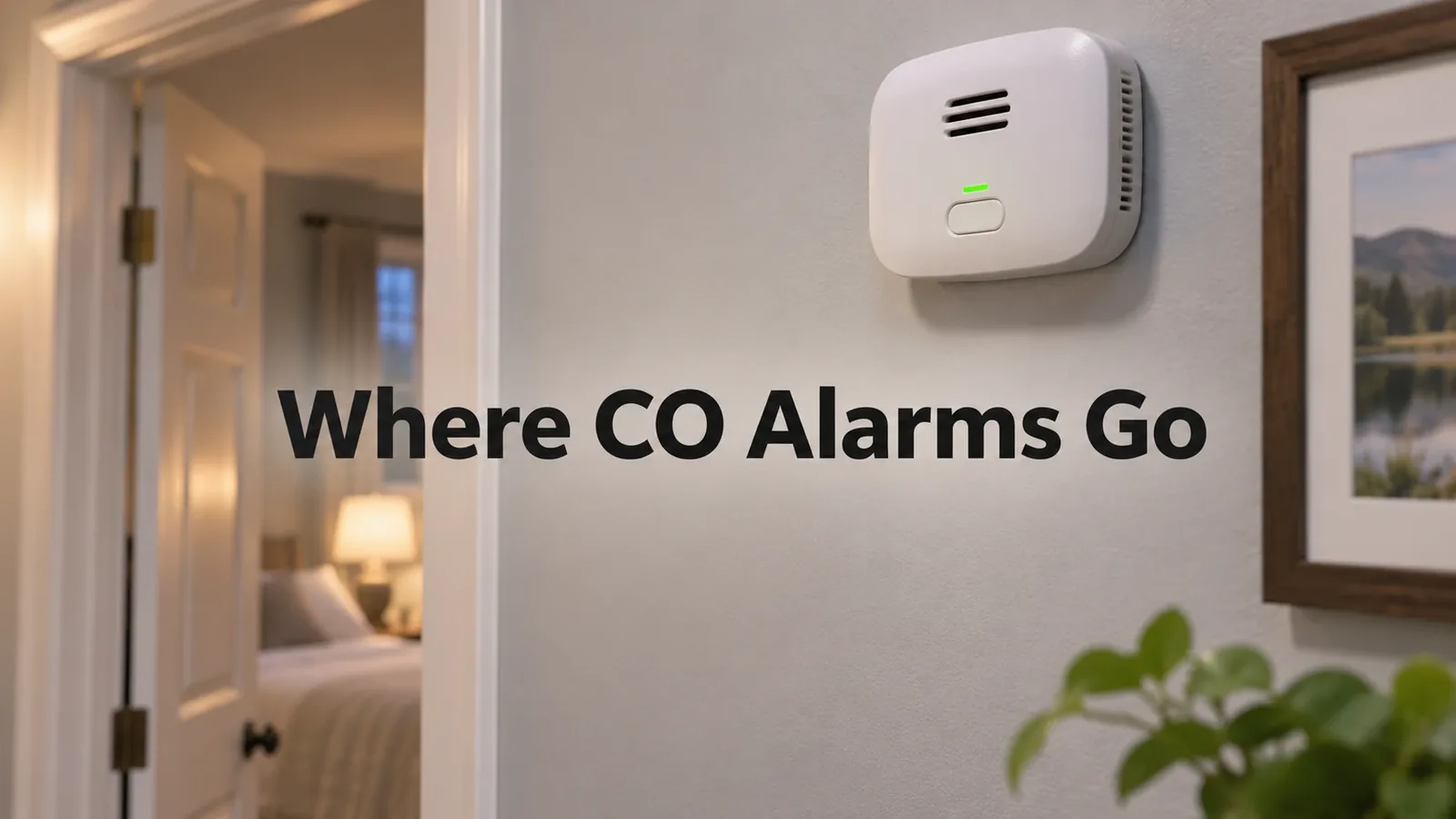
Put a carbon monoxide (CO) alarm in the hallway outside each separate sleeping area and on every level of your home, including the basement, following the manufacturer’s instructions for mounting height. If bedrooms are spread across the house, each cluster needs its own alarm, and a bedroom with a fuel-burning appliance (like a gas fireplace) should have one inside. Keep alarms out of kitchens, bathrooms and garages and away from the immediate area around furnaces and water heaters, where they can give false alarms.
Carbon monoxide is a colorless, odorless gas from burning fuel: gas furnaces, water heaters, stoves, fireplaces, generators and cars. The CDC reports that more than 400 people in the U.S. die each year from unintentional CO poisoning not linked to fires, and many more end up in emergency rooms, with risk peaking in winter when heating systems run and windows stay shut. Here’s how many alarms you need, exactly where to put them, which type to buy, and how to maintain them.
Does your home need CO alarms?
You need carbon monoxide alarms if your home has any of the following:
- A gas, oil or propane furnace, boiler or water heater
- A gas range, oven or clothes dryer
- A wood-burning or gas fireplace or stove
- An attached garage, even if you never idle a car there
- A portable generator you might run during outages
Most states require CO alarms in at least some homes, often when a home with fuel-burning appliances or an attached garage is sold, built or rented. Rules differ on details, so check your state or local fire marshal’s requirements. Even an all-electric home can be exposed through a generator or a neighboring unit in an apartment building.
Where to place carbon monoxide alarms
The National Fire Protection Association recommends CO alarms outside each sleeping area, on every level of the home, and in other locations required by codes. Placement near bedrooms matters most because CO poisoning is most dangerous when people are asleep and can’t notice early symptoms.
| Location | Alarm needed? | Notes |
|---|---|---|
| Hallway outside bedrooms | Yes | One per separate sleeping area, within hearing distance of each bedroom door |
| Each level, including basement | Yes | On basements, place it away from the furnace and near the stairs |
| Bedroom with a fuel-burning appliance | Yes | Gas fireplace or stove in the room |
| Room above or next to an attached garage | Recommended | Garage exhaust can seep through shared walls and doors |
| Kitchen | No | Cooking can cause brief false alarms; place it nearby, not in the kitchen |
| Bathroom | No | Humidity can damage the sensor |
| Garage | No | Exhaust, temperature swings and dust cause false alarms and failures |
| Right next to furnace or water heater | No | Many manufacturers suggest about 15 feet of distance; check your instructions |
Mounting height is a common question. Carbon monoxide mixes with air rather than sinking or rising sharply, so there’s no single correct height. Follow the instructions for your model: some are designed for the ceiling, some for the wall, and plug-in units sit at outlet height. Combination smoke and CO alarms belong where smoke alarms go, usually on the ceiling or high on the wall.
Places to avoid
- Within a few feet of fuel-burning appliances, where small startup puffs of CO can set off nuisance alarms.
- Near vents, fans, open windows or doors, where drafts can dilute the gas before it reaches the sensor.
- Humid areas like bathrooms and laundry rooms with poor ventilation.
- Direct sunlight or spots that get very hot or cold, which can affect the sensor.
- Behind curtains, furniture or inside closets, where air doesn’t circulate.
- Outlets controlled by a wall switch, for plug-in models, since someone can turn them off without realizing it.
Types of CO alarms and costs
Look for an alarm listed to the UL 2034 standard (or CSA 6.19 in Canada). Main types:
- Battery-operated: About $20 to $40. Easy to place anywhere. Models with a sealed 10-year battery save you from yearly battery changes.
- Plug-in with battery backup: About $25 to $50. Good for outlets near bedrooms; the backup battery keeps it working during outages.
- Hardwired with battery backup: About $35 to $70 each, plus installation if you don’t have existing wiring. Often required in new construction and can be interconnected.
- Combination smoke and CO: About $30 to $60 for battery models. Saves ceiling space, but the whole unit is replaced when either sensor expires.
- Interconnected or smart alarms: Higher cost. When one alarm detects CO, all of them sound, and some send phone alerts when you’re away.
A digital display showing CO levels in parts per million can be handy for spotting low, ongoing levels that don’t trigger the alarm.
Example: The Nguyens live in a two-story house with a basement, a gas furnace and an attached garage. Bedrooms are all upstairs in one hallway. They install a combination smoke and CO alarm in the upstairs hall, a plug-in CO alarm with battery backup in the family room on the main floor next to the garage wall, and a 10-year sealed-battery CO alarm near the basement stairs, about 20 feet from the furnace. Total cost: about $115.
How to install, test and maintain CO alarms
- Read the manufacturer’s instructions for placement, height and distance from appliances before drilling any holes.
- Mount the alarm or plug it in, and write the install date on the back with a marker.
- Press the test button to confirm it sounds. Test every alarm once a month.
- Replace standard batteries at least once a year, or whenever the alarm chirps a low-battery warning.
- Vacuum or wipe dust off the vents gently every few months. Don’t spray cleaners or paint on the alarm.
- Replace the entire unit when it reaches its end-of-life date, often 7 to 10 years after manufacture. Many alarms give a distinct end-of-life chirp.
- Have fuel-burning appliances, chimneys and vents inspected by a qualified technician every year, ideally before heating season.
What to do if your CO alarm goes off
Treat every CO alarm as real until proven otherwise:
- Get everyone, including pets, outside to fresh air right away.
- Call 911 or your fire department from outside.
- Don’t go back inside until emergency responders say it’s safe.
- If anyone has symptoms such as headache, dizziness, nausea, weakness, confusion or chest pain, tell responders and get medical care.
- Have a qualified technician find and fix the source before using fuel-burning appliances again.
Don’t confuse a low-battery chirp (a single chirp every 30 to 60 seconds) with a CO alarm, which is usually a pattern of four loud beeps repeated. Your model’s manual lists its signals.
Example: On a cold January night, Teresa’s basement CO alarm sounds its four-beep pattern. She gets her kids and dog outside and calls 911. Firefighters measure elevated CO near the furnace and shut off the gas. An HVAC technician finds a cracked heat exchanger and a blocked flue pipe, which are replaced before the furnace is turned back on.
Preventing CO buildup
- Never run a generator, grill, camp stove or charcoal inside your home, garage, basement or crawlspace, even with doors open. Keep generators well away from windows and doors.
- Never warm up a car in an attached garage, even with the garage door open.
- Don’t use a gas oven or range to heat your home.
- Keep furnace, dryer and water heater vents clear of snow, leaves and nests.
- Open the fireplace damper before lighting a fire and keep it open until the ashes are cool.
Common questions
How many carbon monoxide detectors do I need?
At minimum, one outside each separate sleeping area and one on every level, including the basement. A typical two-story home with a basement and bedrooms in one hallway needs at least three.
Should a CO detector be high or low on the wall?
Follow your model’s instructions, since alarms are designed and tested for specific mounting positions. CO mixes evenly with room air, so placement near sleeping areas matters more than exact height.
Can a smoke detector detect carbon monoxide?
Only if it’s a combination smoke and CO alarm. A standard smoke alarm can’t sense carbon monoxide, so check the label.
How long do carbon monoxide detectors last?
Most last 7 to 10 years before the sensor needs replacing. Check the manufacture date on the back and replace the unit by the date the manufacturer gives.
Do I need a CO detector in an all-electric home?
It’s still worth having one if you have an attached garage, use a portable generator, or live in an apartment building with gas appliances in other units.
Before you buy and install
- Count your sleeping areas and levels to figure out how many alarms you need.
- Check your state and local CO alarm requirements.
- Buy UL 2034 listed alarms, and consider sealed 10-year batteries or interconnected models.
- Mark install dates and set monthly test reminders.
- Schedule a yearly inspection of your furnace, water heater and chimney.
Editorial note: This article is general information. Guidance and prices were checked as of November 2026; follow your alarm manufacturer’s instructions and local codes, and see the CDC, NFPA and the CPSC for safety guidance. In an emergency, call 911.