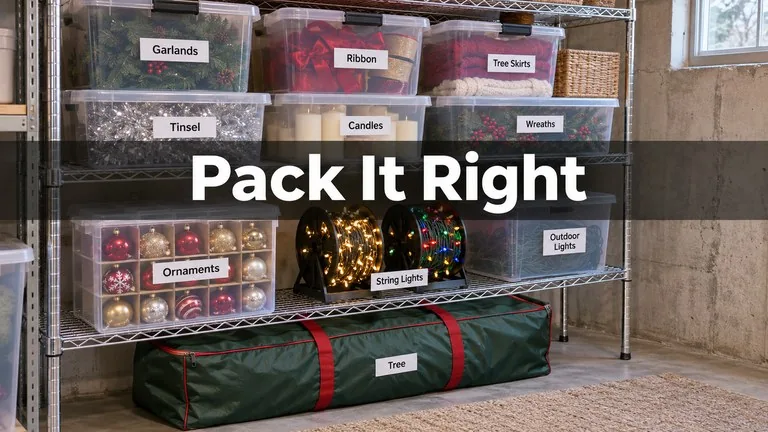
The best way to store Christmas decorations is in sealed plastic bins sorted by room or type, kept somewhere with steady temperature and humidity, such as an interior closet, a dry basement on shelves or under a bed. Wrap glass ornaments in acid-free tissue and pack them in divided boxes, wind lights around a card or reel after testing them, bag the artificial tree by section, and pull every battery before anything goes in a box.
Where you store things matters as much as how. Attics get extremely hot in summer, which softens glue and warps plastic, while damp basements and garages invite mildew and mice. This guide covers what to put each item in, bin sizes that actually fit, a packing order that makes next year faster, and which storage spots are worth avoiding.
Where to store Christmas decorations
The ideal spot is dry, out of direct sun and kept between ordinary room temperatures all year. That usually means inside the conditioned part of the house.
- Interior closets and under beds: the best conditions. Good for ornaments, heirlooms and anything with glue, paint or glitter.
- Finished or dry basements: good if the space stays under about 50 to 60 percent humidity. The EPA recommends keeping indoor humidity below 60 percent, ideally between 30 and 50 percent, to limit mold. Keep bins on shelves, not on the slab, in case of a leak.
- Garages: acceptable for sturdy items in sealed bins, such as artificial trees and outdoor decor. Temperature swings and rodents are the main problems.
- Attics: the worst choice for most decor. Summer attic heat can run far above outdoor temperatures, which melts hot glue, softens candles, warps thin plastic ornaments and makes old light wire brittle. If the attic is your only option, store only metal, wood and sturdy plastic items there.
A small digital hygrometer (often under $15) tells you whether a basement or closet is too humid. If it reads over 60 percent in summer, add a dehumidifier or move fragile decorations elsewhere.
Bin and container sizes that fit
Buy containers to fit the items, not the other way around. Clear bins with latching lids let you see contents without opening them, and same-size bins stack safely.
| Item | Container | Typical size | What to know |
|---|---|---|---|
| Glass and delicate ornaments | Divided ornament box | Holds 48 to 64 standard 3-inch ornaments | Use separate boxes for large or odd shapes |
| Shatterproof ornaments, tree skirt, stockings | 18-gallon latching tote | About 24 x 16 x 14 in | Keep under about 30 pounds for safe lifting |
| String lights | Light reels in a tote or a light storage bag | 3 to 4 reels per 18-gallon tote | Test and label working sets first |
| Garland | 27-gallon tote or garland bag | Holds roughly 30 to 50 feet coiled loosely | Do not crush pre-lit garland |
| Wreaths | Round wreath box with handle | Sized 24, 30 or 36 inches | Measure the wreath with its bow on |
| Artificial tree | Tree storage bag or upright tree bag | Bags labeled for 7.5 ft or 9 ft trees | Upright bags skip disassembly but need floor space |
Weight is a real concern if you carry bins down attic stairs or a pull-down ladder. The Consumer Product Safety Commission notes that nearly half of holiday decorating injuries involve falls, and a 50-pound bin on a ladder is how many of them start. Splitting heavy loads across two smaller bins is safer.
How to pack Christmas decorations, step by step
- Take everything down to one room and sort it into piles by where it goes next year: tree, mantel, porch, kitchen, outdoor.
- Discard or donate as you go: broken ornaments, burned-out or frayed light sets, dried natural items, and anything you skipped this year.
- Remove every battery from candles, light sets, animated figures and remotes. Batteries left in place can leak and corrode contacts over the summer.
- Test each light string while it is still on the tree or mantel. Tag working sets green and bad ones for repair or recycling.
- Clean what needs it: wipe dust from ornaments and wash tree skirts and table linens so food stains do not set or attract pests.
- Pack heavy, sturdy items at the bottom of each bin and fragile items on top.
- Label each bin on two sides and the lid with the room and a short list of contents. A phone photo of the inside, saved in an album, works as an inventory.
- Store bins with the ones you need first (tree, lights) closest to the door.
Ornaments: protecting glass and heirlooms
Wrap glass ornaments individually in acid-free tissue paper. Newspaper ink can transfer to light-colored ornaments, and regular tissue can yellow or stick over years. Remove metal hooks before packing so they do not scratch the finish of neighboring ornaments.
Divided ornament boxes protect the most. Small ornaments fit well in clean egg cartons or plastic cups glued into a shallow box. Heirlooms and handmade pieces with glue, glitter or paper deserve their own small box, stored in the most stable spot in the house, not in the garage with everything else.
Toss a few silica gel packets into ornament boxes stored anywhere humid. They are cheap and help prevent the paint flaking and mildew that ruin vintage glass.
Lights and pre-lit pieces
Tangles come from stuffing strings into a box loose. Wrap each string around a light reel, a piece of stiff cardboard cut with a notch at each end, or a large plastic hanger, then secure the plug end with a twist tie.
- Wrap firmly but not tight. Sharp bends at the bulb sockets break wires.
- Label each string with its length and where it was used (“porch rail, 25 ft”).
- Keep spare bulbs and fuses in a zip bag taped to the reel.
- Recycle burned-out sets. Many hardware stores and recycling centers take old light strings in December and January.
Pre-lit garland and wreaths should be coiled in large loose loops, never folded flat. Folding crushes the wire at the bend and leaves dark sections next year.
Artificial tree storage
Most sectional trees store in a duffel-style bag. Before taking it apart, mark each section with colored tape or a tag (A, B, C from bottom to top) so assembly next year takes minutes. Fold hinged branches up toward the pole, wrap each section loosely with a strap or stretch wrap so the tips are not crushed, and slide them into the bag with the heaviest section at the bottom.
An upright tree storage bag lets you lift the tree off its base fully assembled and decorated in some cases, and roll it into a closet. It saves hours but needs a corner at least as tall as the tree’s lower sections and about 2 to 3 feet of floor space.
Example: Kevin has a 7.5-foot pre-lit tree, 120 ornaments (about half glass), eight light strings, two 9-foot garlands, a 24-inch wreath and a box of mantel decor. He buys a 7.5-foot tree bag ($25), two 64-count ornament boxes ($30 for both), one 18-gallon tote for shatterproof ornaments and stockings ($12), one 18-gallon tote with four light reels ($25 total), a 27-gallon tote for the garlands ($15) and a 24-inch wreath box ($15). His full setup costs about $122 and fits on two shelves in a dry basement.
Garland, wreaths and fabric
Fluff garland back into shape before storing, then coil it in loose loops in a large tote. Pinecones, berries and picks wired into garland sometimes loosen; fix them now while you remember. Fresh greenery and real pinecones should go to yard waste, since dried natural items can carry insects into storage.
Store wreaths flat in a round wreath box, or hang them on a hook inside a closet covered with a large bag, so the bow keeps its shape. Wash fabric items like tree skirts, stockings and table runners before packing, and store them in a breathable cotton bag or a sealed bin with a cedar block if moths are a concern.
Example: Rosa used to keep everything in cardboard boxes in her garage. After finding chewed garland and water-stained stockings, she moved to latching plastic totes on metal shelving 6 inches off the floor, put the stockings and tree skirt in a closet, and added mouse traps along the garage wall in fall. The next December, nothing came out damaged.
Common questions
Can I store Christmas decorations in the attic?
Only sturdy items like metal, wood and thick plastic. Attic summer heat can melt glue, warp thin plastic and damage glass ornament finishes. Keep ornaments, candles, heirlooms and anything with adhesive in a closet or other spot inside the conditioned house.
Are cardboard boxes okay for storing decorations?
For a dry interior closet, sturdy cardboard is fine. In garages, basements and attics, cardboard absorbs moisture, attracts pests and crushes when stacked, so latching plastic bins are the better choice.
How do you store Christmas lights so they do not tangle?
Wrap each string around a reel, notched cardboard or a plastic hanger and tie off the plug end. Test them first and label working sets so you know what you have before next season.
Should I keep the box my artificial tree came in?
The original box works the first year or two, but it rarely closes once branches are fluffed. A tree storage bag with handles is easier to carry and protects better against dust and moisture.
Before you pack it all away
- Pick a storage spot inside the conditioned house when possible, and check humidity with a hygrometer.
- Sort by room, discard broken items and test every light string.
- Remove all batteries.
- Use acid-free tissue and divided boxes for glass ornaments.
- Keep bins under about 30 pounds if they travel up a ladder.
- Label bins on two sides and the lid, and store first-needed items in front.
Editorial note: This article is general information, and guidance was checked as of November 2026. For humidity and mold guidance, see the EPA, and follow your tree and light manufacturer’s storage instructions.