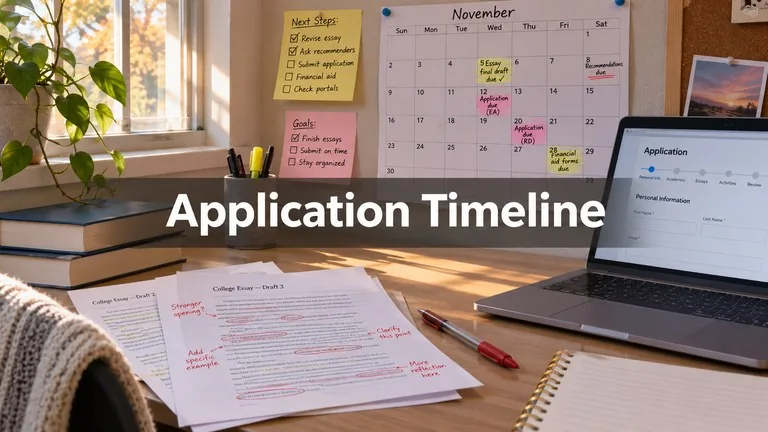
A realistic college application timeline starts in earnest the spring of junior year and ends on May 1 of senior year, when most colleges expect your enrollment deposit. The busiest stretch is August through early November of senior year: the Common App opens August 1, most early decision and early action deadlines fall on November 1 or November 15, and regular decision deadlines cluster between January 1 and January 15.
Ninth and tenth grade matter mostly for grades and course choices, since your transcript is the biggest part of most applications. This guide lays out what to do in each grade, how early decision, early action and regular decision differ, and when to line up essays, test scores, recommendations and financial aid forms so nothing lands in the same week.
Application deadlines at a glance
Exact dates vary by college, so treat these as typical patterns and confirm each school’s deadline on its admissions site or in the Common App.
| Plan | Typical deadline | Decision usually arrives | Binding? |
|---|---|---|---|
| Early decision I (ED) | November 1 or 15 | Mid to late December | Yes. You must enroll if admitted with enough aid and withdraw other applications |
| Early decision II | January 1 to 15 | February | Yes |
| Early action (EA) | November 1 or 15 | December to February | No. You can apply EA to many schools |
| Restrictive or single-choice early action | November 1 | Mid-December | No, but limits other private early applications |
| Regular decision (RD) | January 1 to February 1 | Mid-March to early April | No |
| Rolling admission | Open until the class fills | Usually 4 to 8 weeks after you apply | No |
Many public universities also have priority deadlines, often in early November or December, that affect merit scholarship and honors college consideration even when the final deadline is later. Missing a priority deadline can cost real money.
Ninth and tenth grade: build the transcript
Colleges see every grade from ninth grade forward, and they look at the difficulty of your courses as well as the grades. The most useful moves in these two years are simple:
- Take the most demanding courses you can handle well, especially in math. Many selective colleges expect math through precalculus or calculus.
- Keep a running list of activities, hours per week, leadership roles and awards. Rebuilding this in senior year is painful.
- Try a few activities, then go deeper in the ones you care about. Depth over two or three years reads better than a long list.
- Use summers for something real: a job, a class, a volunteer commitment or a project.
Tenth graders can take the PSAT 10 or PreACT for practice. These scores don’t go to colleges.
Eleventh grade: testing, research and recommenders
Junior year is the last full year of grades colleges see before early deadlines, so it carries a lot of weight. The PSAT/NMSQT in October of junior year is the only one that counts for National Merit Scholarship qualification.
If you plan to submit SAT or ACT scores, take the first official test in winter or spring of junior year. That leaves room for a retake in late spring, summer or early fall. Most four-year colleges remain test-optional, but a growing group of selective schools requires scores again, so check each school on your list.
By spring, build a list of roughly 6 to 12 colleges split into reach, target and likely schools based on where your GPA and scores fall in each school’s published ranges. Run every school’s net price calculator now, before you fall in love with a campus you can’t afford.
Before junior year ends, ask two teachers for recommendations, ideally from core academic subjects you took in 11th grade. Asking in May gives them the summer and puts you ahead of classmates who ask in October. Also meet with your school counselor, who writes a separate letter and sends your transcript.
Summer before senior year: essays and the Common App
The Common App opens August 1, and accounts you created earlier roll over. For the 2026-27 cycle the seven personal essay prompts are unchanged from the prior year, and the essay must be 250 to 650 words. Write your main essay in July and August while you have time to revise it several times.
Supplemental essays are where students get buried. Some colleges ask for none, others ask for three or four short responses. Make a spreadsheet with each school’s prompts and word limits, then group similar ones (“Why this college,” “Describe a community you belong to”) so one strong draft can be adapted for several schools.
Example: Priya has nine schools on her list and 14 supplemental prompts. When she sorts them, six are “why us” essays, four are about community or identity, and four are unique. She writes one strong community essay and trims it to 250, 200 and 150 words for different schools, and drafts a “why us” template she customizes with specific programs and professors for each. Her total writing load drops from 14 separate essays to about eight.
Senior fall: the deadline crunch
The FAFSA for the next school year opens on or before October 1. The 2027-28 FAFSA opened September 23, 2026, the earliest launch in the program’s history, and it uses 2025 tax information. Many private colleges also require the CSS Profile, which typically opens October 1. Some schools set financial aid deadlines as early as their early decision deadlines, so check both dates for every early application.
Follow these steps in order from September through early November:
- Confirm your final college list and which plan (ED, EA, RD or rolling) you’ll use at each school.
- In the Common App, add each school, invite your recommenders and counselor, and confirm they know your earliest deadline.
- Finish your personal essay and supplements for early schools by mid-October.
- Register for any final SAT or ACT test date that reports scores before your earliest deadline.
- File the FAFSA and, if required, the CSS Profile before each school’s priority aid deadline.
- Submit early applications at least a few days before the deadline. Portals slow down on deadline day.
- Send official test scores if you’re submitting them, or self-report where allowed.
- Check each college’s applicant portal within a week to confirm every document arrived.
Applying early decision makes sense only if the school is a clear first choice and you’ve run the net price calculator. If the financial aid offer doesn’t make the school affordable, ED agreements generally let you decline, but you should talk to the aid office before you apply so you know how they handle that.
Senior winter and spring: decisions and deposits
Early decision results usually arrive in mid-December. If you’re admitted ED, you withdraw your other applications. If you’re deferred, send a short update letter in January with new grades or achievements, and finish your regular decision applications on schedule.
Most regular decision results come in March and early April, with financial aid offers at the same time or shortly after. National College Decision Day is May 1, the common deadline for enrollment deposits. Use April to compare aid offers side by side and, if needed, ask a school to reconsider its offer.
Example: Marcus applies early action to his state university in November and is admitted in January with a $4,000 merit scholarship. He’s also waiting on two regular decision schools. When both arrive in late March, he compares the net cost after grants at all three. One private college is $9,000 a year more after aid. He asks its aid office to review his offer using his state school’s award, gets an extra $3,500 grant, and makes his decision on April 28 with the deposit paid before May 1.
After you commit, your senior grades still count. Colleges request a final transcript, and a sharp drop in grades can lead to a rescinded offer.
Common questions
When should I start the college application process?
Start serious planning in the spring of junior year: build a college list, take or plan your SAT or ACT, and ask teachers for recommendations. Write your main essay over the summer. Ninth and tenth grade should focus on strong grades and meaningful activities.
What is the difference between early decision and early action?
Early decision is binding: if you’re admitted and the aid is enough, you must enroll and withdraw other applications. Early action is not binding, so you can apply EA to several schools and decide by May 1. Both usually have November deadlines and December to February decisions.
How many colleges should I apply to?
Many counselors suggest roughly 6 to 12 schools, balanced among reach, target and likely admits. Include at least two schools where you’re likely to be admitted and that you can afford based on their net price calculators. Applying to many more often lowers essay quality without improving outcomes.
When should I ask for letters of recommendation?
Ask teachers in the spring of junior year or, at the latest, at the start of senior year. Give them at least four to six weeks before your earliest deadline, plus a short note listing your deadlines, the classes you took with them and anything you’d like them to mention.
When does the FAFSA open for college applicants?
By law the FAFSA opens on or before October 1 for the following school year. The 2027-28 FAFSA opened September 23, 2026, and uses 2025 tax information. File as early as possible, because some state and college aid is limited.
Before you submit
- Every school on your list has a deadline, plan type and aid deadline in your spreadsheet.
- Recommenders and your counselor are invited in the Common App and know your earliest date.
- Your personal essay is 250 to 650 words and has been read by at least one trusted adult.
- Test scores are sent, or you’ve confirmed each school is test-optional.
- The FAFSA and any CSS Profile are filed before priority aid deadlines.
- You’ve checked each applicant portal for missing documents.
File federal aid at StudentAid.gov and find CSS Profile details at College Board.
Editorial note: This article is general information. Deadlines and dates were checked as of November 2026 and vary by college; confirm each school’s dates on its admissions site and federal aid details at StudentAid.gov.