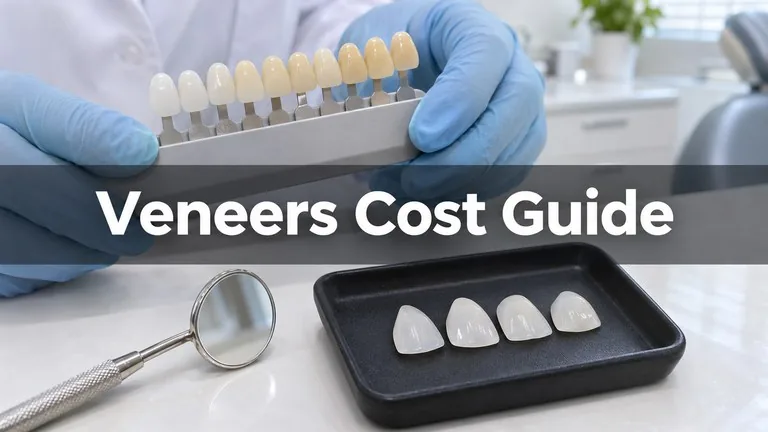
Dental veneers cost about $750 to $1,800 per tooth in 2026, depending mainly on the material. CareCredit’s 2026 national cost study puts a composite veneer made chairside at $751 on average, a porcelain veneer at $1,455, and a “no-prep” porcelain laminate at $1,781. A full set of six to eight porcelain veneers averages $13,954, with most quotes between about $9,700 and $24,000.
Dental insurance almost never pays for veneers placed for looks, so the full price usually comes out of pocket. Because porcelain veneers also involve removing a thin layer of enamel, the decision is permanent in a way that whitening or bonding is not. This guide covers the cost of each type, how long they last, who tends to be a good candidate, what the appointments involve, and the cheaper options worth comparing first.
Veneers cost by type
The figures below come from the 2026 Synchrony Average Procedural Cost Study that CareCredit published in August 2026. They are per tooth unless noted and exclude the consultation.
| Veneer type | Average per tooth | Typical range | Usual lifespan | Enamel removed |
|---|---|---|---|---|
| Composite, made in the office | $751 | $541 to $1,220 | About 5 to 7 years | None to minimal |
| Composite, made in a lab | $1,068 | $783 to $1,760 | About 5 to 7 years | Minimal |
| Porcelain | $1,455 | $1,020 to $2,506 | About 10 to 20 years | A thin layer, usually a fraction of a millimeter |
| Porcelain laminate, “no-prep” or minimal-prep | $1,781 | $1,243 to $2,997 | About 10 to 20 years | Little or none, case dependent |
| Full set, six to eight porcelain | $13,954 total | $9,712 to $24,046 | About 10 to 20 years | As above |
A second data set gives a similar picture. Pearl, which builds its numbers from ADA fee survey data, lists a national average of $1,425 for a veneer (procedure code D2962) with a typical range of $930 to $2,440, updated May 2026.
Price spreads come from a few places: the ceramist and material the dentist uses, how much planning goes into the smile design (digital scans, a trial “mock-up”), regional fees, and whether a cosmetic specialist or a general dentist does the work. A quote at the very bottom of the range is worth questioning, particularly for porcelain.
Porcelain vs composite: which makes sense
Composite veneers are tooth-colored resin sculpted onto the tooth and hardened with a light, often in a single visit. They cost roughly half as much, can usually be repaired chairside if they chip, and need little or no enamel removal. The trade-offs are that they stain over time (coffee, tea, red sauces) and typically need refinishing or replacing every five to seven years.
Porcelain veneers are thin ceramic shells made in a lab and bonded to the front of the teeth. They hold their color and gloss far better and last longer, but a chip usually means replacing the whole veneer, and in most cases some enamel has to come off so the veneer does not look bulky.
A simple decision rule: if you are fixing one or two small chips or gaps, or you are in your late teens or early twenties and want to keep options open, composite is the lower-risk start. If you want a full color and shape change on six or more upper teeth and plan to keep the result for a decade or more, porcelain usually costs less per year of use.
Example: Dana is choosing between six composite veneers at $751 each ($4,506) and six porcelain veneers at $1,455 each ($8,730). If the composite set needs replacing at year 6 and again at year 12, she spends about $13,500 over 15 years. If the porcelain set lasts 15 years, she spends $8,730. If one porcelain veneer chips and must be redone at year 8, add about $1,455, for $10,185. On these assumptions porcelain comes out cheaper long term, but composite costs far less up front and does not commit her to enamel removal.
Who is a good candidate for veneers
Veneers cover the front surface of a tooth. They work best on healthy teeth that are discolored, chipped, slightly misshapen or have small gaps. Dentists usually check a few things before recommending them:
- Healthy gums and no active decay. Gum disease and cavities need treatment first.
- Enough sound enamel to bond to. Teeth with large fillings or root canals may be better suited to crowns.
- Bite and grinding habits. Heavy grinding (bruxism) or an edge-to-edge bite raises the risk of chipping and debonding. A night guard is often required.
- Tooth position. Moderately crooked teeth may need clear aligners or braces first, since forcing veneers onto crowded teeth can require removing much more enamel.
- Stain type. Deep internal staining (from tetracycline, for example) often needs a more opaque porcelain to hide it.
Veneers do not stop decay. The tooth underneath still needs brushing, flossing and regular checkups.
What the veneer process involves
Porcelain veneers usually take two or three visits over two to four weeks:
- Consultation and planning. The dentist examines your teeth and gums, takes photos, X-rays and impressions or a digital scan, and discusses shade and shape.
- Mock-up or trial smile. Many dentists build a temporary preview from tooth-colored material so you can see and approve the length and shape before anything permanent happens.
- Preparation. The dentist numbs the area and removes a thin layer of enamel from each tooth, then takes final impressions or scans.
- Temporaries. You wear temporary veneers while the lab makes the porcelain shells, typically for one to three weeks.
- Try-in and bonding. The dentist checks fit and color, adjusts as needed, then bonds each veneer with resin cement and a curing light.
- Bite check and follow-up. A short visit a week or two later confirms the bite and gum health. Many dentists fit a night guard at this stage.
Composite veneers are often done in one longer appointment, with the dentist shaping the resin directly on each tooth.
How long veneers last and what wears them out
Porcelain veneers commonly last 10 to 20 years, and composite veneers about 5 to 7 years, with care. Pearl’s data review gives 10 to 15 years as the typical porcelain lifespan, so budgeting for replacement in the second decade is realistic.
What shortens their life: biting fingernails, pens or ice, opening packages with your teeth, grinding without a guard, contact sports without a mouthguard, and gum recession that exposes a margin. Whitening products will not lighten porcelain or composite, so if you want whiter teeth, whiten before veneers are matched to your shade.
Plan for upkeep costs as well. A night guard, polishing visits for composite, and occasional repairs add a few hundred dollars over the life of a set.
Alternatives to compare before committing
Several options cost less or remove no enamel. They do not all solve the same problem, so match the option to the issue:
- Cosmetic bonding: resin added to one area of a tooth to fix a chip or small gap. CareCredit’s 2024 data puts the average at $431 per tooth.
- Professional whitening: for color alone, with no shape change. CareCredit’s 2024 data puts in-office whitening around $583 to $792.
- Enamel contouring: the dentist smooths small irregularities, around $215 per tooth on average in CareCredit’s 2024 data.
- Clear aligners or braces: for crowding, rotation or gaps caused by tooth position. More expensive and slower, but they keep your natural enamel.
- Crowns: for teeth that are heavily filled, cracked or root canal treated, where a veneer would not have enough tooth to hold onto.
Example: Luis has one chipped front tooth and mild yellowing. Six porcelain veneers would cost about $8,700. Whitening plus bonding on the chipped tooth would cost roughly $1,000 to $1,200 using the averages above. He chooses the second option and keeps veneers as a future possibility, since nothing was removed from his teeth.
Common questions
Does insurance cover veneers?
Usually not, because veneers are considered cosmetic. A plan may pay part of the cost when a veneer restores a tooth damaged by an accident or decay, often at the same rate it would pay for a filling or crown. Ask for a pre-treatment estimate if you think your case is restorative.
Can you get veneers on just one tooth?
Yes, but matching a single veneer to natural neighbors is one of the harder jobs in cosmetic dentistry. Expect extra shade-matching time, and sometimes a remake. Many dentists suggest veneering the two front teeth together for symmetry.
Are veneers permanent?
Porcelain veneers are considered irreversible because enamel is removed, so the teeth will always need some type of covering afterward. Composite veneers done with little or no preparation can often be removed or redone, which is why some people try them first.
Do veneers ruin your teeth?
Properly placed veneers do not damage the teeth, but the enamel removed during preparation does not grow back, and the edges still need cleaning to prevent decay. Problems usually come from poor fit, grinding without a guard, or skipped checkups.
How much do veneers cost for a full smile?
Most people who want a full smile change treat the six to ten teeth visible when they smile, usually on the upper arch. At 2026 national averages that is about $8,700 to $14,600 for porcelain on six to ten teeth, or roughly $4,500 to $7,500 for chairside composite.
Before you commit
- Ask to see a mock-up or digital preview of your result before any enamel is removed.
- Get the material, number of teeth, lab and per-tooth price in writing.
- Ask what happens if a veneer chips or debonds in the first year and whether replacements are discounted.
- Whiten your natural teeth first if you want a brighter shade overall.
- Budget for a night guard and plan for replacement at some point in the second decade.
- Ask to see before-and-after photos of the dentist’s own veneer cases, not stock images.
Editorial note: This article is general information, not dental advice. Costs were checked as of November 2026 using published national survey data and vary by region and provider; confirm candidacy, materials and pricing with your dentist.