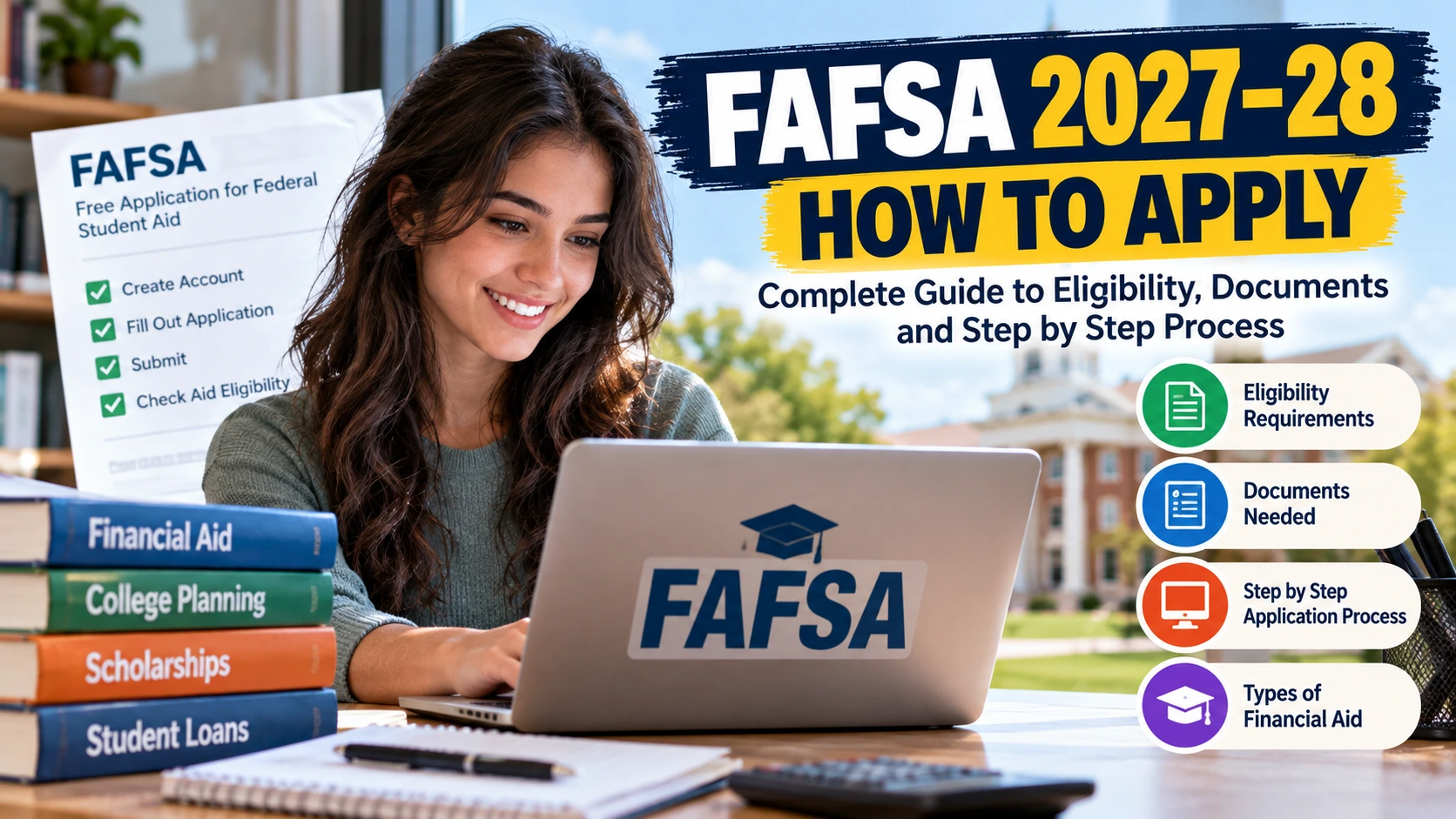
The Free Application for Federal Student Aid (FAFSA) is the form students use to apply for federal grants, work-study and federal student loans, and many states and colleges use it to award their own aid as well. The 2027–28 FAFSA, for the school year starting in fall 2027, opened on September 23, 2026, the earliest launch in the program’s history according to the U.S. Department of Education.
This guide explains who should file, what you need before you start, how to complete the form and which deadlines matter. It is general information. Always check StudentAid.gov, your state’s aid agency and each school’s financial aid office for the rules and deadlines that apply to you.
Who should file the 2027–28 FAFSA
You should file the 2027–28 FAFSA if you plan to attend college, career school or trade school at any point between July 1, 2027 and June 30, 2028. That includes high school seniors in the class of 2027, current college students returning in fall 2027 and adults going back to school.
Many students assume they will not qualify and skip the form. That is a mistake. There is no income cutoff for filing, and the FAFSA is also required for federal student loans, many state grants and a large share of college scholarships. Filing costs nothing.
What you need before you start
The form is shorter than it used to be, and the Department of Education says most families can finish their section in about 15 minutes. Gathering a few things first makes it much faster.
| Item | Why you need it | Tip |
|---|---|---|
| StudentAid.gov account for the student and each contributor | Each person signs and gives consent with their own account | Create accounts early, since identity verification can take time |
| Social Security numbers (if available) | Used to identify each person | Contributors without an SSN can still participate |
| 2025 federal tax information | The 2027–28 FAFSA uses income from two years earlier | Most tax data transfers directly from the IRS with consent |
| Current balances of cash, savings and investments | Asset information may be required | Use balances as of the day you file |
| List of schools | Schools you list receive your information | You can list up to 20 schools and change the list later |
A “contributor” is anyone required to provide information, such as a dependent student’s parent or an independent student’s spouse. Each contributor must give consent for the IRS to share their federal tax information, even if they did not file a tax return. Without that consent, the student cannot receive a full aid eligibility result.
Step-by-step: completing the FAFSA
- Create your StudentAid.gov accounts. The student and each contributor set up their own account with a unique email address.
- Start the 2027–28 form. Log in at StudentAid.gov and choose the 2027–28 FAFSA.
- Answer the dependency questions. These determine whether parent information is needed.
- Invite contributors. Send invitations by email or text so each contributor can complete their section.
- Give consent and enter information. Each person consents to the IRS data transfer and completes any remaining questions.
- Add schools and submit. List up to 20 schools, sign and submit, then check your FAFSA Submission Summary for errors.
Example: A high school senior completes her section in October but forgets to check whether her parent finished theirs. The form stays incomplete for weeks, and she misses her state’s early grant deadline. Checking the form’s status on StudentAid.gov after inviting a contributor, and following up, avoids this common problem.
Deadlines that matter
The federal deadline for the 2027–28 FAFSA is June 30, 2028, but that date is rarely the one that matters most. State grant programs and colleges often set much earlier priority deadlines, and some state and school aid is limited and awarded first come, first served. Filing as soon as possible after the form opens gives you the best chance at limited funds.
Check three sets of dates: your state’s deadline on its higher education agency website, each college’s financial aid priority deadline and any scholarship deadlines that require a FAFSA. Mark the earliest one as your real deadline.
After you submit
You will receive a FAFSA Submission Summary showing your Student Aid Index (SAI), a number schools use to calculate how much need-based aid you may receive. Review it for mistakes and make corrections on StudentAid.gov if needed. Schools that admit you will then send financial aid offers showing grants, scholarships, work-study and loans.
Some students are selected for verification, a process in which the school asks for documents to confirm information on the FAFSA. Respond quickly so your aid is not delayed. If your family’s finances have changed significantly since 2025, such as a job loss or medical costs, contact each school’s financial aid office to ask about a professional judgment review.
Avoid FAFSA scams
The FAFSA is free. Be wary of any website or service that charges a fee to file it, and never share your StudentAid.gov username or password with anyone, including people offering to help. The official site is StudentAid.gov. Free help is available from school counselors, college financial aid offices and the Federal Student Aid Information Center.
Common questions
When did the 2027–28 FAFSA open
It opened on September 23, 2026, ahead of the October 1 date set by law, according to the Department of Education.
What tax year does the 2027–28 FAFSA use
It uses 2025 federal tax information, which is transferred directly from the IRS when each contributor gives consent.
Is there an income limit for the FAFSA
No. Anyone can file, and the FAFSA is required for federal student loans and many scholarships even if you do not qualify for need-based grants.
Do I have to file the FAFSA every year
Yes. You need to file a new FAFSA for each school year you want aid. Returning students can use a simplified renewal process.
Before you file
Create StudentAid.gov accounts for everyone involved, gather your 2025 tax information and school list, and file as early as you can. Check state and school deadlines, follow up with contributors and review your submission summary carefully.
Editorial note: This article is general information and is not affiliated with the U.S. Department of Education or Federal Student Aid. Dates and requirements come from Department of Education announcements and StudentAid.gov as of October 2026 and may change. Confirm details at StudentAid.gov.