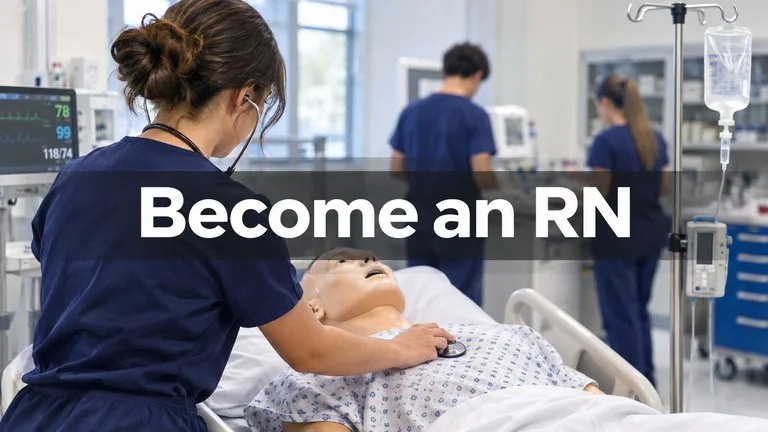
To become a registered nurse (RN), you complete a state-approved nursing program, either an associate degree in nursing (ADN) or a bachelor of science in nursing (BSN), then pass the NCLEX-RN licensing exam and apply for a license from your state board of nursing. The fastest common route, an ADN from a community college, takes about two to three years including prerequisites. A BSN usually takes four years, or 11 to 18 months for career changers who already hold a bachelor’s degree in another field.
The Bureau of Labor Statistics (BLS) reports a median RN salary of $97,550 in May 2025, about 180,800 job openings a year on average, and 6% projected growth from 2025 to 2035. This guide compares the ADN and BSN routes on time, cost and hiring, explains the NCLEX, and walks through the steps from prerequisites to your first job.
ADN vs BSN: which path fits you
Both degrees qualify you to sit for the same NCLEX-RN exam and hold the same RN license. The differences are in time, cost and how employers treat them.
| Path | Typical length | Where offered | Rough tuition range | Best for |
|---|---|---|---|---|
| ADN (associate degree in nursing) | 2 to 3 years including prerequisites | Community colleges, some technical schools | About $8,000 to $25,000 total at public community colleges, plus program fees | Lower cost, faster entry, working adults |
| BSN (traditional) | 4 years | Public and private universities | About $48,000 in tuition at the average in-state public university; far more at private schools | Recent high school graduates, students aiming for leadership or graduate study |
| Accelerated BSN | 11 to 18 months | Universities | Often $30,000 to $90,000 or more | People who already have a bachelor’s in another field |
| RN-to-BSN | About 9 to 24 months, often online | Universities, many online | Often $10,000 to $20,000 or more | Working ADN nurses, frequently with employer tuition help |
| Hospital diploma | 2 to 3 years | A small number of hospitals | Varies | Limited availability in most states |
Tuition ranges vary widely by state and school, so use them only as a starting point. The College Board’s 2025-26 averages were $4,150 a year for in-district community college tuition and $11,950 for in-state public universities. Nursing programs often add fees for labs, simulation, clinical placement, uniforms, testing packages and background checks.
The BSN makes the biggest difference in hiring. Many hospitals, especially large health systems and those with Magnet recognition, prefer BSN-prepared nurses or hire ADN graduates on the condition that they finish a BSN within a set number of years. In long-term care, home health, clinics and many smaller or rural hospitals, ADN graduates are hired regularly. Check job postings in the area where you plan to work before you choose.
Prerequisites and getting admitted
Nursing programs at public colleges are often competitive, with more qualified applicants than seats. Typical prerequisites include anatomy and physiology I and II, microbiology, chemistry, statistics or college algebra, English composition, psychology and sometimes nutrition or human development.
Most programs also require an entrance exam, such as the ATI TEAS or HESI A2, and look closely at your prerequisite science GPA. Some community colleges use point systems or waitlists, which can add a semester or more. A CNA (certified nursing assistant) certificate isn’t always required, but it can add admission points at some schools and gives you patient care experience.
Example: Keisha, 19, wants to start working as a nurse quickly and keep costs low. She spends two semesters at her community college finishing prerequisites while working as a CNA, then enters the four-semester ADN program. She graduates in about three years, passes the NCLEX and starts at a local hospital that requires new ADN hires to complete a BSN within five years. The hospital’s tuition reimbursement covers most of her online RN-to-BSN program.
The NCLEX-RN exam
The NCLEX-RN is the national licensing exam for registered nurses, run by the National Council of State Boards of Nursing (NCSBN). Since April 2023 it has used the Next Generation NCLEX format, which adds case studies and new question types that test clinical judgment.
- Format: computer adaptive, taken at a Pearson VUE test center.
- Length: a minimum of 85 and a maximum of 150 questions, with up to five hours.
- Fee: $200 for registrations completed before February 1, 2027. NCSBN has announced the U.S. fee rises to $350 for registrations on or after that date, including retakes.
- Pass rate: 86.7% for first-time, U.S.-educated RN candidates in 2025.
- Retakes: if you don’t pass, you must wait at least 45 days before testing again, and some states require longer.
Your state board of nursing also charges a separate license application fee, which varies by state, and usually requires fingerprints and a criminal background check. Before choosing a school, look up its NCLEX first-time pass rate on your state board’s website. Programs with pass rates well below the national average are a warning sign.
Steps to become a registered nurse
- Decide on ADN or BSN based on your budget, timeline and the hiring requirements of employers near you.
- Choose programs approved by your state board of nursing and, ideally, accredited by ACEN or CCNE.
- Complete the prerequisite courses with strong grades, especially in the sciences.
- Take the required entrance exam and apply, often to several programs because seats are limited.
- File the FAFSA every year to qualify for grants and federal loans.
- Finish the nursing program, including clinical rotations in hospitals and other settings.
- Apply for licensure with your state board, which then authorizes you to register for the NCLEX-RN with Pearson VUE.
- Pass the NCLEX-RN, receive your license and start applying for RN jobs, ideally new graduate residency programs.
If you live in a state that belongs to the Nurse Licensure Compact, more than 40 U.S. states and territories, your multistate license lets you practice in other compact states without getting a new license.
RN pay and where nurses work
BLS reports a median RN wage of $97,550 a year, or $46.90 an hour, in May 2025, with about 3.47 million RN jobs nationwide. Pay varies by setting:
- Government: $110,780 median
- Hospitals (state, local and private): $100,220
- Ambulatory health care services: $91,230
- Nursing and residential care facilities: $84,300
Pay also varies widely by state and metro area, and new graduates usually start below the median. Night shifts, weekends, overtime and specialty certifications can add noticeably to base pay. An ADN and a BSN nurse in the same staff role at the same hospital often earn similar base rates, though some employers pay a small BSN differential.
Example: Carlos, 31, has a bachelor’s degree in biology and works in a lab. He completes two missing prerequisites in one semester, then enrolls in a 15-month accelerated BSN program costing about $55,000. He borrows part of it, since he can’t work much during the program. After passing the NCLEX, he starts in a hospital residency program. Because he already had a degree, he reached a BSN in about 1.5 years of nursing school instead of four.
Paying for nursing school
Nursing students qualify for the same federal aid as other undergraduates: Pell Grants up to $7,395 for 2026-27, and Direct Loans at a fixed 6.52% rate for loans first disbursed between July 1, 2026 and June 30, 2027. Many states fund nursing scholarships or loan repayment programs for nurses who work in shortage areas. The federal Nurse Corps Scholarship and Loan Repayment programs, run by HRSA, cover costs in exchange for service at qualifying facilities.
Hospital tuition assistance is especially common for RN-to-BSN programs. Employer education benefits of up to $5,250 a year can be tax-free to the employee under Section 127 of the tax code, though many plans require you to stay for a year or two after the course ends.
Common questions
How long does it take to become a registered nurse?
About two to three years through an ADN program, including prerequisites, or four years through a traditional BSN. If you already have a bachelor’s degree in another field, an accelerated BSN can take 11 to 18 months. Add a few weeks to a few months after graduation for NCLEX testing and licensure.
Is an ADN or BSN better?
Both lead to the same RN license. An ADN is faster and cheaper, while a BSN opens more hospital jobs, leadership roles and graduate programs. Many nurses start with an ADN and complete an RN-to-BSN while working, often with employer tuition help.
How much does the NCLEX-RN cost?
The NCLEX-RN registration fee is $200 for registrations completed before February 1, 2027, and rises to $350 on that date. Your state board of nursing charges a separate license application fee, and you may pay for fingerprinting and background checks.
How much do registered nurses make?
The BLS median RN wage was $97,550 a year in May 2025, or $46.90 an hour. Hospital RNs had a median of $100,220, while nurses in nursing and residential care facilities had a median of $84,300. Pay varies widely by state and experience.
Can you become an RN online?
Not entirely. You can take some coursework online, and RN-to-BSN programs for nurses who are already licensed are often fully online. Initial RN programs require in-person labs and supervised clinical hours in health care settings.
Before you apply to nursing school
- Check job postings near you to see whether hospitals require a BSN.
- Confirm each program is approved by your state board of nursing.
- Compare first-time NCLEX pass rates for the programs on your list.
- Ask about waitlists, point systems and total program fees, not just tuition.
- File the FAFSA and look up state nursing scholarships.
- Ask local hospitals about tuition assistance if you plan an RN-to-BSN later.
Sources: BLS Occupational Outlook Handbook, NCSBN and StudentAid.gov.
Editorial note: This article is general information, not career, financial or legal advice. Pay, fees and exam details were checked as of November 2026; confirm licensing requirements with your state board of nursing and aid details with StudentAid.gov.