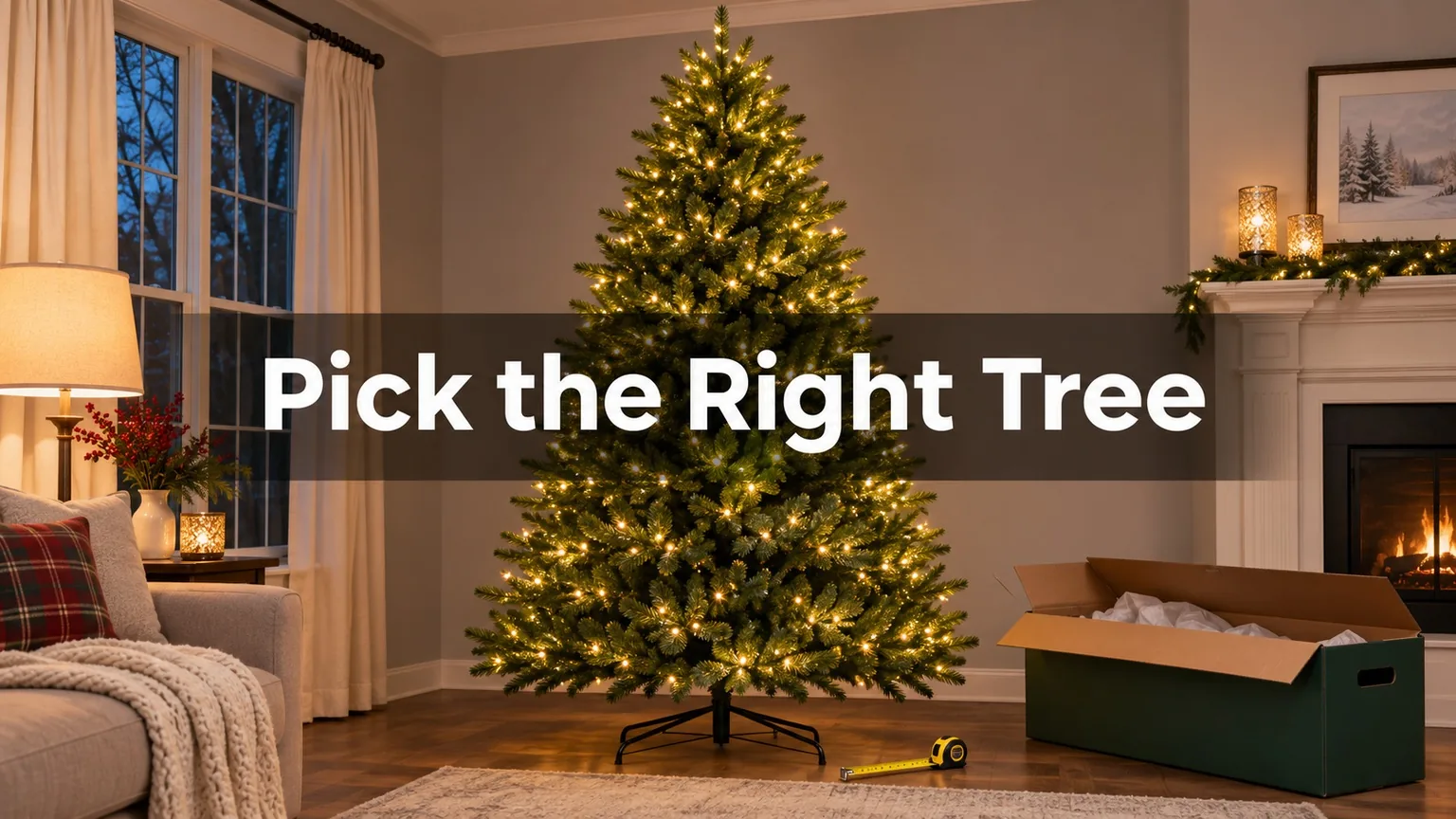
To choose an artificial Christmas tree, start with your room: measure ceiling height and subtract 12 to 18 inches for the topper and stand, then measure the floor space you can give up, since a full 7.5-foot tree is often close to 5 feet wide at the base. Next, decide between pre-lit and unlit, and look for PE (molded) tips on the outer branches if realism matters to you. A 7.5-foot tree is the right size for most living rooms with 8 to 9 foot ceilings.
Price follows those choices. Budget trees around $100 to $200 can look fine with heavy decorating, mid-range trees in the $250 to $500 range are where most families get the best mix of looks and durability, and premium trees with dense PE foliage often run $600 to well over $1,000. The rest of this guide covers sizing, shape, needle material, lights, setup features and the details that decide whether a tree lasts three seasons or ten.
Get the height right first
Height is the mistake people regret most, because a tree that brushes the ceiling leaves no room for a star and looks cramped. The simple rule: ceiling height minus 12 to 18 inches. Most tree heights are measured without the stand, and the stand usually adds a few inches.
- 8-foot ceiling: a 6.5 to 7-foot tree, or 7.5 feet with a low-profile topper.
- 9-foot ceiling: 7.5 feet is the comfortable pick.
- 10-foot ceiling: 8.5 to 9 feet.
- Vaulted ceilings: measure at the exact spot the tree will stand, not at the room’s peak.
Also check the doorway path from storage to the living room. Sectioned trees come apart, but a big storage box still has to fit through your hallway and up or down stairs.
Choose a shape that fits your floor
Width is the number people forget to check. Product listings show the diameter at the widest point, which is the bottom tier. Exact sizes vary by brand, but at 7.5 feet the ranges look roughly like this:
| Profile | Typical width at 7.5 ft | Floor space taken | Good fit for |
|---|---|---|---|
| Full | about 50 to 60 inches | Large: plan for a 5-foot circle plus walkway | Open living rooms, a tree you view from all sides |
| Slim | about 35 to 45 inches | Medium | Corners, smaller living rooms, spaces near a couch |
| Pencil | about 20 to 30 inches | Small | Entryways, apartments, beside a fireplace or between windows |
| Flocked (any profile) | Same as above | Same as above | A snowy look; sheds some white powder, especially the first year |
Use painter’s tape to mark the tree’s footprint on the floor before you buy. Leave at least 2 to 3 feet of walking room in front and keep the tree 3 feet from heat sources such as a fireplace, wood stove, space heater or heating vent.
Example: Priya has a 9-foot ceiling and a corner between a window and the couch that measures 44 inches at its widest. A full 7.5-foot tree at 56 inches would push into the walkway. A slim 7.5-foot tree around 40 inches fits with a few inches to spare and still gives her the height she wants.
PE vs. PVC needles and why tip count is only half the story
Artificial foliage comes in two main types. PVC tips are flat strips cut and wrapped around a wire, which gives a fuller but flatter, more obviously artificial look. PE tips are molded from real branch casts, so they have rounded, three-dimensional needles that read as real from a few feet away. PE costs more to make, so most mid-range and premium trees use PE on the outer tips (where you see them) and PVC inside to add fullness at a lower cost.
When a listing says “70% PE” or “100% PE tips,” it refers to the share of tips that are molded. For a tree you look at up close in a living room, 50% PE or more makes a visible difference. For a tree that will be loaded with ornaments and ribbon, a mostly PVC tree can look perfectly good.
Tip count measures how many branch tips the tree has. More tips usually means a fuller tree and more places to hang ornaments, but compare tip counts only between trees of the same height and width. As a rough guide for a 7.5-foot full tree, under 1,500 tips tends to look sparse, 2,000 to 3,000 looks full, and 3,000-plus looks dense. A slim tree will have fewer tips at the same quality level because it is narrower.
Pre-lit or unlit
Pre-lit trees save the most annoying hour of the season. The lights are already wrapped along each branch, and many newer models connect at the trunk so you plug in once. The trade-off: when a section fails after a few years, repairs can be fiddly, and you are locked into that light style.
Unlit trees cost less and let you choose your own lights, swap colors year to year, and replace a dead strand for $15. They also usually last longer, since nothing built into them can fail.
If you go pre-lit, check these details:
- Light count. A common rule of thumb for a well-lit look is about 100 lights per vertical foot, so roughly 700 to 900 on a 7.5-foot tree. Fewer than 500 on a full 7.5-foot tree will look dim.
- LED or incandescent. LEDs run cooler, use far less power and last longer. Warm white LEDs come closest to the old incandescent glow.
- Color options. Dual-color trees switch between warm white and multicolor with a foot pedal or remote, which is handy for families who disagree.
- Safety listing. Look for lights certified by a recognized lab such as UL or ETL, and a tree labeled fire resistant.
- Replacement policy. Check whether the maker covers lights separately from the tree and for how long, since lights usually fail before the branches do.
Setup and build quality features worth paying for
A few construction details matter more than the photos suggest.
- Hinged branches fold down into place as you lift each section. Hook-on branches must be attached one by one, which can mean 100+ branches to sort by color-coded tags.
- A metal stand with a wide footprint beats a plastic one, especially with pets or kids around.
- Fewer sections (three is common at 7.5 feet) means faster setup, but each section is heavier.
- Some trees have a “quick shape” or “easy fluff” design that cuts fluffing time; many still need 30 to 60 minutes of shaping the first year.
- Warranty length varies widely, from a single year on budget trees to much longer coverage on some premium trees.
How to shop and set up a new tree
- Measure ceiling height at the tree spot, the available floor diameter, and the doorway or hallway to storage.
- Pick your profile (full, slim or pencil) and height from those numbers.
- Set a budget and compare trees of the same size by tip count, PE share, light count and warranty, not just photos.
- Read reviews for specific complaints: lights failing in year two, a wobbly stand, heavy shedding, or a strong plastic smell.
- When it arrives, assemble it in place, start fluffing from the bottom tier and the inside of each branch, and work outward and upward.
- Test the lights before decorating. Fix or return a defective tree while you are still inside the return window.
- Keep the original box for the first season if returns need it, then switch to a tree storage bag or upright cover.
Example: The Garcias are choosing between a $180 unlit tree and a $420 pre-lit 7.5-foot tree with 70% PE tips. Adding 800 warm white LED lights to the cheaper tree costs about $50 to $80, bringing it to roughly $240. The pre-lit tree saves setup time and looks fuller, but the cheaper tree’s lights are easy to replace. If they expect to keep the tree eight years or more, the extra $180 works out to about $22 a year for the better tree.
Making the tree last
A decent artificial tree can last 10 years or more when it is stored well. Most damage happens in the off season: crushed branches, bent hinges, and dust or moisture in the box.
- Fold the branches up gently and wrap each section loosely before it goes in a bag or box.
- Store it somewhere dry and temperature stable. A hot attic can make PVC brittle and shorten LED life; a damp basement can cause mildew.
- Keep the stand and any remotes or foot pedals in a labeled zip bag inside the storage container.
- Avoid stacking heavy boxes on top of the tree bag.
Before each season, check light cords for cracks, frays and loose connections. Unplug the tree when you go to bed or leave the house; the Consumer Product Safety Commission publishes holiday decorating safety guidance each year that covers lights and cords.
Common questions
What size artificial Christmas tree do I need for an 8-foot ceiling?
A 6.5 or 7-foot tree is usually the best fit, leaving room for the stand and a topper. A 7.5-foot tree can work if you use a flat or low-profile topper. Measure at the spot the tree will stand before you buy.
Is PE or PVC better for an artificial tree?
PE tips look more realistic because they are molded to resemble real needles, while PVC is flatter but cheaper and adds fullness. Most good trees mix them, with PE on the outside. For a realistic look up close, aim for at least half PE tips.
How many lights should a 7.5-foot tree have?
A common rule of thumb is about 100 lights per foot of height, which puts a 7.5-foot tree at roughly 700 to 900 lights. Slim trees need fewer, and people who like a very bright tree often go higher.
When is the best time to buy an artificial Christmas tree?
The deepest discounts usually come right after Christmas, when stores clear inventory. The best selection is from October through early December, and popular sizes can sell out closer to the holiday.
How long do artificial Christmas trees last?
Many last 6 to 10 years, and well-made trees stored carefully can go longer. Pre-lit lights are usually the first thing to fail, so check the warranty on lights specifically.
Before you buy
- Measure ceiling height at the exact spot, then subtract 12 to 18 inches.
- Tape out the base diameter on the floor and keep 3 feet from heat sources.
- Choose full, slim or pencil based on that footprint, not just the photo.
- Compare same-size trees on tip count, PE share, light count and warranty.
- Decide whether you value faster setup (pre-lit) or easier long-term repairs (unlit).
- Plan where it will live the other 11 months of the year.
Editorial note: This article is general information, with prices and product details checked as of November 2026. Sizes, materials and warranties vary by brand, so confirm the specifications with the retailer or manufacturer before you buy.