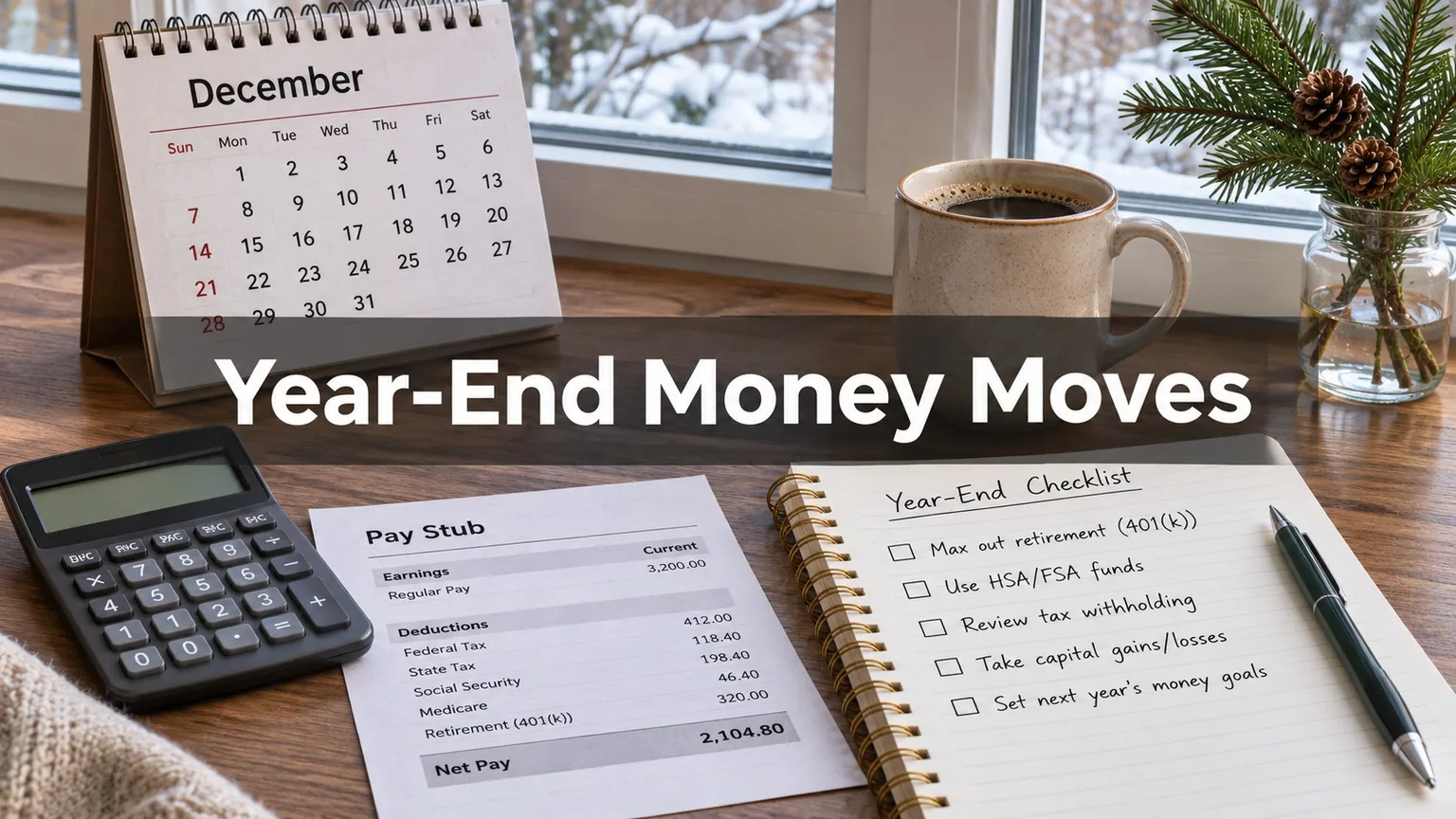
A year-end financial checklist covers the money moves that have a hard December 31 deadline: raising your 401(k) contributions through your last paychecks, spending down a health FSA, taking any required minimum distribution, harvesting investment losses, and making charitable gifts you want to count for 2026. Other moves, such as IRA and HSA contributions for 2026, can wait until April 15, 2027, so you can sort the list by deadline and handle the December items first.
2026 also brings some new tax rules that change the math. Starting this year, people who take the standard deduction can deduct up to $1,000 in cash gifts to charity ($2,000 for married couples filing jointly), and the 401(k) limit rose to $24,500. Below you will find the main 2026 numbers in one table, then each checklist item with who it applies to and how to act on it before the year closes.
2026 limits and deadlines at a glance
| Item | 2026 limit or rule | Deadline for 2026 |
|---|---|---|
| 401(k), 403(b), most 457 plans and TSP | $24,500; plus $8,000 catch-up at 50+, or $11,250 at ages 60 to 63 | Through payroll by Dec. 31 |
| Traditional or Roth IRA | $7,500; plus $1,100 catch-up at 50+ | April 15, 2027 |
| HSA | $4,400 self-only, $8,750 family; plus $1,000 at 55+ | April 15, 2027 |
| Health FSA | $3,400 contribution limit; carryover up to $680 if your plan allows it | Spend by Dec. 31 or your plan’s grace period |
| Required minimum distribution | Generally starts at age 73 | Dec. 31 (April 1, 2027 for a first RMD) |
| Annual gift tax exclusion | $19,000 per recipient | Dec. 31 |
| Standard deduction | $16,100 single; $24,150 head of household; $32,200 married filing jointly | Applies to the 2026 return |
| Fourth-quarter estimated tax | For self-employed and others without enough withholding | Jan. 15, 2027 |
Top up your 401(k) before your last paychecks
Workplace plan contributions for 2026 have to come out of 2026 paychecks, so this is the item with the shortest runway. Most payroll systems need a week or two of notice, which means a change made in early December may only affect one or two checks.
Look at your year-to-date contributions on your latest pay stub, subtract them from your limit, and divide by the number of paychecks left. If you are 50 or older, add the catch-up. Workers aged 60 through 63 get the larger $11,250 catch-up for 2026.
One rule changed this year: if you earned more than $150,000 in FICA wages from your employer in 2025, catch-up contributions in 2026 must go in as Roth (after-tax) money. Your plan should handle this automatically, but check your elections so the result is not a surprise at tax time.
Example: Jordan, 52, has put $18,000 into his 401(k) by early November and has four paychecks left. His total 2026 limit is $32,500 ($24,500 plus the $8,000 catch-up). To max out, he needs $14,500 more, or about $3,625 per check. If that is more than his budget can handle, raising contributions enough to capture his full employer match is the first priority.
Spend down your health FSA
Health FSA money is use-it-or-lose-it unless your employer offers one of two safety valves: a carryover of up to $680 into 2027, or a grace period of up to two and a half months to spend the balance. Plans can offer one or the other, not both, so check your plan documents or benefits portal.
If you have a balance you will lose, December is a good time to book an eye exam, buy prescription glasses or contacts, refill prescriptions, or stock up on eligible over-the-counter items such as pain relievers, first-aid supplies and sunscreen. Keep receipts in case the administrator asks for documentation.
While you are in the benefits portal, review your 2027 elections during open enrollment. The dependent care FSA limit rose to $7,500 per household starting in 2026, which matters for families paying for daycare or after-school care.
Take required minimum distributions on time
If you are 73 or older, you generally must take an RMD from traditional IRAs and most workplace plans by December 31. The first RMD can wait until April 1 of the following year, but then you take two distributions in one tax year, which can push you into a higher bracket. Missing an RMD triggers a 25% excise tax on the shortfall, reduced to 10% if you correct it promptly.
Inherited IRAs have their own rules. Many non-spouse beneficiaries who inherited after 2019 must empty the account within 10 years, and some must also take annual distributions in the meantime. Ask the account custodian which rules apply to yours.
If you are 70½ or older and give to charity, a qualified charitable distribution sends money from your IRA directly to a charity. It can count toward your RMD and is excluded from your taxable income, which often beats taking the RMD and donating cash.
Plan charitable gifts under the 2026 rules
The new law changed charitable deductions in two ways for 2026. First, if you take the standard deduction, you can now deduct cash gifts to qualified charities of up to $1,000 if single or $2,000 if married filing jointly. Gifts to donor-advised funds do not qualify for this deduction. Second, if you itemize, only the portion of your charitable giving above 0.5% of your adjusted gross income is deductible.
For itemizers, that floor makes bunching more attractive: grouping two or more years of planned gifts into a single year so your itemized deductions clear the standard deduction by a wider margin. A donor-advised fund lets you take the deduction in the year you fund it and send grants to charities over later years.
Example: Lena and Chris file jointly, take the standard deduction, and usually give about $1,500 a year to their church and a local food bank. Under the 2026 rules, all $1,500 is now deductible on top of their $32,200 standard deduction. In the 22% bracket, that saves them about $330 in federal tax. They keep bank records or written acknowledgments for each gift.
Review investments for losses and gains
If you hold investments in a taxable brokerage account, look at unrealized gains and losses before year-end. Selling a position at a loss can offset realized capital gains, and up to $3,000 of net losses a year can offset ordinary income. Unused losses carry forward to future years.
Watch the wash sale rule: if you buy the same or a substantially identical investment within 30 days before or after the sale, the loss is disallowed for now. Many investors sell a fund and buy a similar but not identical one to stay invested.
This step does not apply to 401(k)s, IRAs or HSAs, where gains and losses have no current tax effect. It also makes sense to check whether your portfolio has drifted from its target mix after the year’s market moves, and rebalance inside tax-advantaged accounts where possible.
A December checklist you can work through in order
- Pull your latest pay stub and calculate how much more you can put into your 401(k) or 403(b), then submit the change to payroll.
- Check your health FSA balance, your plan’s carryover or grace period rules, and schedule eligible spending.
- Confirm any RMDs (yours or from inherited accounts) have been taken or are scheduled.
- Decide on charitable gifts, keep receipts, and consider a qualified charitable distribution if you are 70½ or older.
- Review your taxable investment account for losses to harvest, minding the wash sale rule.
- Run the IRS Tax Withholding Estimator and adjust your W-4 or plan a fourth-quarter estimated payment due Jan. 15, 2027.
- Make any family gifts you want counted in 2026, keeping each under $19,000 per recipient to avoid filing a gift tax return.
- Confirm beneficiaries on retirement accounts and life insurance, especially after a marriage, divorce, birth or death.
- Set calendar reminders for IRA and HSA contributions before April 15, 2027.
A few common year-end tasks have more time than people think. You can make 2026 IRA contributions, traditional or Roth, until the tax filing deadline of April 15, 2027. The same goes for HSA contributions, as long as you had HSA-eligible coverage. Solo 401(k) and SEP-IRA employer contributions can generally be made up to your filing deadline, including extensions.
Waiting has a cost, though: money contributed in January instead of April has a few extra months to grow. If you have the cash now, earlier is still better.
Common questions
Can I contribute to a 401(k) after December 31 for 2026?
No, for most people. Employee 401(k) deferrals must come out of paychecks dated in 2026. IRAs and HSAs are different and allow 2026 contributions until April 15, 2027.
What is the 401(k) limit for 2026?
The employee contribution limit is $24,500. Savers 50 and older can add an $8,000 catch-up, and those aged 60 to 63 can add $11,250 instead. Employer contributions do not count toward the $24,500.
Do I lose my FSA money at the end of the year?
You may, unless your employer offers a carryover (up to $680 into 2027) or a grace period of up to two and a half months. Plans pick one option or neither, so check your plan rules before December 31.
Can I deduct charitable donations if I don’t itemize?
Yes, starting with 2026 returns. Non-itemizers can deduct up to $1,000 in cash gifts to qualified charities, or $2,000 for joint filers. Gifts to donor-advised funds and non-cash gifts do not qualify for this deduction.
What happens if I miss my RMD?
The shortfall is subject to a 25% excise tax, which drops to 10% if you take the missed amount and correct it within the correction window. Take the distribution as soon as you notice and ask a tax professional about filing Form 5329.
Is tax-loss harvesting worth it for small accounts?
It can be, since even a few hundred dollars of harvested losses offsets gains or up to $3,000 of ordinary income. The benefit is larger if you have realized gains this year or are in a higher tax bracket.
Before you close the books on 2026
- Deal with the Dec. 31 items first: 401(k) contributions, FSA spending, RMDs, charitable gifts and tax-loss sales.
- Keep receipts and acknowledgments for every donation.
- Check withholding now so April does not bring a surprise bill.
- Put April 15, 2027 on your calendar for IRA and HSA contributions.
- Start 2027 with updated payroll elections so you are not playing catch-up next December.
The IRS website has the official limits, the Tax Withholding Estimator and the rules for RMDs and charitable deductions.
Editorial note: This article is general information, not financial, tax or legal advice. Figures were checked as of November 2026; confirm current limits and rules with IRS.gov, your plan administrator or a tax professional before acting.