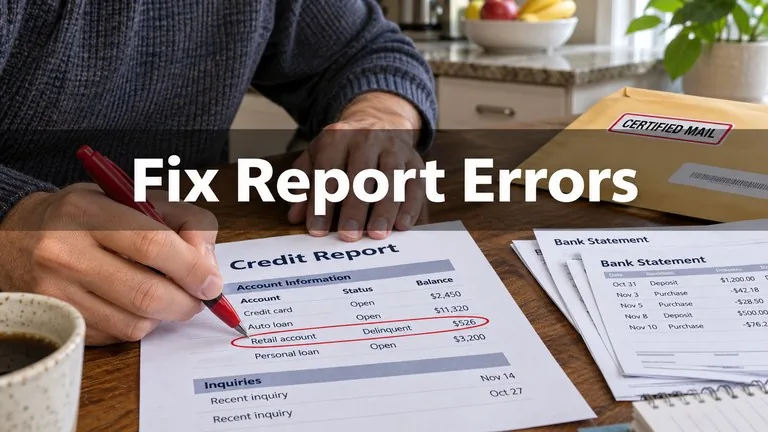
To dispute a credit report error, contact the credit bureau that shows it (Equifax, Experian or TransUnion) online, by mail or by phone, explain what’s wrong, and include copies of documents that prove it. Under the Fair Credit Reporting Act (FCRA), the bureau generally has 30 days to investigate, must forward your dispute to the company that supplied the information, and must correct or delete anything that’s inaccurate or can’t be verified. Disputing is free.
You can also dispute directly with the lender or collector that reported the information, which is often faster for clear-cut errors. If neither fixes it, you can file a complaint with the Consumer Financial Protection Bureau. This guide covers which errors are worth disputing, how to dispute at each bureau, what to put in a dispute letter, the timelines that apply, and what to do if a dispute fails.
Errors worth disputing
Start by getting all three reports. AnnualCreditReport.com is the official site for free reports, and you can now get them from each bureau every week. Each bureau’s report can differ, so an error might appear on only one.
Common errors include:
- Accounts that aren’t yours, from identity theft or a mix-up with someone who has a similar name or Social Security number
- Late payments reported when you paid on time
- Wrong balances or credit limits, which can inflate your credit utilization
- Closed accounts shown as open, or accounts you closed shown as “closed by creditor”
- The same debt listed more than once, such as both the original creditor and a collector showing a balance due
- Negative items past their reporting limit. Most negative information must come off after seven years, and Chapter 7 bankruptcies after ten years.
- Paid medical collections, which the three bureaus have said they no longer report
- Wrong personal details such as an address you never lived at, which can point to fraud
Accurate negative information, such as a late payment that really happened, can’t be removed through a dispute just because it hurts your score. Companies that promise to erase accurate items are making a claim the law doesn’t support.
How to dispute with each credit bureau
Each bureau has an online dispute center, and online is usually fastest. Mail creates the best paper trail. Whichever you choose, dispute with every bureau that shows the error.
| Bureau | Online | Phone | Tip |
|---|---|---|---|
| Equifax | equifax.com/personal/credit-report-services (Dispute Center) | 866-349-5191 | Requires a myEquifax account; you can upload documents |
| Experian | experian.com/disputes | 888-397-3742 | Use the report number from your Experian report if you have one |
| TransUnion | transunion.com/credit-disputes | 800-916-8800 | Upload documents in the online dispute center to support each item |
- Pull a fresh copy of the report from the bureau you’re disputing with and note the exact account name and number shown.
- Gather proof: bank statements showing payment, a payoff letter, a court order, a police or FTC identity theft report, or correspondence with the creditor.
- File one dispute per error, and pick the dispute reason that best matches (for example “not my account” or “incorrect payment status”).
- In the explanation field, state what is wrong, what it should say and what proof you’re attaching, in plain words. Upload clear copies, never originals.
- Save the confirmation number and take a screenshot or printout of what you submitted.
- If you mail it, send it by certified mail with return receipt requested and keep a copy of everything.
- Mark the 30-day deadline on your calendar and watch for results by email or mail.
- Pull your report again after the result to confirm the change actually appears.
What to put in a dispute letter
A good dispute letter is short and specific. The CFPB recommends including:
- Your full name, address, phone number and, if available, the report confirmation number
- Each error, identified by account name and account number
- A clear explanation of why it’s wrong
- A request to correct or delete the item
- A copy of the report page with the error circled or highlighted
- Copies of supporting documents
Example: Jasmine’s TransUnion report shows a $1,240 collection from a utility company in a city she never lived in. Her letter says: “The Metro Gas collection account ending in 4471 is not mine. I have never lived at the service address listed, 220 Pine Street. Enclosed are my lease and utility bills for the same period at my actual address and a copy of my FTC identity theft report. Please delete this account from my file.” She circles the item on a printed copy of her report, encloses copies of her documents, and sends it certified. Because she has an identity theft report, she also asks for the item to be blocked, which bureaus must do within four business days under the FCRA’s identity theft provisions.
Timelines and what happens next
Once a bureau receives your dispute, the FCRA sets these deadlines:
- The bureau must notify the furnisher (the lender, collector or other company that supplied the data) within five business days.
- It generally has 30 days to finish the investigation. That can stretch to 45 days if you send more information during the 30 days or if you filed after getting your free annual report.
- It must send you the results within five business days after finishing, along with a free copy of your updated report if anything changed.
- If a deleted item is later put back, the bureau must tell you within five business days.
The furnisher must review the dispute and report its findings. If the information is wrong, or the furnisher can’t verify it, it must be corrected or deleted, and the furnisher must notify every bureau it reports to. A bureau can reject a dispute it reasonably considers frivolous, for example one that doesn’t say what’s wrong, but it must tell you within five business days and explain why.
Example: Ben’s Experian report shows a 60-day late payment on his car loan for March, but his bank statement shows the payment cleared on March 2. He files online on May 1 and uploads the statement. Experian forwards it to the lender, which checks its records, finds a payment-posting error, and updates the account to “current.” Experian sends Ben the result on May 24, and the lender also corrects the account at Equifax and TransUnion.
Disputing directly with the lender or collector
You can dispute directly with the company that reported the information. Send a written dispute to the address the company lists for credit reporting disputes, or the address shown on your credit report. Furnishers generally must investigate and respond within 30 days. This route works well when the lender clearly made the mistake and has the records to fix it, such as a misapplied payment.
For collection accounts, also use your rights under the Fair Debt Collection Practices Act. If you dispute a debt in writing within the validation period shown on the collector’s first notice (generally 30 days after you receive it), the collector must stop collecting until it sends you verification.
If your dispute is denied
A result of “verified as accurate” isn’t necessarily the end. These next steps often help:
- Dispute again with new or better evidence. Repeating the same dispute without new information may be rejected as frivolous.
- Dispute directly with the furnisher if you haven’t yet.
- Ask the bureau how it verified the item. You’re entitled to a description of the procedure used and the name and contact information of the furnisher, if available.
- Add a brief statement of dispute to your file. The bureau must include it, or a summary, in future reports.
- File a complaint with the CFPB. Companies generally respond within 15 days and are expected to close most complaints within 60 days.
- Talk to a consumer protection attorney if the error is serious and the companies won’t fix it. The FCRA lets consumers sue for violations, and many attorneys take these cases without upfront fees.
Be careful with credit repair companies. Under federal law they can’t charge you before they’ve performed the services they promised, and they can’t do anything you can’t do yourself for free.
Common questions
How long does a credit report dispute take?
Most disputes are resolved within 30 days, and the bureau can take up to 45 days if you send more information mid-investigation or disputed after getting your annual report. Results must reach you within five business days after the investigation ends.
Does disputing hurt my credit score?
No. Filing a dispute doesn’t lower your score. If the dispute leads to a correction, your score may rise. During the dispute the account may show a “disputed” note, which some mortgage lenders ask you to clear before closing.
Should I dispute online or by mail?
Online disputes are faster and let you upload documents. Mail gives you the clearest proof of what you sent and when, which matters if you later need to file a complaint or take legal action.
Can I dispute an item that’s accurate but old?
If a negative item is past its legal reporting period, usually seven years from the original delinquency, you can dispute it as obsolete. If it’s accurate and within the period, it can stay on your report.
What if the error came from identity theft?
Report it at IdentityTheft.gov to create an FTC identity theft report and recovery plan. Send that report with your dispute and ask the bureau to block the fraudulent information, and consider placing a credit freeze to stop new accounts.
Before you file a dispute
- Pull all three reports and list every error by bureau and account.
- Collect proof for each item before you file.
- File one dispute per error with every bureau that shows it.
- Keep confirmation numbers, copies and certified mail receipts.
- Set calendar reminders at 30 and 45 days.
- Check your reports again after each result.
The CFPB’s dispute guide includes sample letters, and you can file a complaint through the CFPB complaint portal.
Editorial note: This article is general information, not legal advice. Rules and contact details were checked as of November 2026; confirm current dispute procedures with Equifax, Experian, TransUnion and consumerfinance.gov.