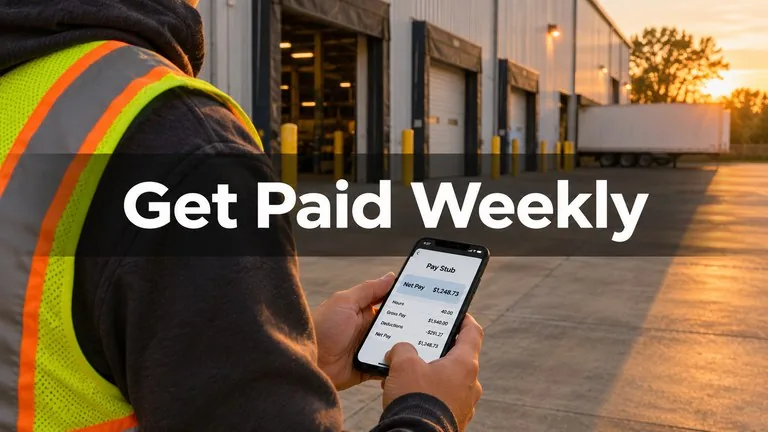
Jobs that pay weekly are most common in staffing agency work, construction and the trades, warehouses, manufacturing, landscaping, home health care and some restaurant and hotel jobs. For same-day pay, your realistic options are gig apps with instant cash-out (delivery, rideshare, task apps), day labor agencies, and tipped work where card tips are paid out at the end of a shift. Some employers that pay every two weeks also offer early access to earned wages through an app.
Federal law does not say how often you must be paid. The Fair Labor Standards Act requires minimum wage and overtime, but the pay schedule is set by state law and by the employer, which is why a company may pay weekly in one state and every two weeks in another. Below is how pay frequency rules differ by state, which industries most often pay weekly, what gig work costs you in exchange for fast cash, and how to compare offers when one pays sooner and the other pays more.
Where weekly pay is most common
Weekly pay tends to show up where workers are hourly, turnover is high, and employers compete on how quickly new hires see money. Asking “what is the pay schedule?” during the interview is normal, and the answer is usually in the posting if you look for it.
- Staffing agencies. Temp and temp-to-hire jobs in warehouses, light industrial, events and clerical work very often pay weekly, and some agencies offer daily pay for an added fee or on a pay card.
- Construction, roofing, landscaping and other trades. Weekly checks are a long-standing habit in these fields, and some states require weekly pay for manual workers.
- Manufacturing and distribution. Many plants and fulfillment centers pay weekly to attract hourly staff.
- Home health and caregiving agencies. Weekly pay is common, sometimes with mileage reimbursed on the same check.
- Restaurants and bars. Paychecks are often weekly or biweekly, but servers may receive credit card tips at the end of each shift, depending on the employer and the state.
- Hotels and event staffing. Banquet servers and event crews frequently work through agencies that pay weekly.
State pay frequency laws
Each state sets a minimum pay frequency, and employers can always pay more often than required. The Department of Labor keeps a table of state payday requirements; the examples below come from its most recent revision, dated January 1, 2023. States update these laws, so confirm with your state labor department before relying on them.
| State | Minimum pay frequency | What it means for you |
|---|---|---|
| New York | Weekly for manual workers; semi-monthly allowed with approval | Construction, warehouse and similar workers are generally paid every week |
| Connecticut | Weekly (longer intervals up to monthly with labor commissioner approval) | Weekly is the default for most workers |
| Rhode Island | Generally weekly, with limited exceptions | Most hourly workers get weekly checks |
| Massachusetts | Weekly or biweekly for hourly workers; semi-monthly for salaried | Hourly workers never wait more than two weeks |
| New Hampshire | Weekly or biweekly; longer only with state permission | Biweekly is the most you should wait in most jobs |
| California | At least twice per calendar month for most workers, with exceptions | Weekly is common in some industries but not required |
| Texas | Semi-monthly or biweekly for non-exempt workers; monthly for exempt | Weekly is an employer choice |
| Illinois | Semi-monthly; monthly for executive, administrative and professional staff | Weekly is an employer choice |
| Washington | Monthly | Employers may pay much less often than weekly |
| Florida and North Carolina | No frequency specified in state law | The employer sets the schedule; ask before accepting |
The full state-by-state list is on the Department of Labor’s state payday page. Some states also set rules for how quickly a final paycheck must be paid when you quit or are let go, which matters if you are switching jobs to get faster pay.
Same-day pay through gig apps: the trade-offs
Delivery, rideshare and task apps can put money in your account the same day, usually through an instant transfer to a debit card. Standard transfers that take a day or more are often free, while instant transfers may carry a per-transfer fee or require the app’s own card. Check the current terms inside the app, because they change.
The speed comes with costs that a W-2 job does not have:
- Most app workers are classified as independent contractors, so federal minimum wage and overtime rules generally do not apply to them.
- You pay self-employment tax of 15.3 percent on most of your net earnings, plus income tax, and nothing is withheld unless you set it aside yourself.
- Gas, insurance, phone data and vehicle wear come out of your pocket.
- Time spent waiting between orders is usually unpaid.
- There is no employer-paid unemployment insurance or workers’ compensation in most cases.
Example: Carlos compares a staffing agency warehouse job at $17 an hour, paid weekly, with delivery driving that shows about $24 for each hour he is actively on an order. He logs 30 hours a week in the app, but about a quarter of that is waiting, so he is paid for roughly 22.5 hours: $540. He drives about 300 miles a week, and his own estimate of gas and upkeep is 25 cents a mile, or $75, which leaves $465. Setting aside roughly 15 percent for self-employment tax brings it to about $395, or about $13.18 per logged hour. The warehouse job pays $510 for 30 hours, about $471 after the 7.65 percent for Social Security and Medicare. In his case the weekly W-2 job comes out ahead, even before counting the warehouse’s paid breaks.
Gig work makes the most sense as a flexible add-on or a bridge between jobs. If you rely on it full time, track every mile and every logged-in hour, including the waiting time your earnings screen leaves out.
Earned wage access and pay cards
Some employers that pay biweekly let you draw part of the wages you have already earned before payday, through an app run by a payroll or benefits company. In December 2025 the Consumer Financial Protection Bureau issued an advisory opinion saying that certain employer-integrated earned wage access programs are not credit under the federal Truth in Lending Act. Programs still differ in their fees: some are free to you, some charge for instant transfers, and some ask for optional tips. Using it every pay period can leave a smaller and smaller paycheck, so treat it as an occasional tool.
Weekly or daily pay is sometimes delivered on a payroll card. Many states limit fees on these cards and require employers to offer direct deposit or another option. Read the card’s fee schedule for ATM withdrawals and balance checks before you agree to use it.
How to find a job that pays weekly
- Search job boards with “weekly pay,” “paid weekly,” “daily pay” or “same day pay” together with your city and the type of work.
- Read the benefits or pay section of each posting. Employers that pay weekly almost always say so because it attracts applicants.
- Contact two or three staffing agencies in person or online. Ask about pay frequency, how quickly they place new workers, and whether daily pay costs anything.
- Ask about the pay schedule in the interview, along with the date of your first paycheck. Some weekly employers hold the first week, so your first check arrives in week two.
- Check how you will be paid: direct deposit, paper check or pay card, and any fees involved.
- Get the hourly rate, overtime rules and pay schedule in writing before your first shift.
Example: Tasha needs money within 10 days. She signs up with a staffing agency on a Monday, starts a warehouse assignment on Thursday, and learns the agency pays every Friday for the week ending the previous Sunday. Her first check arrives the second Friday, eight days after she starts, covering her first four shifts. A biweekly retail job she also interviewed for would have paid her first check about three weeks after her start date.
Common questions
Is it legal for my employer to pay me every two weeks instead of weekly?
In most states, yes. Federal law does not set a pay frequency, and many states allow biweekly or semi-monthly pay. A few states, such as New York for manual workers and Connecticut for most workers, require weekly pay unless an exception applies.
What jobs pay daily?
Gig apps with instant cash-out, day labor agencies, and some staffing agencies offer daily pay. Tipped workers may also leave each shift with their credit card tips, depending on the employer. Daily pay often comes with a fee or a requirement to use a specific card.
Does weekly pay mean higher total pay?
No. Weekly and biweekly schedules pay the same hourly rate over a year; weekly pay just spreads it into 52 smaller checks instead of 26 larger ones. The benefit is cash flow, which can help you avoid late fees or short-term loans.
Do gig apps take taxes out?
Usually not. Independent contractors are responsible for their own income tax and self-employment tax, often through quarterly estimated payments. Setting aside a fixed share of every payout keeps a tax bill from surprising you in April.
Before you accept a job for the pay schedule
- Compare take-home pay per hour as well as how often you are paid.
- Ask when your first check will arrive and whether the first week is held.
- Check fees for daily pay, instant transfers and pay cards.
- For gig work, track miles and logged-in hours for two weeks before deciding it pays enough.
- Look up your state’s payday rule so you know what you are owed.
Editorial note: This article is general information, not legal, tax or financial advice. Rules were checked as of November 2026; confirm current pay frequency requirements with your state labor department and the U.S. Department of Labor.