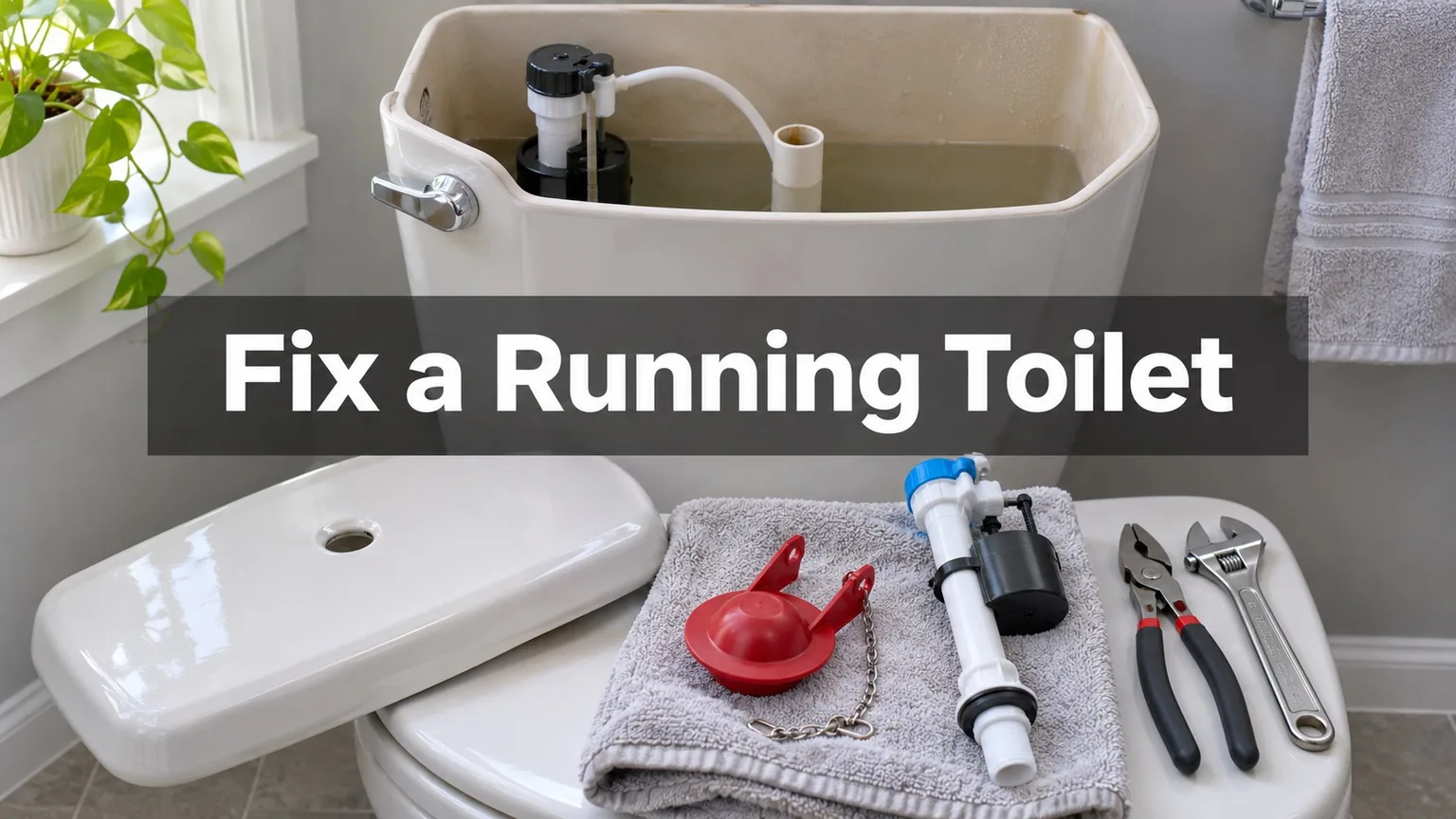
A toilet that keeps running almost always has one of three problems: a worn flapper letting water seep into the bowl, a fill valve that will not shut off, or a float set so high that water spills into the overflow tube. Lift the tank lid and look at where the water is going, and you will usually know which one within a minute. Most fixes take under 30 minutes and $5 to $30 in parts.
It is worth doing soon. A constantly running toilet can waste hundreds of gallons a day, and even a quiet seep shows up on the water bill over a billing cycle. This guide covers how to diagnose the cause, the repair for each one, what parts cost compared with a plumber visit, and the cases where replacing the toilet makes more sense than fixing it.
How a toilet tank works
When you press the handle, a chain lifts the flapper off the flush valve opening at the bottom of the tank, and the water drops into the bowl. As the tank empties, the flapper falls back and seals the opening. The fill valve, the tall assembly on the left side of most tanks, senses the low water through its float and opens to refill the tank. A small refill tube sends some water down the overflow tube to top up the bowl. When the float rises to the set level, the fill valve shuts off.
A running toilet means one of those steps is not finishing. Either water is escaping out of the tank (a flapper or flush valve problem), or the fill valve keeps adding water it should not.
Diagnose it in five minutes
Take the tank lid off and set it on a towel, since lids crack easily. Then watch the tank while it is running.
- Water is spilling over the top of the overflow tube. The water level is set too high or the fill valve is not shutting off. Start with the float adjustment.
- The water is below the overflow tube but the toilet hisses or refills every so often by itself (sometimes called a phantom flush). Water is leaking past the flapper into the bowl, and the fill valve keeps topping it back up.
- The handle sticks down or the toilet runs only after certain flushes. The chain is too short, tangled, or catching under the flapper.
To confirm a flapper leak, put a few drops of food coloring or a dye tablet in the tank and do not flush. Some utilities suggest waiting an hour. If color shows up in the bowl, water is getting past the flapper or its seat. Flush afterward so the dye does not stain.
Common causes, fixes and costs
| Symptom | Likely cause | Fix | DIY parts cost |
|---|---|---|---|
| Water flowing into overflow tube | Float set too high | Lower the float or adjust the screw on the fill valve | $0 |
| Water still flows after float is lowered | Worn fill valve seal or debris | Flush out the valve cap or replace the fill valve | $10 to $30 |
| Dye reaches bowl, random refills | Warped or hardened flapper | Replace the flapper (match 2 or 3 inch size) | $5 to $25 |
| New flapper still leaks | Rough or pitted flush valve seat | Clean the seat, add a seat repair kit, or replace the flush valve | $10 to $40 |
| Runs only after some flushes | Chain too short, too long or tangled | Adjust to about half an inch of slack | $0 to $5 |
| Weak flush plus running | Several worn parts | Install a complete tank repair kit | $25 to $50 |
Hiring a plumber typically costs $100 to $400 for a running toilet, depending on your area, the trip charge and which parts they replace. Fill and flush valve jobs usually land around $50 to $150 in labor, and after-hours calls can add $100 to $300.
Fix the float and fill valve
If water is going down the overflow tube, start here. The correct water level is usually marked on the inside of the tank, or about 1 inch below the top of the overflow tube.
- Most modern fill valves have a float cup that slides on the valve shaft. Pinch the clip or turn the adjustment screw to lower it, then flush and watch where the water stops.
- Older toilets have a ball float on a metal arm. Turn the adjustment screw on top of the valve, or gently bend the arm down a little.
- Check the refill tube. It should clip to the top of the overflow tube, aimed into it. If the tube is pushed down inside the overflow pipe, it can siphon water continuously.
If the valve still will not shut off at the right level, shut the water, remove the cap on top of the fill valve (usually a quarter turn), and hold a cup over the open valve while you turn the water on briefly. That flushes out grit sitting on the seal. If that does not work, replace the whole fill valve. Universal fill valves cost about $10 to $30 and fit nearly every standard toilet.
Replace a flapper step by step
The flapper is the most common culprit. Rubber hardens and warps over a few years, faster if you use in-tank bleach or chlorine tablets. Before you shop, take the old flapper out and bring it with you, or check the size: most toilets use a 2-inch flapper, while many newer ones use 3-inch.
- Turn off the water at the shutoff valve behind the toilet by turning it clockwise.
- Flush and hold the handle down to drain as much of the tank as you can. Sponge out the rest if needed.
- Unhook the chain from the handle arm, then pull the flapper’s ears off the pegs on the sides of the overflow tube. Some flappers have a ring that slides over the tube instead.
- Run a finger around the flush valve seat where the flapper sits. If you feel mineral crust, scrub it gently with a nonabrasive pad or very fine wet sandpaper until smooth.
- Attach the new flapper to the pegs or tube, and center it over the opening.
- Clip the chain to the handle arm with about half an inch of slack when the flapper is closed. Too tight and the flapper cannot seal; too loose and the chain can get trapped underneath.
- Turn the water back on, let the tank fill, and flush a few times to check the seal and the flush strength.
- Repeat the dye test after 30 minutes or so to confirm there is no more seepage.
Some newer toilets use a canister or tower flush valve instead of a hinged flapper. Those use a round rubber seal at the bottom of the canister, which you replace by twisting the canister off. Look up your toilet’s model number, usually stamped inside the tank behind the water line, to get the right seal.
Example: Priya’s upstairs toilet refilled for a few seconds every 20 minutes or so. She added food coloring, and the bowl turned blue within 10 minutes. The flapper had stiffened and was not seating fully. A $9 universal 2-inch flapper and 15 minutes of work stopped it. Her next water bill dropped by about $14 compared with the same period the year before.
When the flapper is not the problem
If a new flapper still leaks, look at the flush valve seat. Pits, cracks or a warped plastic seat can keep any flapper from sealing. Seat repair kits glue a new stainless or plastic ring over the old one, a fix that avoids taking the tank off. A cracked overflow tube is also a leak path; if the tube itself is damaged, the whole flush valve has to be replaced, which means separating the tank from the bowl.
That bigger job involves new tank bolts and a tank-to-bowl gasket. It is doable for a confident DIYer in an hour or two, but it is also the point where many people call a plumber, since overtightening the bolts can crack the porcelain.
Example: Tom replaced the flapper and fill valve on a 1990s toilet and it still ran. The flush valve seat was cracked. A plumber quoted $260 to replace the flush valve and gaskets. A new 1.28 gallon per flush toilet installed was quoted at $550. Because the old toilet used about 3.5 gallons per flush, he chose the replacement, which also cut his household water use going forward.
Fix it or replace the toilet?
Repair makes sense for nearly all running toilets. Replacement is worth considering when:
- The toilet was made before 1994 and uses 3.5 gallons or more per flush. Current WaterSense-labeled models use 1.28 gallons or less.
- The porcelain tank or bowl is cracked anywhere, even a hairline crack.
- You have replaced several internal parts and it still runs or clogs often.
- Parts for an unusual or discontinued model are hard to find or expensive.
Common questions
Why does my toilet keep running after I replaced the flapper?
The most common reasons are a chain with too little slack, the wrong flapper size, or a rough flush valve seat that the new flapper cannot seal against. Check that the water level is not spilling into the overflow tube too. If both look fine, the fill valve may be the real problem.
How much water does a running toilet waste?
A slow flapper leak might waste a few hundred gallons over a month. A toilet running full time can waste far more, on the order of hundreds of gallons a day, which can add noticeably to a monthly bill. The food coloring test is the easiest way to catch quiet leaks.
Can I jiggle the handle instead of fixing it?
Jiggling only reseats a flapper or frees a stuck chain for that one flush. If you have to do it regularly, the part causing it is worn or misadjusted, and it will usually get worse.
Is it safe to turn off the toilet water until I can fix it?
Yes. Turning the shutoff valve clockwise stops the running water. You can still flush by pouring a bucket of water into the bowl. If the shutoff valve itself leaks or will not turn, that is a separate repair worth doing soon.
Do in-tank cleaning tablets cause running toilets?
They can. Tablets that contain bleach or chlorine break down rubber flappers and seals faster. Many toilet manufacturers advise against them for that reason.
Before you start
- Find the toilet’s shutoff valve and make sure it turns.
- Note the brand and model number inside the tank, and measure the flush valve opening (2 or 3 inches).
- Have a towel, sponge, bucket and food coloring ready.
- Buy a universal flapper or fill valve that matches your toilet, and keep the receipt in case the fit is off.
- Call a plumber if the tank is cracked, the shutoff valve leaks, or the fix requires removing the tank and you are not comfortable doing it.
Editorial note: This article is general home repair information. Part and labor prices were checked as of November 2026 and vary by region. Follow your toilet manufacturer’s instructions, and see the EPA WaterSense leak guidance or your local water utility for more on finding household leaks.