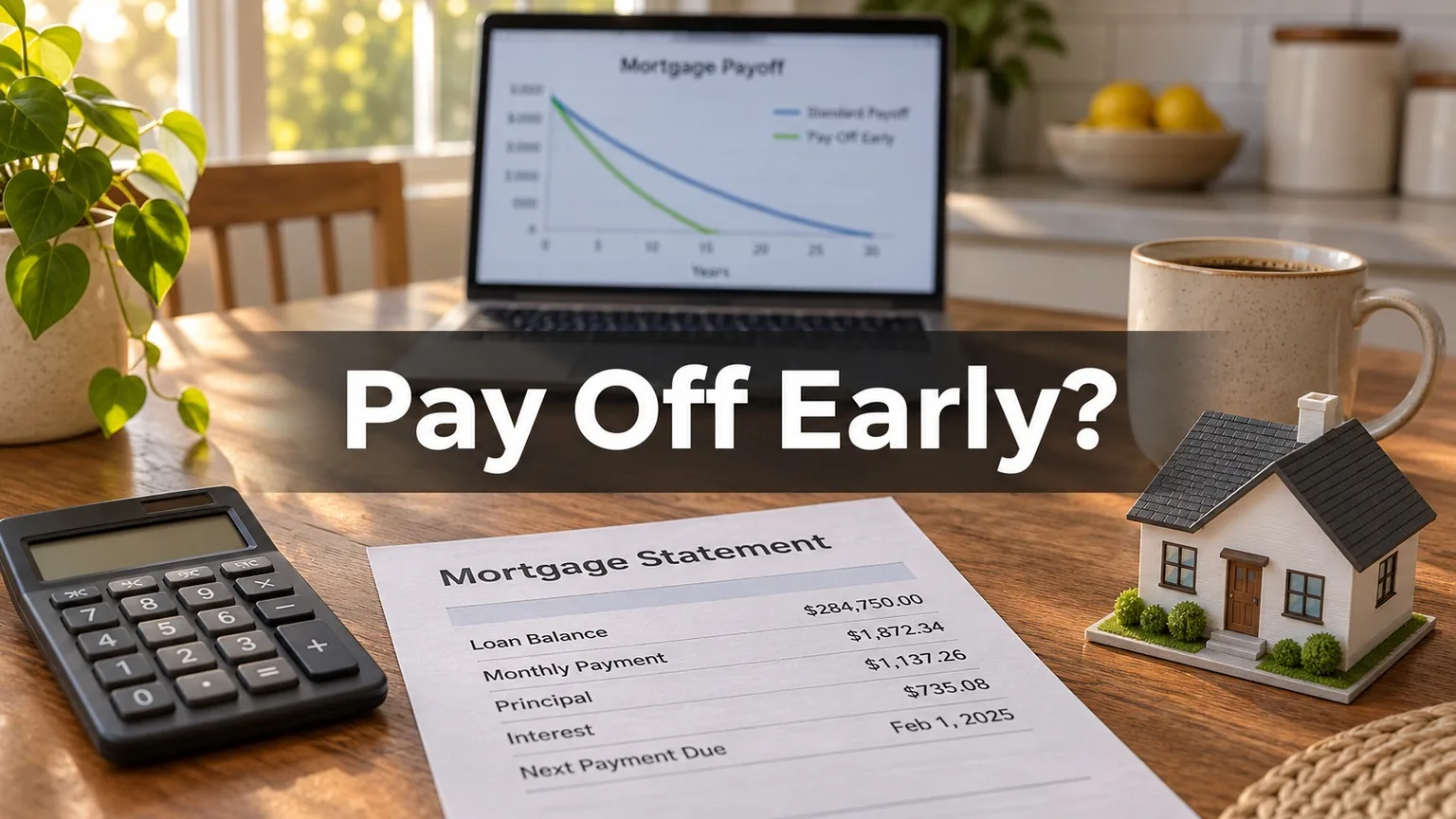
Paying off your mortgage early makes the most sense when your rate is higher than what you could reliably earn elsewhere after taxes, you already have an emergency fund and your employer’s full 401(k) match, and you carry no credit card or other high-interest debt. If your mortgage rate is around 3% to 4% and you have cash sitting in savings or retirement accounts that you have not maxed out, investing or saving usually comes out ahead on paper. Between those cases, it comes down to risk, liquidity and how much you value owning your home outright.
Every extra dollar of principal earns a guaranteed return equal to your mortgage rate, with no tax owed on it. The catch is that the money is locked inside your house once you send it.
What an extra principal payment does
A fixed-rate mortgage charges interest each month on the balance you still owe. When you pay extra toward principal, the balance drops sooner, so every future month’s interest charge is a little smaller and a little more of each regular payment goes to principal.
Two practical points matter here. First, the extra money has to be applied to principal. Most servicers have a separate “additional principal” box on the payment page or coupon. If you just send more than the amount due without saying so, some servicers treat it as an early payment of next month’s bill, which does nothing for your interest cost. Second, extra payments do not lower your required monthly payment on a standard loan. They shorten the loan. Your payment only drops if you formally recast or refinance.
Worked example: a $350,000 loan at 6.5%
Take a new 30-year fixed loan of $350,000 at 6.5%. The principal and interest payment is about $2,212 a month (plus taxes and insurance). If you make every payment for the full term, you pay roughly $446,400 in interest. Here is what different prepayment approaches do to that loan when started in the first month:
| Approach | Extra cash out of pocket | Loan paid off in | Total interest | Interest saved |
|---|---|---|---|---|
| Regular payments only | $0 | 30 years | $446,400 | $0 |
| Extra $100 a month | $100/month | 26 years 6 months | $383,800 | $62,600 |
| Extra $200 a month | $200/month | 23 years 10 months | $338,300 | $108,100 |
| Extra $500 a month | $500/month | 18 years 7 months | $252,800 | $193,600 |
| Biweekly (one extra payment a year) | About $2,212/year | 24 years 2 months | $344,600 | $101,800 |
| One $20,000 lump sum at closing | $20,000 once | 25 years 6 months | $346,400 | $100,000 |
Figures are rounded and assume every extra dollar goes to principal. Starting later still helps, but the savings shrink because less interest is left to avoid.
Example: Maria and Josh take out the $350,000 loan above and add $200 to every payment. Over the life of the loan they send about $57,200 in extra principal. In return they skip roughly six years of $2,212 payments and save about $108,100 in interest. That works out to the same thing as earning 6.5% a year on every extra dollar, with no market risk and no tax bill on the “return.”
Prepaying vs investing the same money
A fair comparison spends the same cash either way. Suppose Maria and Josh instead invest the $200 every month for 30 years. Then compare that with prepaying $200 a month and, once the house is paid off, investing the full $2,412 they no longer owe each month until year 30.
- If the investments earn 6.5% a year, the two paths end within a few thousand dollars of each other: about $221,000 from investing all along versus about $219,000 from prepaying first. When the return matches the mortgage rate, the choice is close to a tie.
- If the investments earn 8% a year, investing all along grows to about $298,000, versus about $230,000 for the prepay-first path. The higher return wins because it compounds for longer.
- If the investments earn 4%, investing all along grows to only about $139,000, and prepaying wins clearly.
These are pre-tax numbers, and stock returns are not guaranteed. Investing has the higher expected payoff when your rate is well below long-run stock returns; prepaying gives a certain one. Tax breaks on 401(k) and IRA money tilt the math further toward investing there first. Compare your rate with a safe alternative too: if a high-yield savings account, CD or Treasury bill pays more than your mortgage rate after tax, parking cash there beats prepaying with no added risk.
Biweekly payments: what they do and what to avoid
A biweekly plan has you pay half your monthly payment every two weeks. There are 52 weeks in a year, so that is 26 half payments, which equals 13 full payments instead of 12. The extra payment is the whole effect. On the example loan, it cuts about six years and $101,800 of interest.
You get nearly the same result by adding one-twelfth of your payment (about $184 on the example loan) as extra principal every month. That is often the better route because:
- Some third-party biweekly services charge an enrollment fee, often a few hundred dollars, plus per-payment fees that eat into the savings.
- Some servicers hold each half payment until the full amount arrives instead of applying it right away, so you get no interest benefit from paying early.
A free servicer biweekly option that applies each half payment on receipt works fine. Ask before you enroll.
Recasting: lower payment instead of a shorter loan
A recast (also called re-amortization) lets you make a large lump-sum principal payment and have the servicer recalculate your monthly payment over the remaining term, at the same interest rate. You keep the loan, there is no new credit check or appraisal, and the fee is usually a few hundred dollars. Servicers commonly set a minimum lump sum, often $5,000 or $10,000. Conventional loans are the usual candidates. FHA, VA and USDA loans generally cannot be recast, so check with your servicer.
Example: Five years into the $350,000 loan, Priya owes about $327,600. She sells a rental property and pays $30,000 toward principal, then asks for a recast. Her payment drops from $2,212 to about $2,010, freeing up roughly $200 a month, and she saves around $30,800 in interest over the remaining 25 years. If she had made the same $30,000 payment without recasting and kept paying $2,212, she would finish nearly five years early and save about $99,300 in interest. Recasting saves less interest but lowers her required bill, which helps if her income is about to drop.
Check for prepayment penalties first
Most mortgages made today have no prepayment penalty, but some do, and you need to know before you send a large check. Under federal rules that took effect in January 2014, a lender can charge a prepayment penalty on a home loan only if the loan is a fixed-rate qualified mortgage that is not higher priced. Even then the penalty is capped at 2% of the outstanding balance during the first two years and 1% in the third year, with no penalty after three years. A lender offering a loan with a penalty also has to offer you a comparable option without one. The Consumer Financial Protection Bureau explains how to spot one.
To check your own loan, look for the “Prepayment Penalty” line in the Loan Terms section of your Closing Disclosure, or read the prepayment clause in your promissory note. Some penalties apply only to large payoffs, so small extra payments may still be allowed.
Taxes and liquidity: the two trade-offs people miss
The mortgage interest deduction matters less than many people assume. You only benefit if you itemize, and for 2026 the standard deduction is $16,100 for single filers and $32,200 for married couples filing jointly. Interest is deductible on up to $750,000 of mortgage debt for loans taken out after December 15, 2017 (IRS Publication 936 has the details). Many homeowners with moderate balances take the standard deduction and get no tax benefit from their mortgage, so their real cost is the full rate. If you do itemize and are in the 22% bracket, a 6.5% mortgage costs closer to 5.1% after tax on the interest you deduct, which lowers the return on prepaying.
Liquidity is the bigger issue. Money paid into your house is hard to get back. You would need to sell, refinance, or borrow against the equity with a home equity loan or HELOC, and lenders can tighten or freeze HELOC lines during a downturn, which is exactly when people lose jobs. Extra payments also do not let you skip a payment later. The full payment is still due even if you have prepaid $50,000.
Who paying off early suits, and who should wait
A simple order of priorities that works for most households:
- Build an emergency fund of three to six months of essential expenses in a savings account.
- Contribute enough to your workplace retirement plan to get the full employer match.
- Pay off credit cards, personal loans and any debt charging more than your mortgage rate.
- If you pay private mortgage insurance, prepay until you reach 80% of the original home value, then ask your servicer to drop PMI (it ends automatically at 78% on most conventional loans).
- Decide on the split: compare your mortgage rate with what you could earn on safe savings and your expected investment returns, then direct extra money accordingly. Splitting it, for example half to principal and half to retirement accounts, is a reasonable middle ground.
- Tell your servicer in writing (or through the online “additional principal” option) that extra money should go to principal, and check your next statement to confirm it did.
Prepaying tends to suit people with mortgage rates of about 6% or higher, people within 10 to 15 years of retirement who want lower fixed costs once their paycheck stops, and people who simply sleep better without the debt. It is a weaker fit for anyone with a rate in the 2% to 4% range from 2020 or 2021, anyone not yet getting a full 401(k) match, and people with thin savings or variable income.
Common questions
Does paying extra on my mortgage lower my monthly payment?
Not on a standard fixed-rate loan. Extra principal shortens the loan and cuts total interest, but the required payment stays the same until the loan is paid off. To lower the payment, ask your servicer about a recast after a lump-sum payment, or refinance.
Is it better to make one lump sum or extra monthly payments?
Money paid sooner saves more interest, so a lump sum you already have does more than spreading the same amount over a year. In practice most people prepay from monthly cash flow, and that works well. The bigger question is whether you keep enough cash on hand after the lump sum.
Should I pay off my mortgage before retiring?
No house payment lowers the income you need to draw each year in retirement. The risk is pulling a large sum from a 401(k) or IRA to do it, since that withdrawal can be taxable and push you into a higher bracket. Paying it down gradually before retiring avoids that.
Before you send extra money to your lender
- Pull your Closing Disclosure or promissory note and confirm there is no prepayment penalty, or that small extra payments are allowed.
- Write down your rate and compare it with today’s safe savings yields and your realistic investment returns.
- Confirm your emergency fund and full 401(k) match are in place first.
- If you itemize, estimate your after-tax mortgage rate. If you take the standard deduction, use the full rate.
- Decide whether you want a shorter loan (keep paying extra) or a lower bill (ask about a recast).
Editorial note: This article is general information, not financial, tax or legal advice. Figures were checked as of November 2026, and the loan examples are illustrative. Confirm your loan terms and options with your mortgage servicer, and tax rules with the IRS or a tax professional.