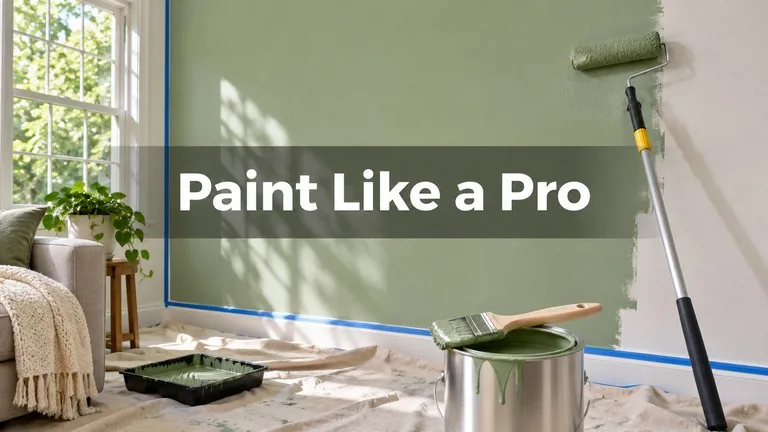
To paint a room like a pro, measure the walls and buy one gallon for every 350 to 400 square feet per coat, choose eggshell or satin for most rooms and semi-gloss for trim, and spend most of your time on prep: cleaning, patching, sanding and taping. Then cut in the edges with a brush, roll the walls in small sections while the cut-in line is still wet, and wait the recoat time on the can before the second coat. A typical 12-by-14-foot bedroom takes about two gallons of wall paint and one weekend.
Doing it yourself usually costs $150 to $350 in paint and supplies. Hiring a painter for the same room tends to cost roughly $700 to $1,500 for walls and ceiling, more for trim, repairs or tall ceilings. The steps below cover the coverage math, sheen choices, tools, the actual technique and the drying times that trip most people up.
How much paint you need: the coverage math
Paint makers generally rate a gallon to cover about 350 to 400 square feet on a smooth, primed wall. Some premium lines claim more; Benjamin Moore lists its Regal Select matte at 400 to 450 square feet per gallon. Rough or porous surfaces such as textured walls and new drywall soak up more, so use the low end of the range for them.
- Measure the room’s perimeter (add the lengths of all four walls).
- Multiply by the ceiling height to get gross wall area.
- Subtract about 20 square feet for each standard door and about 15 square feet for each average window.
- Multiply by the number of coats. Plan on two for any color change.
- Divide by 375 and round up to the next gallon. Add about 10% if you want leftover paint for touch-ups.
Example: Jenna’s bedroom is 12 by 14 feet with 8-foot ceilings. The perimeter is 52 feet, so the walls are 416 square feet. One door and two windows take off 50 square feet, leaving 366. Two coats make 732 square feet, and 732 divided by 375 is 1.95. She buys two gallons of wall paint. The 168-square-foot ceiling needs about one gallon for two coats, and a quart of semi-gloss handles the baseboards and door casing.
Primer coverage depends heavily on the surface, since bare drywall soaks it up. Sherwin-Williams estimates about 200 to 300 square feet per gallon. You need primer on new drywall, large patched areas, stains, glossy surfaces, and when going from a very dark color to a light one. A “paint and primer in one” product can usually handle a repaint over a sound, similar color.
Which sheen to use in each room
Sheen is how shiny the dried paint looks. More shine means easier scrubbing but also shows every dent and roller mark. This is the rule most painters follow:
| Room or surface | Best sheen | Why |
|---|---|---|
| Ceilings | Flat | Hides flaws and doesn’t reflect light from fixtures |
| Bedrooms, living and dining rooms | Matte or eggshell | Low glare, hides wall imperfections, wipes clean enough for light use |
| Hallways, kids’ rooms, family rooms | Eggshell or satin | Stands up to hands, backpacks and scrubbing |
| Kitchens and bathrooms | Satin or semi-gloss | Resists moisture and grease and cleans easily |
| Trim, doors and cabinets | Semi-gloss or gloss | Hard finish that handles bumps and frequent wiping |
For a bathroom without a strong exhaust fan, pick a paint labeled for high-humidity rooms, usually with a mildew-resistant finish. Satin is the safer choice there because semi-gloss on large walls shows lap marks if you’re new to rolling.
Tools and supplies worth buying
Expect to spend about $150 to $200 on supplies the first time, and less for later rooms since most tools are reusable. Paint itself runs about $25 to $60 per gallon for flat, $35 to $100 for semi-gloss, and $20 to $50 for primer.
- A 2 to 2.5-inch angled sash brush for cutting in. A good brush is the one tool where paying more changes your results.
- A 9-inch roller frame and an extension pole. The pole lets you roll with even pressure and saves your shoulders.
- Roller covers sized for the wall: 3/8-inch nap for smooth drywall, 1/2-inch for light texture, 3/4-inch for heavy texture.
- A 5-gallon bucket with a roller grid, or a deep tray. A bucket holds more paint and lets you box (mix) two gallons for consistent color.
- Canvas or plastic drop cloths, painter’s tape, spackle, a putty knife, 120 to 220-grit sanding sponge, and a damp rag.
- Caulk for gaps between trim and wall. Freshly caulked joints are a big part of why pro work looks crisp.
Prep: where most of the quality comes from
Professional painters often spend as long preparing a room as painting it. Paint shows every flaw in the wall underneath, so this is the step to slow down on.
- Move furniture to the center, cover it, and remove outlet covers, switch plates and nail-on hardware.
- Wash greasy or dirty areas (kitchen walls, around light switches) with mild detergent and water, then rinse and let dry.
- Fill nail holes and dents with spackle, let it dry, sand flush, and spot-prime large patches so they don’t show as dull spots.
- Caulk gaps along baseboards, casing and crown molding.
- Tape only where you need it, such as along a ceiling line if your hand isn’t steady, and press the edge down firmly.
If your home was built before 1978, the existing paint may contain lead. Sanding or scraping it releases dust that is harmful to children and pregnant people. Use lead test kits or hire a firm certified under the EPA’s lead renovation, repair and painting program for that work.
Cutting in and rolling like a pro
Paint the ceiling first, then the walls, then the trim. Drips fall downward, so working top to bottom keeps you from repainting.
- Stir the paint well. If you’re using more than one can, pour them together in a bucket so the color matches.
- Cut in one wall at a time. Load the brush about one-third deep, then draw a band 2 to 3 inches wide along the ceiling, corners and trim.
- Roll that wall right away while the cut-in band is still wet. This blends the brushed edge into the rolled texture and prevents a visible “picture frame.”
- Load the roller fully, then roll a large “W” or “M” shape about 3 feet wide, and fill it in without lifting the roller.
- Keep a wet edge. Work from a wet area into a dry one, always overlapping the last pass, and finish each section with light top-to-bottom strokes.
- Don’t go back over areas that have started to dry. Patchy touch-ups show as shiny or dull spots once the paint dries.
- Pull tape while the final coat is still slightly soft, at a 45-degree angle, so the paint film doesn’t tear.
Drying and recoat times
Most interior latex paints are dry to the touch in about an hour, and many can be recoated in about two to four hours. Some fast-drying premium lines allow a recoat in one to two hours. Always go by the label, since temperature and humidity change these numbers. Cool or damp rooms can double the wait. Oil-based and alkyd paints usually need much longer, often a day before recoating.
Dry is not the same as cured. Latex paint keeps hardening for days to weeks, so wait before scrubbing walls, hanging heavy art or pushing furniture against them. Many manufacturers say full cure takes around two to four weeks.
Cost: DIY versus hiring a painter
Painters usually price by the square footage of the surfaces they paint, not the floor area, at about $1 to $3 per square foot. Hourly rates run about $20 to $50 per painter. Ceilings, trim, color changes, high walls and drywall repairs all add to the bill.
Example: For Jenna’s 12-by-14 bedroom, the walls and ceiling add up to about 534 square feet of paintable surface after the door and windows. At $1.50 to $2.50 per square foot, a painter would likely quote around $800 to $1,350. Doing it herself, she spends about $210 on three gallons of mid-grade paint and a quart of trim enamel plus $160 in tools, for $370, and keeps the tools for the next room.
Hiring out makes sense when ceilings are above 10 feet, walls need significant drywall repair, the house was built before 1978 and paint will be disturbed, or you’re painting several rooms on a deadline. A two-person crew can often finish a bedroom in a day.
Common questions
How many gallons of paint do I need for a 12×12 room?
A 12-by-12 room with 8-foot ceilings has about 384 square feet of wall, or around 350 after a door and window. Two coats need about 700 square feet of coverage, so buy two gallons. Add one gallon for the ceiling if you’re painting it.
Do I need to prime before painting?
Prime new drywall, patched areas, stains, glossy surfaces and big color changes from dark to light. On a clean, previously painted wall in a similar color, a quality paint usually covers in two coats without separate primer.
Should I paint the ceiling or walls first?
Ceiling first, then walls, then trim. Ceiling drips and roller spatter land on the walls, which you haven’t painted yet.
How long should I wait between coats?
Most latex wall paints can be recoated after about two to four hours, and some fast-drying lines after one to two hours. Follow the can’s label, and wait longer in cool or humid rooms.
What is the most durable sheen for walls?
Satin is the most scrubbable sheen most people use on walls, and semi-gloss is tougher still but shows wall flaws. Eggshell is the usual middle ground for living spaces.
Before you start
- Measure, do the coverage math, and buy all the paint in one batch.
- Check the label for recoat time so you can plan your day around it.
- Test the color on two walls with a sample and look at it in morning and evening light.
- Patch, sand, caulk and clean the day before you paint.
- Check whether a pre-1978 home needs lead testing before sanding.
- Ventilate the room and keep pets and kids out until the paint is dry.
Editorial note: This article is general information. Coverage, drying times and prices were checked as of November 2026 and vary by product and region, so follow the instructions on your paint’s label and the manufacturer’s technical data.