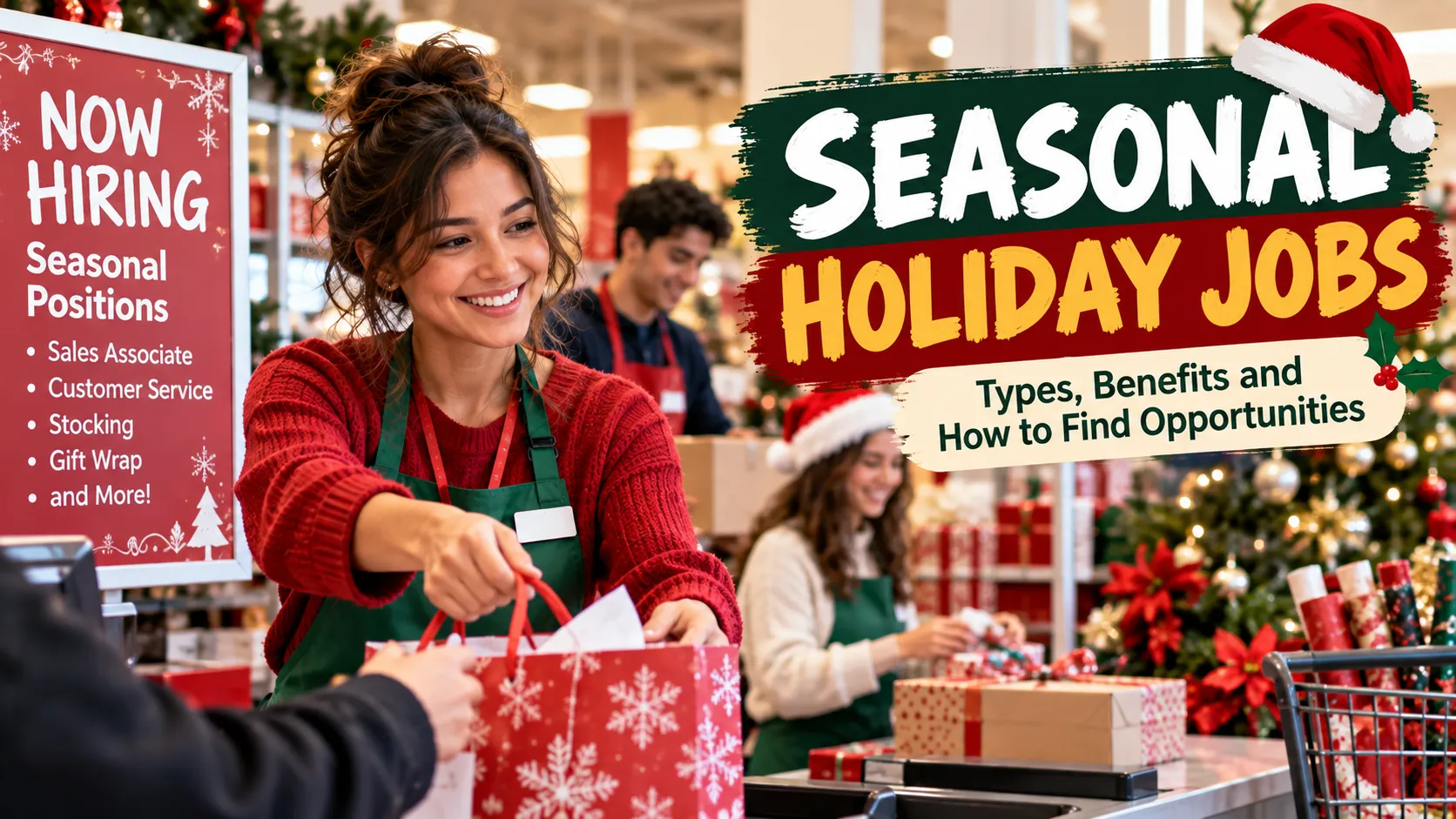
Every fall, retailers, warehouses and delivery companies add temporary staff to handle the holiday rush. These jobs can mean extra income for students, retirees, people between jobs and anyone who wants short-term work, and some turn into permanent positions. Hiring usually starts in September and October, and the best shifts tend to go to people who apply early.
This guide explains the main kinds of seasonal work, what large employers have done in recent years, what to expect from pay and schedules, and how to apply safely. It does not promise that any particular job is open. Always check the employer’s own careers website for current openings and pay.
The main kinds of holiday work
Seasonal jobs fall into a few broad groups. The right one depends on whether you prefer working with customers, physical work behind the scenes or driving.
| Job type | What you do | What to check in the posting |
|---|---|---|
| Retail store associate | Help customers, run registers, restock shelves and process online pickup orders | Evening and weekend availability, discount, store location |
| Warehouse and fulfillment | Pick, pack, sort and ship orders in distribution centers | Shift length, overtime, lifting requirements, standing time |
| Package handler | Load, unload and sort packages at delivery hubs | Early-morning or overnight shifts, lifting limits |
| Delivery driver or driver helper | Deliver packages or help a driver with stops | Minimum age, driving record, whether you use your own vehicle |
| Customer service | Handle order, return and delivery questions by phone or chat | Remote or on-site, training period, schedule |
Physical jobs in warehouses and delivery hubs usually pay more than store roles and offer more overtime, but they involve long periods on your feet and repeated lifting. Store jobs are less physical but often require evening, weekend and holiday availability.
Who hires for the holidays
Large employers tend to hire on a similar pattern each year, although the exact numbers change. Amazon has hired around 250,000 full-time, part-time and seasonal workers for recent holiday seasons across its fulfillment and transportation network. Target has typically hired around 100,000 seasonal team members for stores and supply chain sites, and has said that more than half of its 2024 seasonal workers were offered a chance to stay on after the holidays. UPS brought on 125,000 seasonal workers in 2024, including package handlers, driver helpers and seasonal support drivers.
Not every big employer runs a separate seasonal campaign. Walmart, for example, has leaned on offering extra hours to existing staff rather than announcing a large seasonal hiring number. The U.S. Postal Service also hires seasonal workers in many areas, often announced regionally rather than nationally.
Beyond the big names, department stores, craft and toy retailers, shipping companies, restaurants, ski resorts and event venues all add staff for the season. Local employers can be easier to get hired by, because they receive fewer applications.
Example: Two people apply for seasonal warehouse work in the same city. One applies in late September and gets a full schedule from early November. The other applies in mid-December, when most positions are filled, and is offered only a few short shifts. Applying early makes a real difference.
Pay, hours and schedules
Seasonal pay varies by employer, job and location. Warehouse and delivery roles at large companies have commonly advertised starting pay in the high teens to low twenties per hour in recent seasons, with some driver roles paying more. Store roles often start lower. Always check the pay shown on the specific posting for your area rather than relying on national averages.
Expect variable schedules. Warehouses may run early-morning, overnight and weekend shifts, and many add mandatory or optional overtime close to the holidays. Retail stores need the most help on weekends, evenings and around Black Friday and the days before Christmas. Most seasonal roles run from October or November through late December or early January, and the posting should state an expected end date.
Some employers offer extras such as employee discounts, referral bonuses or attendance bonuses. A few offer benefits to certain seasonal workers, but many seasonal positions do not include health insurance, so read the posting carefully.
Requirements
Requirements are usually simple, which is part of the appeal. Most store and warehouse jobs require you to be at least 16 or 18 depending on the employer and state, to pass a background check and to be legally authorized to work in the United States. Driving jobs typically require you to be 21 or older with a valid license and a clean driving record, and some require you to use your own insured vehicle with mileage reimbursement. Warehouse and package roles often state a lifting requirement, such as being able to lift up to 50 or 70 pounds.
How to apply and get hired
- Pick the type of work. Decide between store, warehouse, delivery or customer service roles based on your schedule and physical comfort.
- Apply on official careers sites. Go directly to the employer’s own careers page and search for seasonal roles near you.
- Apply early. Aim for September to early November, when most seasonal hiring happens.
- Be clear about availability. Employers value people who can work weekends, evenings and the busiest days, so state your availability honestly.
- Prepare for fast hiring. Many large employers hire quickly, sometimes with an online assessment and no formal interview, so keep your phone and email handy.
- Ask about staying on. If you want a permanent role, say so, and ask your manager near the end of the season what openings exist.
Avoid seasonal job scams
Scammers take advantage of the holiday hiring rush. Be wary of “jobs” offered through text messages or social media that promise high pay for little work, ask you to pay for training or equipment, or send you a check and ask you to return part of it. Package reshipping and “quality control” jobs that involve receiving and forwarding parcels from home are a common trap.
Example: A message offers a remote “holiday order processing” job paying far above normal rates and asks you to buy a starter kit with gift cards. A real employer will not ask you to pay to start work or to pay with gift cards. Search for the job on the company’s official site, and if you cannot find it, do not respond.
Never share your Social Security number or bank details until you have confirmed the job is real and you are completing official onboarding paperwork.
Common questions
When do companies start hiring for the holidays
Most large employers start in September or October and continue into November. Some keep hiring into December, but the choice of shifts is usually much smaller by then.
Can a seasonal job become permanent
Often, yes. Many employers keep some seasonal workers after the holidays, especially reliable people who show up for their shifts. Tell your manager early if you want to stay on.
Do seasonal jobs come with benefits
Sometimes, but not usually. Employee discounts are common, and a few employers offer limited benefits to some seasonal workers. Check the posting for details.
Do I need experience
Usually not. Most seasonal store, warehouse and handler roles provide on-the-job training. Driving roles have stricter requirements around age and driving record.
Before you apply
Decide what kind of work suits you, apply early through official careers sites and be honest about your availability. Read each posting for pay, hours, physical demands and the expected end date, and ignore any offer that asks you to pay to get hired.
Editorial note: This is an independent job guide, not a recruitment notice. It is not affiliated with any employer mentioned and does not guarantee any job, pay or benefit. Hiring figures describe recent seasons as reported by the companies and news outlets and may differ for 2026. Check each employer’s official careers site for current openings.