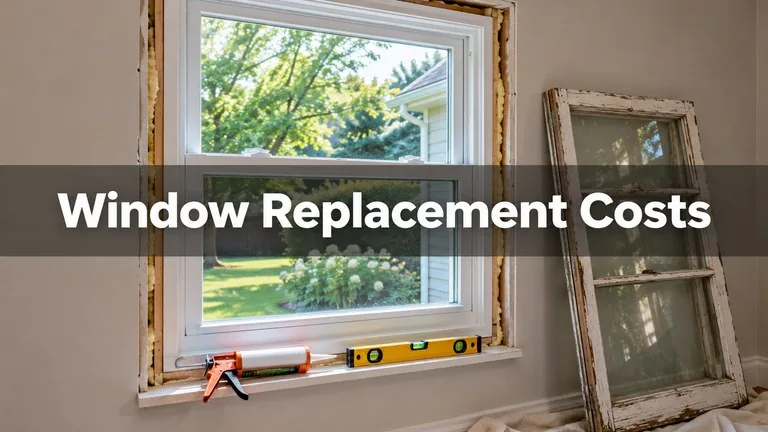
Replacing a standard-size window typically costs about $400 to $1,600 installed in 2026, depending on frame material, size and installation method. Vinyl is the budget choice at roughly $400 to $1,600 per window, fiberglass runs about $400 to $2,200, and wood about $650 to $2,200 or more. For a whole house, homeowners commonly spend $8,000 to $12,000 for 10 to 15 windows on a one-story home and $12,000 to $24,000 for a two-story home with more openings.
The two biggest price levers are frame material and whether the installer uses an insert (pocket) window inside your existing frame or tears out down to the rough opening. Energy performance matters too, and the labels on every new window tell you exactly what you’re paying for if you know how to read them. This guide covers all three, plus the signs that tell you whether you need new windows at all or just a repair.
Window replacement cost by frame material
Price ranges vary by source because brands, sizes and local labor differ. The figures below combine national data from Fixr and Pella’s 2026 cost guide, plus Zonda’s 2025 Cost vs. Value report, which priced replacing ten 3-by-5-foot double-hung windows with full contractor rates.
| Frame material | Installed cost per window | Commonly cited lifespan | Good to know |
|---|---|---|---|
| Vinyl | $400 to $1,600 (Cost vs. Value average about $2,200 per window) | About 20 to 30 years | Lowest cost, no painting; limited color options, can’t be refinished |
| Fiberglass | $400 to $2,200 | About 30 years or more | Very stable in heat and cold, paintable, slimmer frames than vinyl |
| Wood | $650 to $2,200 and up (Cost vs. Value average about $2,700 per window) | 30 years or more with upkeep | Best for historic homes; needs paint or stain; often clad in aluminum outside |
| Composite | $300 to $2,500 | About 30 years or more | Wood-fiber and resin blend; looks like wood with less upkeep |
| Aluminum | $200 to $800 | Varies | Slim and strong but conducts heat; mostly used in mild climates |
Labor is roughly 30% of the total, commonly $150 to $300 per standard window and up to $800 for large bay or bow units that need more than one installer. Window style changes the price as much as material does. National installed ranges run about $300 to $1,000 for double-hung, $400 to $1,200 for casement, $700 to $1,500 for sliding, $300 to $1,600 for picture windows, $900 to $4,500 for bay windows and $1,500 to $8,000 for bow windows.
Insert versus full-frame replacement
An insert replacement (also called pocket or retrofit) slides a new, complete window unit into your existing frame. The old sashes and stops come out, the frame stays, and interior trim and exterior siding are left alone. It’s faster, usually a few hours per window, and less expensive.
A full-frame replacement removes everything down to the rough opening, including the frame, and sometimes trim and a strip of siding. The installer can inspect for rot, add new flashing and insulation, and fit a larger glass area. It costs noticeably more per window because of the added carpentry, trim and exterior patching.
Choose an insert when the existing frames are square, solid and dry, and you’re happy with the glass size. Choose full-frame when:
- Frames or sills are soft, rotted or water-stained
- You see water damage on the wall below the window
- You’re also replacing siding, which makes it easy to flash the new windows properly
- You want to change window size or style, or bring a bedroom window up to egress requirements
Inserts shrink the glass area slightly because the new frame sits inside the old one. On small windows that loss can be noticeable, so ask to see the visible glass dimensions on the quote.
Example: Hannah gets two bids for 12 vinyl double-hung windows in her 1990s ranch. The insert bid is $9,600 ($800 per window). The full-frame bid is $14,400 ($1,200 per window), including new exterior trim. The installer probes the sills and finds them solid, so she chooses inserts and saves $4,800. On a neighbor’s house with soft sills and stained drywall below two windows, the full-frame bid would be the better spend.
Energy ratings: U-factor, SHGC and ENERGY STAR zones
Every new window should carry a National Fenestration Rating Council (NFRC) label. Three numbers on it matter most:
- U-factor: how much heat the whole window lets escape. Lower is better. Good double-pane windows are often around 0.25 to 0.30; high-performance and triple-pane units go lower.
- Solar heat gain coefficient (SHGC): how much of the sun’s heat comes through, from 0 to 1. Lower is better where air conditioning dominates. A higher value can help in cold climates by letting in winter sun.
- Visible transmittance (VT): how much daylight passes through. Higher means brighter rooms.
ENERGY STAR divides the US into four climate zones, and a window must meet that zone’s criteria to carry the label there. Under Version 7.0 requirements:
- Northern zone: U-factor 0.22 or lower and SHGC of at least 0.17, with an alternative path that allows a slightly higher U-factor when paired with higher solar gain
- North-Central zone: U-factor 0.25 or lower and SHGC of 0.40 or lower
- South-Central zone: U-factor 0.28 or lower and SHGC of 0.23 or lower
- Southern zone: U-factor 0.32 or lower and SHGC of 0.23 or lower
Look for the ENERGY STAR label marked for your zone, then compare U-factor and SHGC between quotes. Two windows that both qualify can differ quite a bit. Note that the federal tax credit for qualifying windows (up to $600 a year under Section 25C) ended for windows installed after December 31, 2025.
Signs you need new windows, and when a repair is enough
New windows rarely pay for themselves through energy savings alone, so it helps to replace for the right reasons. Strong signs you need replacement:
- Rot in the frame or sill that goes deeper than surface paint
- Single-pane glass in a climate with real winters or hot summers
- Sashes that won’t stay open, won’t lock, or are painted shut beyond repair
- Water leaking into the wall or onto the sill during storms
- Several windows with failed seals at once
Situations where a repair may be enough:
- Fog or condensation between the panes on one or two windows. The sealed glass unit can often be replaced for about $280 to $350 per window instead of replacing the whole window.
- Drafts around the sash. New weatherstripping and caulk cost little and often fix it.
- A broken balance, crank or lock. Parts are available for most major brands.
- Condensation on the inside surface of the glass in winter. That usually signals high indoor humidity, not a bad window.
Example: Marcus has 14 windows from 2004. Two have fogged glass and one sash is drafty. Replacing all 14 would cost about $11,000. Replacing the two glass units ($650 total) and weatherstripping the drafty sash ($100) fixes the problems for $750, and he plans full replacement when he re-sides the house in a few years.
How to get accurate window quotes
- Count and measure every window, noting its style, which room it’s in, and whether any have rot or leak history.
- Decide which windows truly need replacing. Doing the worst side of the house first is a common way to split the cost.
- Look up your ENERGY STAR climate zone and set minimum U-factor and SHGC targets.
- Get at least three quotes listing brand, product line, frame material, glass package, U-factor and SHGC for each window.
- Ask each installer whether the quote is insert or full-frame, and how they flash, insulate and seal each opening.
- Confirm lead-safe practices if the home was built before 1978, since removing old window frames disturbs painted surfaces.
- Compare product warranty and the installer’s separate labor warranty, and get both in writing.
Resale value of new windows
In Zonda’s 2025 Cost vs. Value report, vinyl window replacement cost $22,073 for ten windows and recouped 75.5% of that at resale nationally. Wood window replacement cost $26,781 and recouped 70.1%. Buyers notice new windows in inspection reports and listing photos, so replacement before a sale makes the most sense when the old windows are visibly failing.
Common questions
How much does it cost to replace one window?
A single standard vinyl double-hung window typically costs about $400 to $1,600 installed. Fiberglass and wood run higher, and installers often charge more per window on small jobs because travel and setup are spread over fewer units.
Is vinyl or fiberglass better for replacement windows?
Vinyl costs less and works well in most climates. Fiberglass costs more but expands and contracts less with temperature, holds paint, and allows slimmer frames, which suits extreme climates and dark exterior colors.
Are insert replacement windows as good as full-frame?
Insert windows perform well when the existing frame is solid, square and dry. If there’s rot or water damage around the opening, full-frame replacement lets the installer fix it and flash the opening correctly.
What U-factor should I look for?
Match the ENERGY STAR criteria for your zone: 0.22 or lower in the Northern zone, 0.25 in North-Central, 0.28 in South-Central and 0.32 in the Southern zone. Lower is always better for keeping heat in.
Can I still get a tax credit for new windows?
No federal credit is available for windows installed in 2026. The Section 25C credit, which covered up to $600 a year for qualifying windows, ended for property placed in service after December 31, 2025. Some utilities and local programs still offer rebates.
Before you buy
- Check sills and frames for rot to decide between insert and full-frame.
- Find your ENERGY STAR zone and compare U-factor and SHGC, not just the label.
- Ask whether fogged glass can be replaced on its own before replacing a whole window.
- Get product and labor warranties in writing.
- Schedule in mild weather if you can, since each opening sits exposed for part of the install.
Editorial note: This article is general information. Prices, ENERGY STAR criteria and incentive status were checked as of November 2026 and vary by region and product, so confirm ratings on the NFRC label and with ENERGY STAR, and confirm prices with local installers.