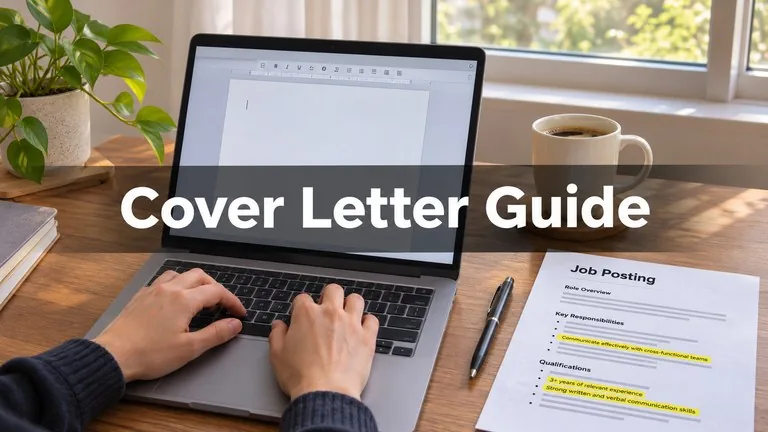
To write a cover letter, keep it to one page and about 250 to 400 words, address it to a named person if you can find one, open with the job you want and the strongest reason you fit, use one or two short paragraphs to prove that reason with specific results, and close by asking for an interview. Every sentence should connect something you have done to something the posting asks for. If a line could appear in anyone’s letter for any job, cut it.
A cover letter is the one place in an application where you explain your choices: why this job, why now, and why someone with your background makes sense. It matters most when your resume needs context, such as a career change, a gap, a move, or a first job. It matters least for high-volume hourly jobs where the application has no place to attach one. This guide covers structure, length, how to tailor a letter in 20 minutes, two worked examples, mistakes that get letters skimmed, and when you can skip it.
Cover letter structure, section by section
Hiring managers skim. A predictable layout lets them find what they need fast.
| Section | Length | What goes in it |
|---|---|---|
| Header | 3 to 5 lines | Your name, phone, email, city and state, and a LinkedIn or portfolio link if you have one. Then the date and the employer’s name. |
| Greeting | 1 line | “Dear Ms. Patel” or “Dear Hiring Manager” if no name is available. Avoid “To whom it may concern.” |
| Opening paragraph | 2 to 3 sentences | The exact job title, where you found it, and the one reason you fit best. |
| Proof paragraph or two | 4 to 6 sentences each | One or two examples that match the posting’s top requirements, with numbers where possible. |
| Fit and motivation | 2 to 3 sentences | Why this employer or team specifically, using something real from the posting or company. |
| Close | 2 sentences | Ask for a conversation and give your availability. Sign off with “Sincerely” or “Best regards” and your name. |
For an email application, the letter goes in the email body and the header shrinks to your contact details under your name at the end. Use a subject line with the job title and your name, such as “Patient Access Representative application, Dana Lee.”
How long should a cover letter be?
Aim for 250 to 400 words, which fills about three-quarters of a page with normal margins and an 11- or 12-point font. Shorter is fine for hourly and entry-level roles, where 150 to 200 words can do the job. Longer letters rarely help; if you have more to say, the extra detail belongs in the interview. When an online form gives you a text box with a character limit, stay within it and paste plain text so formatting does not break.
How to tailor a cover letter in 20 minutes
- Print or copy the posting and underline the three requirements that appear first or most often. Those are what the manager screens for.
- Next to each, write one thing you have done that matches it. Use a number if you have one: customers per shift, dollars saved, error rate, people trained.
- Pick the two strongest matches. Those become your proof paragraphs.
- Find one specific reason you want this employer: a service they offer, a location, a program in the posting, or a value they state that matches your experience.
- Write the opening last, once you know your strongest point, and put that point in the first two sentences.
- Reuse your best sentences from earlier letters, but rewrite the opening, the motivation paragraph and at least one example for each application.
- Read it aloud, cut every sentence that does not support your case, and check the company name and job title twice.
Cover letter examples
These short examples show the structure in action. The names and details are illustrative.
Example: Dana is applying for a patient access representative job at a hospital after four years as a bank teller. Her letter opens: “I’m applying for the Patient Access Representative position posted on your careers site. For four years I’ve handled identity verification, account questions and sensitive paperwork for about 60 customers a day at a busy bank branch, and I’d like to bring that accuracy to hospital registration.” Her proof paragraph describes finishing the branch’s compliance audit with zero documentation errors two years in a row and training three new tellers on the check-in system. Her motivation paragraph mentions that the posting lists bilingual support as a plus and that she speaks Spanish with customers daily. The full letter is 290 words.
Example: Marcus is 18 and applying for a front desk job at a fitness center with no paid work history. His letter opens: “I’m applying for the weekend front desk position at your Main Street location. I’ve been a member for two years and I already know your check-in process, class schedule and the questions new members ask most.” His proof paragraph covers managing sign-ups and payments for a 40-player youth basketball league as a volunteer, including collecting fees and sending weekly schedule texts to parents. He closes by stating that he is available every Saturday and Sunday and after 3:30 p.m. on weekdays. The letter is 180 words, which is right for the role.
In both letters each claim ties to a requirement in the posting and carries a number or a concrete detail, and neither spends a sentence on “I am a hard worker” or “I am passionate about customer service.”
Mistakes that get a cover letter skimmed
- Repeating the resume line by line. Pick two highlights and explain how they fit this job.
- Opening with your name (“My name is…”) or with a generic line such as “I am writing to express my interest.” Start with the job and your best qualification.
- Making it about what you want: a chance to grow, a stepping stone, a better commute. Mention your goals only where they match what the employer needs.
- Using the wrong company name. This happens constantly when letters are reused, and it usually ends the application.
- Explaining a gap or a firing at length. One neutral sentence is enough, and often none is needed.
- Sending a letter written by an AI tool or template without editing. Managers recognize the stock phrases, and generic letters do not show any real knowledge of the job.
When you can skip the cover letter
Skip it when the application has no upload or text field for one, when the posting says not to send one, or when you are applying in person for an hourly job and the manager just wants your availability. An optional cover letter field on an online application is different: filling it gives you a small edge over applicants who skip it, especially for office, healthcare, government contractor and nonprofit roles.
Always write one when the posting asks for it, when you are changing careers, when you are relocating and need to say when you will be available locally, when someone referred you (name them in the first sentence), or when your resume has a gap or an unusual path that a short explanation would clear up.
Common questions
Should a cover letter be addressed to a specific person?
Yes, when you can find the hiring manager’s name in the posting, on the company site or through a quick professional networking search. If you cannot, “Dear Hiring Manager” is professional and widely accepted. Do not guess a name or gender.
Can I use the same cover letter for every job?
You can reuse its structure and your best example sentences, but the opening, the motivation paragraph and at least one example should change for each posting. A letter that never mentions the specific job reads as a mass mailing.
Should I mention salary in a cover letter?
Only if the posting explicitly asks for salary requirements. In that case, give a range based on local pay data for the role and say it is flexible depending on the full compensation package.
Is a cover letter still needed if I apply through a job board?
If the job board lets you attach one or the employer’s form has a field for it, include it for any role where you want to stand out. Many hourly listings with one-click apply do not allow a letter, and that is fine.
What file format should I use?
Use PDF unless the posting asks for a Word document, and name it with your name and “cover letter,” such as “Dana-Lee-Cover-Letter.pdf.” Keep the same fonts and header as your resume so the two look like a set.
Before you send it
- Confirm the company name, job title and greeting are correct.
- Check that the first two sentences name the job and your best qualification.
- Make sure each proof paragraph matches a requirement in the posting.
- Keep it to one page, roughly 250 to 400 words.
- Read it aloud once and fix anything that sounds stiff.
- Save it as a PDF with a clear file name.
Editorial note: This article is general information about job applications, checked as of November 2026. Always follow the specific instructions in the employer’s job posting.