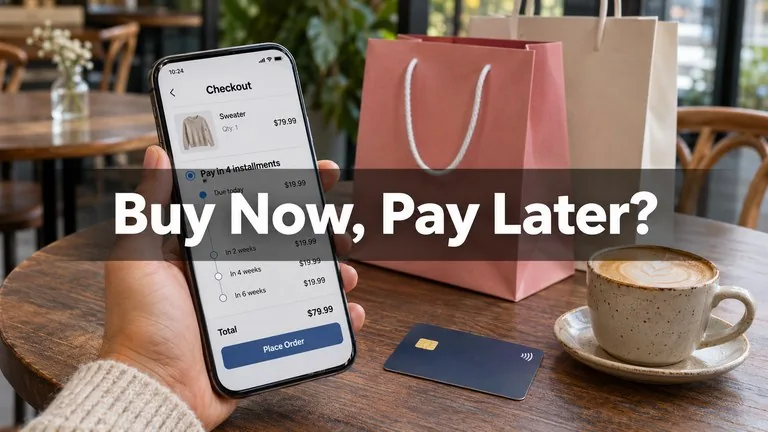
Buy now, pay later (BNPL) lets you split a purchase into smaller payments, most often four payments every two weeks with no interest. The pros are real: no interest if you pay on time, no hard credit check for most short plans, and easier budgeting for a necessary purchase. The cons are easy to underestimate: late fees, longer plans that charge interest rates as high as credit cards, harder refunds, and the risk of stacking several plans at once until the payments crowd out regular bills.
Credit reporting is also changing. Some BNPL lenders now send loan data to the credit bureaus, and FICO has released score versions that can count BNPL loans, though most lenders still use older scores that don’t. Federal oversight shifted too: the Consumer Financial Protection Bureau withdrew its 2024 rule that treated BNPL like credit cards. Here is how the plans work, what they cost and where the protections stand in late 2026.
How buy now, pay later works
At checkout, online or in a store, you pick a BNPL provider such as Affirm, Afterpay, Klarna, PayPal Pay in 4 or Zip. The provider pays the merchant in full, and you repay the provider on a set schedule. There are two main types.
- Pay in 4: You pay 25% at checkout and the rest in three payments two weeks apart, so the purchase is paid off in six weeks. These usually carry no interest, and approval typically uses a soft credit check that doesn’t affect your score.
- Monthly installment loans: Used for larger purchases, these run from about 3 to 36 months or longer. Some are 0% APR promotions, but many charge interest, with rates that can reach about 36% depending on your credit and the merchant. Some providers run a hard credit check for these.
Payments are usually pulled automatically from a debit card, bank account or credit card. The merchant pays the provider a fee, which is why the shopper often pays nothing extra on Pay in 4.
Fees and what BNPL really costs
On a Pay in 4 plan, your cost is zero if every payment goes through on time. Costs show up when they don’t, or when you choose a longer plan.
| Cost | Pay in 4 plans | Monthly installment plans | Typical credit card |
|---|---|---|---|
| Interest | Usually 0% | 0% promos or up to about 36% APR | About 22% average on accounts charged interest (Fed data, August 2026) |
| Late fees | Varies by provider; Afterpay charges up to $8 per missed payment, capped at 25% of the order; some charge none | Varies; some charge no late fee but report missed payments | Often around $30 to $40, depending on the issuer and your history |
| Credit check | Usually soft or none | Soft or hard, depending on provider | Hard inquiry when you apply |
| Federal dispute rights | Limited and provider dependent | Limited and provider dependent | Fair Credit Billing Act dispute rights |
| Rewards | Rarely | Rarely | Often 1% to 2% back or points |
Hidden costs also come from your bank. If an automatic payment pulls from a checking account that doesn’t have enough money, you could pay a bank overdraft or returned payment fee on top of the BNPL late fee. Paying a BNPL plan with a credit card and then carrying that card balance turns an interest-free plan into a 20%-plus loan.
Example: Leah buys a $480 phone with Pay in 4. She pays $120 at checkout and has three more $120 payments due over six weeks. If all four go through on time, the phone costs $480. If she misses the second payment and her provider charges an $8 late fee, then misses the third too, she pays $16 in fees, which is 3.3% of the purchase. If her bank also charges a $35 fee for a failed autopay, she has paid $51 in fees, about 10.6% of the purchase, on a loan that lasted six weeks.
BNPL and your credit report in 2026
For years BNPL loans were mostly invisible to the credit bureaus. That’s changing, but slowly and unevenly.
- Affirm began reporting all of its pay-over-time loans to Experian, including Pay in 4, in April 2025. Klarna began reporting some data to TransUnion in late 2024, and Afterpay does not report payment history.
- In June 2025, FICO announced FICO Score 10 BNPL and FICO Score 10 T BNPL, which can include BNPL loans in the calculation. Older versions of the FICO score, which most lenders still use, don’t count BNPL loans even when they appear on your report.
- Lender adoption of the new scores has been gradual. Most card issuers and auto lenders have not switched, and mortgage lenders mostly rely on older FICO versions that don’t use BNPL data.
The practical effect for most people in 2026: on-time BNPL payments are unlikely to raise the scores most lenders check. Missed payments carry more risk. A provider can report a late payment where it reports, and an unpaid balance sent to a collection agency can show up as a collection account on all three reports, which can hurt your score for years. Mortgage underwriters also read your full bank statements, so regular BNPL payments can come up during a home loan application.
Risks to watch for
The biggest risk is how easy BNPL makes it to borrow a little, many times. Each plan feels small, but four or five plans running at once can add up to hundreds of dollars a month drawn on different days, often hard to track because each lives in a separate app.
Example: Over one month, Devon uses Pay in 4 for $200 sneakers, a $360 tablet, a $140 jacket and a $280 car part. Each plan’s payments look small: $50, $90, $35 and $70. But the payments fall on different Fridays, and in the busiest two-week stretch $245 leaves his checking account on top of rent and utilities. Across six weeks he owes $735 in installments after the four down payments, from a paycheck that already has little room. One short week can trigger late fees on several plans at once.
- Overspending: research by the CFPB has found BNPL users are more likely than non-users to carry high credit card balances and use other high-cost credit.
- Returns: if you send an item back, you usually must keep making payments until the merchant processes the refund and the provider adjusts your plan. Waiting on a refund doesn’t pause the schedule.
- Disputes: credit cards come with federal billing dispute rights. BNPL protection depends on the provider’s own policies.
- Autopay overdrafts: payments drawn from a debit card can bounce on a tight week.
- Essentials on installments: using BNPL for groceries or utilities can signal that monthly cash flow is short, and it adds payments to next month’s bills.
Where federal protections stand
In May 2024 the CFPB issued an interpretive rule saying BNPL lenders that issue digital accounts are card issuers under the Truth in Lending Act, which would have given BNPL users credit card-style rights to dispute charges and get refunds credited. In May 2025 the CFPB withdrew that rule and said it would not prioritize enforcement, and it later said it had no plans to issue a revised version. As a result, your dispute and refund rights depend mostly on each provider’s terms and on state law.
Some states have passed or proposed their own BNPL rules, including licensing requirements for lenders. The CFPB still accepts complaints about BNPL providers, and those complaints are forwarded to the company for a response.
How to use BNPL more safely
- Use it only for a purchase you’d make anyway and could pay for in cash within six weeks.
- Keep to one active plan at a time, or set a firm limit such as two.
- Read the plan before confirming: APR, total cost, late fee, and whether the provider runs a hard credit check or reports to bureaus.
- Link the plan to a checking account or debit card with a buffer, and put every due date on your calendar.
- Avoid paying BNPL installments with a credit card you don’t pay in full.
- For returns, keep the confirmation and tracking number, keep paying until the refund posts, and contact the provider if the merchant stalls.
- If a payment will be late, contact the provider before the due date. Some allow you to reschedule once without a fee.
Common questions
Does buy now, pay later hurt your credit?
Applying for a Pay in 4 plan usually uses a soft check that doesn’t affect your score. Missed payments can be reported by some providers, and debts sent to collections can damage your credit. On-time payments rarely raise the scores most lenders use in 2026.
Is BNPL better than a credit card?
For a planned purchase you’ll pay off in six weeks, Pay in 4 can cost less than carrying a card balance. A card you pay in full each month costs nothing, earns rewards and carries stronger federal dispute rights. Longer BNPL loans with interest are often no cheaper than a card.
Are BNPL loans regulated?
They fall under general federal consumer protection laws and some state lending laws, but the CFPB withdrew its 2024 rule that would have applied credit card protections to them. Consumers can still file complaints with the CFPB and their state attorney general.
What happens if you don’t pay a BNPL loan?
Expect late fees, possible suspension of your account, and possibly reports to credit bureaus. If the debt stays unpaid, the provider may send it to a collection agency, which can show up on your credit reports and lead to collection calls.
Before you click “pay in 4”
- Count how many BNPL plans you already have and total their upcoming payments.
- Check that your account will cover each payment date, not just the first one.
- Read the late fee and interest terms on the checkout screen.
- Know the merchant’s return policy and how the provider handles refunds.
- Compare against your card: if you pay it in full anyway, it may give better protection and rewards.
The CFPB complaint portal handles problems with BNPL providers, and the FTC’s consumer site covers your rights with merchants and collectors.
Editorial note: This article is general information, not financial advice. Fees, credit reporting practices and regulations were checked as of November 2026 and change often; confirm current terms with the BNPL provider and consumerfinance.gov before using a plan.